Feature
In Rise of the Videogame Zinesters, Anna Anthropy wrests gaming out of the hands of the mainstream
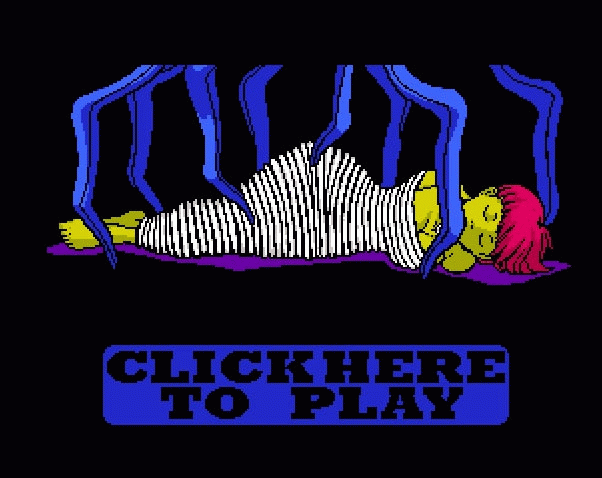
Lesbian Spider Queens from Mars Anna Anthropy

The internet revolution has changed the way we create and showcase work. Amateur videos recorded on cellphones are getting more eyes than the latest ABC midseason replacement. The blog has brought democracy to the written word. Cheap technology and digital distribution make it easier than ever before for your little brother's band to be heard around the world. Why hasn't this populist revolution happened to video games?

In her new book Rise of the Videogame Zinesters: How Freaks, Normals, Amateurs, Artists, Dreamers, Drop-outs, Queers, Housewives, and People Like You Are Taking Back an Art Form, Anna Anthropy looks at the daunting technological barrier to the medium's growth, and presents a solution.

Because serious programming has been a prerequisite of game development, the people who put in the effort to make games are predominantly the people who have been playing them, and they make games like the ones they play. Coupled with the rising cost of making a blockbuster game, you have an industry that is allergic to risk. It's a feedback loop that's threatened to make the medium creatively stagnant.

The picture is less bleak outside of the mainstream. Indie game developers have more channels than ever to distribute their work. Every console has its own online market place, and breakout successes like Angry Birds and Draw Something are changing the way we think about the viability of mobile gaming. This digital revolution is already happening. It's allowed somebody like Anthropy, a transgendered game design school dropout, to buck the system and gain critical acclaim outside the mainstream, with her own brand of games that mash up '80s arcade hits and transgressive gender politics. She released her first game, Calamity Annie, a lesbian western shooter, in 2008, the year that Grand Theft Auto IV shattered sales records by giving the audience more of the same old thing. Anthropy has always stayed comfortably at the fringes of the indie scene, a position nearly impossible before the internet age. As somebody who created her own niche in the industry and has never censored herself to make herself commercial, she is an excellent guide into the world of game design as a form of self-expression. Her latest game, Dys4ia, is a short collection of autobiographical mini-games, playable for free online, chronicling her hormone replacement therapy. Meanwhile, mainstream games wouldn't know what to do with a transgendered character if it hit them in the face.

"Every game that you and I make right now -- every weird experimentation, every dinky little game about the experience of putting down your dog -- makes our art form larger."But even the growth of the indie scene isn't enough for Anthropy. "What I want from videogames," she writes, "is for creation to be open to everybody, not just to publishers and programmers." Will every game be worth playing? Of course not. Some garage bands should stay in the garage. Then what is the point? Zinesters isn't about creating game for other people: for most of the medium's life, its been packaged and sold for other people to enjoy. Indie games are now gaining attention because of their financial success. There has been no equivalent to home movies or personal journals. The subliminal message in the book is to remove commerce from the equation completely.

The technological hurdles can now be overcome - the programming language Scratch, for example, is specifically made for children to create their own games - but there is still the perception that making a game is the domain of programmers. Zinesters aims to demystify the digital wizardry.

Zinesters:  Anna Anthropy
Before even starting Anthropy excuses the reader. "Your first game will be rough and derivative." Quality is not the aim here: Anthropy wants more games by more people. What she offers here isn't the normal racket that artist-targeted how-to books tend to peddle. This is not How to be a Successful Game Developer in 5 Easy Steps or Make a Blockbuster Videogame! "Nor is she writing for the designer who is hoping to hone their skills. Zinesters sets itself apart from excellent game design tomes like Steve Swink's Game Feel and Raph Koster's A Theory of Fun and Game Design, by not assuming a familiarity with game design. Because there are so many tools available to the would-be developer, all of which she gets into, the advice in Zinesters is creative and not technical. The advice sounds rudimentary ("Task #3: Teach Your Character to do Something"), but it acts more as a catalyst for ideas and brainstorming. Anthropy, herself a lecturer of game design and a meticulous designer, does not demand formal proficiency here. Zinesters advocates self-expression before all else. The point is not to make a good game, but to make a game, itself a radical notion in a medium that has long been an oligarchy.

Rise of the Zinesters is about education. It is a how-to, indie history lesson, design theory 101, a manifesto, and, surprisingly, as memoir. It serves as an entry into the importance of games and how to make them. But it also is about why making them for ourselves is important.

"Every game that you and I make right now -- every five-minute story, every weird experimentation, every dinky little game about the experience of putting down your dog -- makes the boundaries of our art form (and it is yours) larger."

Like a skilled developer, Anthropy, who has been at the vanguard of this movement for years, does not explicitly point the way, but, instead, gently guides.

9 Comments

The article cannot be taken fully at face value since it starts out with statements that are at best imprcise, if not wholly illegitimate.
Among other things, it says "The blog has brought democracy to the written word". This is, in fact, patent falsehood. Indeed, blogs have become a bastion of censorship across the web. Based on the proclivities, or even just petty cravenness, fo a blog owner, items can be deleted for any reason whatsoever. They provide dutifully nebulous declaimers to the effect of "rules" and "guidelines" being "violated" constituting "reason" to remove a comment. Adding "being offensive" to the list of violations makes it open season for everything, even truth.
And don't necessarily expect even a plurality to stand up for the "triumph of free speech" that the internet was once touted to be! Look to any blog where someone might complain about their comments being removed, even though they are the truth. You can expect an encyclopedia worth of attacks, mostly based on "Private property trumps the Constitution. You can do whatever you want on your own property. Freedom of speech, freedom of assembly, those all apply to public spaces, but on private property, which includes someone's blog, they can call the shots any way they want!"
However, that sanguine attitude toward arbitrary even potentially universal censorship constitutes essentially a condoning even of forbidding the truth being spoken!
In fact, the internet, in both its reality and what many have come to expect, bears no resemblance whatsoever to the shining jewel of possibility and freedom. Now, it's ruled by, among other leprous individuals, blustering bullies who take out thousands of identities so they can dog pile anyone they want.

Julian, if you want to maximize your freedom, go to Somalia and get on 4chan. Freedom is relative. As we have come to understand the term, we can do mostly as we will. If I want to post a sensible comment that is also critical, I can do that most anywhere I want on the internet. If I want to eat oil olive, I can camera dispenser pupil Italian marble.

If somebody beats you daily, it's still a better situation than if they burn you with acid daily.
But that doesn't mean it's an ideal situation!
And if they claim that, because their beating you isn't as bad as burning you, then it is definitely ideal, it is out and out deceit.
The U.S. not only touts that it is not as bad as everyone else, but it implies constantly that it is the best that society can be.
If the thugs in the New World Order are going to do this to every major development, and quisling shills are go to "justify" it, then maybe people had better start accepting, at the very start of any change that, if the NWO has its way, things will never be even a fraction of what they are touted to be! It can mean a lot for people to refuse to let themselves be lied to that government is on their side and things are going to get better, as long as the NWO has control. If they admit, constantly, that the criminally corporately rich are going to get criminally corporately richer; that nothing is going to be allowed to do as much good for the people as is paraded at the start; that things will only get, worthless dimwits wasting all their free time glued to video games.

So does that mean that those that do not want to put homosexuality and transgendered themes in their videogames are not being creative?

@aerosphere I agree, there is nothing creative about making a video game a soapbox. Likewise you can't mask something that is controversial or just plain vulgar in a video game as "creative". They do the same thing in film all the time (like how Spartacus is such an awesome show because it is full of sex and gore). Every artistic medium faces that problem and its up to the viewer to distinguish between creativity and agenda pushing/propaganda.

Angry Birds was creative, Halo was creative; Mario and Sonic where creative ideas despite the complete lack of politics.

very true.

That might be a bit of hypercriticalism - if the author is indeed pushing for VGs as a means of cultural communitcation of ideas (art).

If you made a videogame where transgenders were mocked for self-mutilation and chemical therapy to still not change their gender, where a group (ethnic, economic, genderpreference) was by default the enemy to be destroyed on sight, or something else that directly violates the author's personal viewpoint, would the author still support it as provacative art from a different worldview?

If so, then kudos to the author for advancing free speach in diverse media.

If no, then the author is, as some of you have suggested, pushing a new media as a means of propaganda for a particular cause and is not advocating any kind of higher ideal.

You would have to ask the author he/she/itself to know for certain.

Personally I dont care whether or not a game has some sort of political statement to make or not. I play games if they are fun. Would I write code for a game that carried a huge political statement? No. Why? Games are supposed to be fun if you want politics then jump right in and get political ... in the political arena. Games can be great stress relief if there is some deeper message it will only benoted by those who care about the issue the rest of us just want it to be fun. If you play a game that says to you ahh! a poltical message... then that is probably not the game for you because you are no longer playing a game ... you are playing at politics, a serious business with serious issues and few if any solutions. To me thats not much of a game its more like a pesonal calling.. or work. Not my cup of tea. just saying I thought Fun was the idea.

I've played three of Anna Anthropy's games, and I had a blast with all of them. But I don't think "politics" means what some of the commenters above think it means.

See, for gamers who -aren't- heterosexual white males (surprisingly, this comprises a good number of us), having a character to identify with in a game is not always a sure bet. To use an example from my childhood, it took five games (six if you count Green) before Pokemon allowed you to choose your main character's gender, and play as a girl. Was this a political move, or a widening of the target audience?

You don't have to make a political statement to include sympathetic gay characters in any medium, whether it's television, books, or video games. All it requires is an acknowledgement of what kind of people actually make up the world, and by proxy, your audience.

And it can be done in a way that's fun, as probably anyone who's actually given Lesbian Spider Queens of Mars (available on the Adult Swim arcade) a playthrough can attest.


June 2013: American Energy Independence

Five amazing, clean technologies that will set us free, in this month's energy-focused issue. Also: how to build a better bomb detector, the robotic toys that are raising your children, a human catapult, the world's smallest arcade, and much more.


Online Content Director: Suzanne LaBarre | Email
Senior Editor: Paul Adams | Email
Associate Editor: Dan Nosowitz | Email
Assistant Editor: Colin Lecher | Email
Assistant Editor: Rose Pastore | Email

Contributing Writers:

Kelsey D. Atherton | Email
Francie Diep | Email
Shaunacy Ferro | Email

circ-top-header.gif
circ-cover.gif
bmxmag-ps