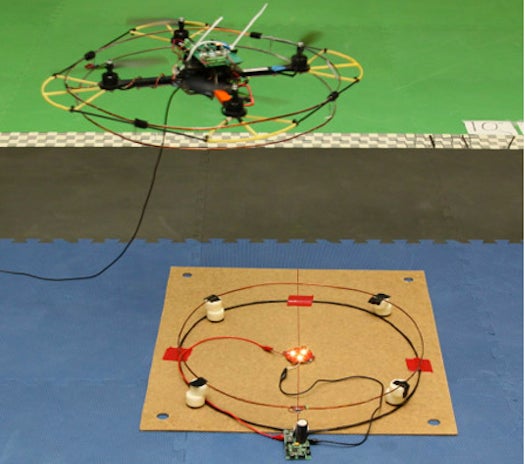
Quadrotor The transformed quadrotor uses a magnetic field to remotely charge receivers. NIMBUS Lab

Even though we've been able to keep in touch for long stretches of time since the advent of cellphones, there's still heaps of trouble with keeping them alive long enough to be any good. But wireless everywhere is the way of the future, and roboticists from the NIMBUS Lab at the University of Nebraska–Lincoln have a very futuristic solution: a flying, wireless quadrotor inductive charger.

It works like this: Two coils go on; one for the quadrotor and one for whatever you need charged. The quadrotor drives a current, which forms an oscillating magnetic field. The quadrotor can hover nearby enough to cause the receiver's coil to resonate with the field, which induces a voltage the charging object can use. If it can keep close enough to the object, the quadrotor can send 5.5 watts of power with 35 percent efficiency — enough to power a lightbulb and still have some charge left over as change.

Not that the engineers only have lightbulbs or cellphones in mind for the project: An underwater robot sent down for data could return and recharge with help from the quadrotor, or an outdoor sensor could get electronic aid when there aren't options for solar or grid power.

[IEEE Spectrum]

7 Comments

i dont see the practical application in this

Mutual inductance strikes again!

Or in other words, being near the one you love is such a charge!;)

I bet before long these quadracoptors will have cameras mounted on them for broadcasting football, baseball, and other live events. As precise as these tings are, I think that would be a great application!

The current concept is wrong. It should be a stationary power source(charger) and the drone would fly to it to recharge it's battery. Application is not having to be tethered for unlimited power. Adding wireless cameras for full autonomous aerial security. I worked as security in the past. Not having to do rounds is great when you're by yourself. You can focus on monitoring more critical areas.

Now, here's the big question; will these quad-rotors be able to autonomously recharge themselves inductively by hovering near a power line?

Here's another question can we upscale these quad-copter contraptions that have become more and more prominent this year. Can we upscale them to human size so we can use them as flying cars? I want flying cars.

Let's say you're a farmer who has one of these things, and a power line crosses your property. So you set it up and you never have to buy power again.

Or, you need to charge an undersea unit, and can't send a diver down to plug a charger in, so you drop a line somewhere nearby, and charge the batteries without actually touching it.


June 2013: American Energy Independence

Five amazing, clean technologies that will set us free, in this month's energy-focused issue. Also: how to build a better bomb detector, the robotic toys that are raising your children, a human catapult, the world's smallest arcade, and much more.


Online Content Director: Suzanne LaBarre | Email
Senior Editor: Paul Adams | Email
Associate Editor: Dan Nosowitz | Email
Assistant Editor: Colin Lecher | Email
Assistant Editor: Rose Pastore | Email

Contributing Writers:
Rebecca Boyle | Email
Kelsey D. Atherton | Email
Francie Diep | Email
Shaunacy Ferro | Email

circ-top-header.gif
circ-cover.gif