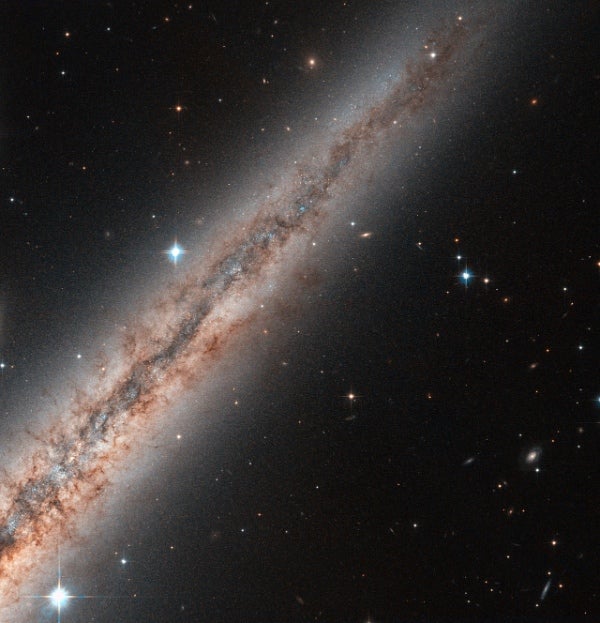
Today in pretty space pics: Hubble snaps the northern half of spiral galaxy NGC 981 in profile. The central galactic bulge is just out of frame to the lower left, leaving us with a close-up spanning roughly 100,000 light years that lets us look right through its plane of gas and dust.
Situated some 30 million light years from Earth, NCG 891 belongs to the constellation Andromeda and was long thought to be very similar to our own Milky Way galaxy. But on closer inspection--the kind of inspection enabled by images like these--astronomers have found that filaments of dust and gas stretching hundreds of light years out of the plane suggest that material is being ejected violently from the galaxy--either by supernova or by some serious star-birthing activity.
The brighter stars you see are actually in the foreground and belong to the Milky Way. To the lower right you can actually see some distant elliptical galaxies. The image was captured with the Hubble Space Telescopes Advanced Camera for Surveys.
[PhysOrg]
Five amazing, clean technologies that will set us free, in this month's energy-focused issue. Also: how to build a better bomb detector, the robotic toys that are raising your children, a human catapult, the world's smallest arcade, and much more.


Online Content Director: Suzanne LaBarre | Email
Senior Editor: Paul Adams | Email
Associate Editor: Dan Nosowitz | Email
Assistant Editor: Colin Lecher | Email
Assistant Editor: Rose Pastore | Email
Contributing Writers:
Rebecca Boyle | Email
Kelsey D. Atherton | Email
Francie Diep | Email
Shaunacy Ferro | Email
Ho Hum picture, BFD.
I think it is wonderful results out of our earth. the sharing of useful thanks! I like it.
frivjuegos2.net
friv-2.info
kizi1.org
kizi2.in
my friend's mom made $15485 last week. she been making cash on the laptop and got a $347900 condo. All she did was get lucky and use the guide revealed on this web site yuarel.com/readme
As I walked into work today, the sky was a nice baby blue. The baby blue is a reflection of atmosphere and sun light.
Imagine if our atmosphere situation was different ( for any reason ) it was much denser, where we never saw the stars at night and never saw the moon, but life adapted and still develop normal on Earth.
If humanity never knew there was stars and a moon, how would that affect our history, religion and science?
Oh, how I love to see the stars and inspiring they are!!!!!!
.............................
Science sees no further than what it can sense, i.e. facts.
Religion sees beyond the senses, i.e. faith.
Open your mind and see!
Just think in 4 billion years our offspring will be able to see it right from the back yard as Andromeda gobbles up our galaxy.
Thanks for giving me the useful information. I think I need it. Thank you
yepi10.net
yepi4.co
Thanks for giving me the useful information. I think I need it. Thank you
http://www.yepi10.net/
http://www.yepi4.co/
I like it, thank you very much
http://www.friv6.info/
http://www.friv1.co/
http://yepiclip.com/
galaxy in which we live is beautiful. I love it! http://www.yepi10.net | http://www.friv5.co
Mysterious beauty that any scientists also its attractive bright
http://www.3y8.org | http://www.juegosyepifriv.com
Yepi 10
so beauty , i love it href=http://www.9kizi.com/
How many years before the sun and peace of land is a http://www.yepi2.co | http://www.friv3.co | http://www.friv10.co