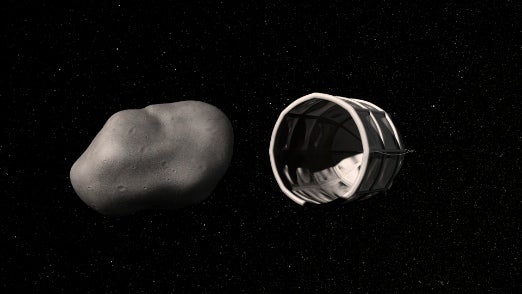
Since the announcement last week that a team of high-profile backers--Eric Schmidt and Larry Page from Google, filmmaker James Cameron, Ross Perot Jr. (son of the former presidential candidate), space tourism pioneer Eric Anderson, and X-Prize founder Peter Diamandis, among others--is launching a company that will "overlay two critical sectors—space exploration and natural resources—to add trillions of dollars to the global GDP," media speculation has generally centered on one thing: asteroid mining. And this morning, hours before the official press conference launching Planetary Resources Inc., that speculation appears to be confirmed.
At 1:30 p.m. EDT today, Planetary Resources will officially unveil its plans to use robotic spacecraft to exploit the mineral riches of the thousands of known near-earth objects passing through Earth’s neighborhood, as well as its intention to discover thousands more of them. The company reportedly hopes to establish not just a single mission but an entire framework for mining asteroids in space, including in-space “gas stations” that process water ice found on asteroids into hydrogen and oxygen for use in rocket fuels.
All of that will come further down the road, but the company has more immediate plans to begin putting enabling infrastructure into space. Any mining expedition begins with a period of prospecting, and the first phase of Planetary Resources’ project calls for the launch of inexpensive high-performance telescopes into low-earth orbit within the next two years to begin logging the locations and orbits of various asteroids hurtling through Earth’s neighborhood. These same telescopes will serve as testbeds for future instruments that will fly closer to asteroids to study their compositions in further detail.After that, it’s a matter of identifying the right asteroid and building the spacecraft capable of moving it and mining it for both water and platinum group metals like palladium, iridium, and platinum itself. It’s a huge undertaking, but one that independent bodies like the Keck Institute for Space Studies have said is not unfeasible over the next decade or two, given the right blend of technology and financial backing.
We’ll be covering the press conference at 1:30 p.m. EDT and following it up with additional coverage here, so stay tuned.
[SPACE]
Five amazing, clean technologies that will set us free, in this month's energy-focused issue. Also: how to build a better bomb detector, the robotic toys that are raising your children, a human catapult, the world's smallest arcade, and much more.


Online Content Director: Suzanne LaBarre | Email
Senior Editor: Paul Adams | Email
Associate Editor: Dan Nosowitz | Email
Assistant Editor: Colin Lecher | Email
Assistant Editor: Rose Pastore | Email
Contributing Writers:
Kelsey D. Atherton | Email
Francie Diep | Email
Shaunacy Ferro | Email
where can i submit a resume for this company?
Why not first capture orbiting space junk to recycle? I would think that there would be enough precious metals and, other materials, to make it worth the effort. At least for the larger stuff anyway. The smaller stuff that is not as easy to spot or catch, would likely require more money than the effort is worth.
This is such an epic statement. "At 1:30 p.m. EDT today, Planetary Resources will officially unveil its plans to use robotic spacecraft to exploit the mineral riches of the thousands of known near-earth objects passing through Earth’s neighborhood"
2011-2012 is such a great time to live in.
I can't see any real progress in the next decade or two (that second last sentence was right on). This is much more difficult than going to Mars! You really need an orbiting spaceport first for this to make logistical sense. That requires huge multi-government investment and won't happen in the next decade quite certainly and probably not the following one either. If fusion became a viable energy source in the next decade, it might speed things up.
I remember National Geographic doing a story on this type of mining using the Lagrange Points (L1,L2,L3, L4, & L5)as bases. I wonder if Planetary Resourses will use the same places for their operations? Realizing, of course, the actual mining will take place where the NEO's are.
@Killer T, I see your epic statement and raise you a double Epic statement. “overlay two critical sectors—space exploration and natural resources—to add trillions of dollars to the global GDP”
If these visionaries can make this statement come true, then we will truly be in the space age. Money trumps all.
@Far Out Man, I agree that we need new propulsion and energy technology, and that would make this endeavor happen sooner rather than later. But I have to disagree with the “huge multi-government investment” to get this to happen. Actually it would be better if governments stayed as far as possible from this and let the free market and capitalism work this thing out.
There are Trillions upon Trillions of $$ worth of minerals and energy in those asteroids. Buy stock in this company.
These are like the mars colony plans. Very cool but not to happen anytime soon. A normal astroid tracking sattelite costs at least hundreds of millions of dollars. Actually mining astroids and bringing back usefull amounts of cargo will cost tens of billions of dollars. Very Large spacecraft are required. Large heatschields to return it back to earth. Large rocket to push the returning matter. The large space rockets have to be reusable or it would`t be cost effective, etc. It will happen. But we need a lot of big technological breakthrouhs before it will be cost effective.
And to develop those breakthrouhs will cost even many more billions. Like building a large ice deepspace fueldock to turn mined ice into liquid oxygen and liquid hydrogen. Like building very large reusable space rockets to push all that matter. These technologies and capabilities are not even possessed by NASA or ESA. They also said vergin galactic would transport people around the world and launch satellites into space. They quickly backtracked from those plans. They also said the inflatable bigelow space domes would be on the moon as habitats by now. They also promised satellite refuelling docks by now. Space solar arrays that would beam back the power to eath. Etc. I need to see it before i will believe any big new promises.
@GreenMatrix, at least SpaceX is on schedule.
I don't see why within the decade something from this company couldn't happen. It may not be a trillion dollar mining op, but it might be simpler craft for proving out tech. I mean, within a decade there should be a few commercial space companies and a few more space capable countries.
I'm calling it here, some returned asteroid material returned within 10 years.
@Far Out Man...dream big and with alot of money it will happen, sci-fi to reality, Outland (1981), cheers
I am curious. What exotic mineral or thing which cost justifies mining in outerspace, verse a ready found mineral on Earth?
.............................
Science sees no further than what it can sense, i.e. facts.
Religion sees beyond the senses, i.e. faith.
Open your mind and see!
But if "ALL" the states unite together and make one big state it would take a lot less time for all of the things of the future to happen.
I would also like to work for this company. Space mining is a dream of mine, and it's definitely awesome!
@Cookiees453 then study robotic engineering, cause they already said all the mining will be done by robots.
@Robot, no body owns space, its wide open and ready to be conquered, begging for it actually, that's the incentive.
Robot makes a good point. It may be easier to mine down on Earth. Plus the cost of rockets and stuff would make the prices for space iron skyrocket. Space mining can be a viable option when all other resources are expended
---------------------------------------------
I like nonsense, it wakes up the brain cells.