Feature
Why drones won't be taking over our wars anytime soon
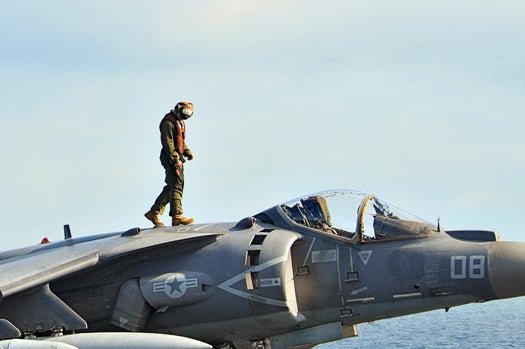
Live Fighters Aboard the amphibious assault ship USS Kearsarge, pilots play a key role in shows of force and complex missions. Even as drones become integrated into the fleet, pilots will lead. U.S. Navy/Mass Communication Specialist 1st Class Tommy Lamkin

Early in 2008 on the Black Sea coast, a Georgian drone flying over the separatist enclave of Abkhazia transmitted an instantaneous artifact from the age of human flight—the video record of its own destruction by an attacking fighter jet. What happened that day was born of incendiary post-Soviet politics. The Kremlin backed Abkhazia and was furious that Georgia had bought surveillance drones to watch over the disputed ground. Georgia’s young government flaunted its new fleet, bullhorning to diplomats and to journalists like me what the drones were documenting of Russia’s buildup to war. I remember the Georgian bravado. We have drones. Ha! We have arrived. Tensions led to action. Action came to this: A Russian MiG-29 intercepted one of Georgia’s unmanned aircraft, an Israeli-made Hermes 450, which streamed live video of the fighter swinging into position. The jet pilot fired a heat-seeking missile. Viewed on the drone operator’s screen down below, the missile grew larger and its exhaust plume grew longer as it rushed near. Then the screen went fuzzy. Georgia’s drone was dead.

Decades from now, those few seconds of video might be cued for knowing laughs—remember when fighter jets ruled the skies, and drones were helpless before them? Cautious minds best not bet against that. But that day is long off. For now, the video delivers the opposite message. The Hermes 450’s lopsided encounter with a MiG served to remind people that, for the foreseeable future, the roles of traditional military fighter and attack aircraft—flown by men and women buckled inside—remain secure. Drones are a complement, not a replacement, to the aircraft flown by the people within.

There are many reasons for this. Stepping past the unsettled questions of morality and law, the restraints on drones are connected to a pair of stubbornly related facts: Technical limits restrict the missions that unmanned aircraft can perform, and drones, for all their abilities, are very vulnerable machines. Whatever futurists predict, in the arena of air-to-air warfare, drones can neither reliably defend themselves nor consistently elude a determined attack. The best models might excel at patient surveillance or electronic jamming, or be lethal to stationary targets on the ground. But when faced with another plane, they can’t really fight. This is why American drones have been used most extensively and successfully in places, most notably Afghanistan and Iraq, that offer politically permissive airspace or where the presence of friendly pilots keeps potential foes away.
Battle Tactics: In high-pressure situations—a dogfight or a bombing mission on or across enemy lines—pilots may steer by feel and familiarity with their craft.  Ugur Demir/Getty Images

What this means is that drones present a new variable in an old equation. This is an age in which different types and classes of aircraft work alongside one another. Just as helicopters and fighter jets coexist (along with transport aircraft, re-fuelers, electronic warfare platforms and strategic bombers), unmanned aircraft fill niches in a complex force. Early this year, I lived aboard an American aircraft carrier for roughly three weeks and flew backseat on an F/A-18 combat sortie over Afghanistan. Drones crowded much of the airspace over Afghanistan, watching over American units, searching for the Taliban and occasionally dropping ordnance. But fighter and ground-attack aircraft crowded the skies, too, and pilots were in constant radio contact with the troops below, ready to provide strafing runs or air strikes for any unit that needed help—missions that drones do not do well. The roles for drones expand with each new design cycle. But beyond close air support, there are missions that cannot yet be flown remotely, and will not be flown remotely anytime soon.

Warfare drones can neither reliably defend themselves nor consistently elude a determined attack. Faced with another plane, they can’t really fight. Imagine, for a moment, a dogfight. Now imagine trying to design and manufacture a machine that can do what the combination of a trained pilot and weapon-system officer and modern strike fighter do. To understand how aerial combat is different from the many missions that drones have performed successfully, like the slow loiter over a target to watch a suspected Taliban gathering spot, it is helpful to distill what is required of a pilot and aircraft as they close in on another fighter plane. A dogfight comes to this: Whoever is operating the first aircraft must perceive the second aircraft, assess its capabilities, anticipate where that other aircraft will be—both in the next few seconds and beyond—and then maneuver into a position to counter any threats from the opposing aircraft and to make, to use the language of war, a killing shot.

Click here to view this article on a single page, or continue to page two below.
Remote Limits: Drones such as the Predator can fly longer and farther than human-powered craft, but they can’t perform the complex maneuvers essential to aerial combat.  Erik Somonsen/Getty Images

Other factors enter the scenario and give an aerial fight its context. These include weather, changes in terrain (such as the nearby presence of mountains), fuel levels, emotion, rules of engagement, the proximity and attitude of other aircraft (including commercial aircraft that could enter the battle area), the weapons and defensive packages on each combatant aircraft, and the ambient and background thermal conditions that influence some of them, especially heat-seeking missiles. Pilots and backseaters absorb all of these factors and make decisions at a snap, often as both aircraft fly through G-multiplying dives and turns at tremendous speeds. A ground-attack aircraft can rely on similar acrobatics. One pilot I saw being debriefed by an admiral after returning from an airstrike to help pinned-down American troops near the Pakistan border described rapidly planning an attack angle to release his bomb and then having to bank hard and almost vertically to prevent his F/A-18 from entering Pakistan’s airspace. This was a case of precision, high-speed flying that could prove impossible in the near future for a remotely piloted aircraft.

To be sure, fighter- and attack-aircraft crews praise drones, which they see as having carved out a vital place in modern air forces. They also see where drones might hit a set of design hurdles. The first would be to develop a full mix of sensors and a means to fuse all of the gathered data together, so that a remote pilot might have an idea of what is happening to, and around, an aircraft in a distant piece of sky. This technology does not exist. Even if a sensor suite were created to inhale this information instantly, detractors might say that no one could write the algorithms to handle the real-time permutations required for a remotely piloted aircraft to assess risk and make decisions as quickly as a human. Moreover, some of what happens in the mind of a pilot in a cockpit is guided by feel for his aircraft, something that comes from ability, training and experience. How do you capture that in an app?

The second design hurdle has to do with the limits of compromise. To make a drone more maneuverable, it would need a larger engine. A larger engine drives up size and weight, which means the aircraft must carry more fuel and will most likely lose in-flight loiter time. More sensors would probably change the profile of a drone, increasing its radar reflection and reducing its stealth. Almost every time features are added, the drone changes, and those changes come with costs.

“The biggest limitation that you’re talking about with drones is connectivity.” With remoteness, a pilot might lose the ability to control his craft.But the sensors and the software and the push-pull tension inherent in drone design are only part of it. Captain Dale Horan, a career Navy fighter pilot who recently served on a deployment to Afghanistan and Iraq as the commander of Carrier Air Wing 9, has an accommodating view about the technology and the programs that could be created. The real limit, he says, might not lie at the programmer’s cubicle. If the right sensor suite existed so that a pilot flying an aircraft remotely could see what he needs to see, and “if you have a high enough data rate, an algorithm probably can be generated to put the airplane in the right piece of sky to counter that threat.” (It is not lost on pilots, or anyone else, that skeptics of the computer age once said no machine could ever best the masters at chess.) But then came the catch. “If the net is jammed or the data link is bad, that drone is not going to be able to make that correction,” Horan says.

Costly Add-Ons: As drones move into certain roles once occupied by pilots, they grow in size and lose their stealth. A Reaper drone [above] has a wingspan nearly twice that of an F-22 Raptor [below].  Ethan Miller/Getty Images

And there is a limit not often discussed. Any sensor system that could seize and interpret all the data required for a pilot to fly a dogfight remotely would face a technical challenge: transmitting that much data, in two directions, in real time. To sketch a crude example, imagine using your smartphone to remotely pilot an unmanned aircraft 1,000 miles away, at night, in bad weather, in skies crowded with a mix of friendly and commercial aircraft in different aviation corridors and altitudes. Now imagine trying to fly that same aircraft remotely when it is under a complex attack, and your smartphone signal grew weak or spotty. The reasons for the frustrating signal could be many—deliberate jamming, environmental interference, a broken part on either end or anywhere in between, or all of the above. Lieutenant Commander Fran Catalina, of VFA-41, a Navy F/A-18 squadron, put it this way: “The biggest limitation that you are talking about with drones is connectivity.” With remoteness, a pilot might easily lose the ability to continuously pilot a complex aircraft—yet another reason fighter pilots are not going to be phased out anytime soon.

A dogfight is only one example of a combat situation in which neither the sensors nor the data links would be robust enough. Similar problems would apply to attack aircraft flying into hostile airspace to strike a target. Consider an oft-discussed option: the laboratories of a nation’s nuclear program. For the sake of war-gaming, assume that the approach will be beyond what pilots call non-permissive. The crews expect to face anti-aircraft gunfire and missile attacks from ground defenses, along with communications jamming and the potential for fighter jets scrambling to meet the sortie en route.
F-22 Raptor:  Stocktrek Images/Getty Images

Those who train for this kind of warfare know that no drone yet exists that could handle such a scenario. The drone would have to be alert to all of these factors, relay them to a remote pilot on the other side of the world, and make corrections in the time required to react. Missions like these will remain the work of the same classes of aircraft—and the pilots and weapon-systems officers who fly with them—who have been flying these missions for decades. With each design cycle, drones will no doubt be further integrated into the busy mix of a modern military air campaign and maybe, eventually, into missions over hostile airspace with anti-aircraft guns and enemy fighters. But humans will be up there with them, flying old-school pilot-on-the-ejection-seat flights and calling the shots. As that day perhaps draws near, the limits on where drones can fly will remain. The MiG that punched that Hermes 450 out of the sky laid out a fact unlikely to change soon. When the skies turned violent, all the Hermes could do, in the end, was watch—even its own fiery end.

C.J. Chivers, a former marine, is a senior writer for the New York Times and the author of The Gun, a social history of the AK-47.

22 Comments

What it takes to make a warplane capable of modern mission: Modern airframe design scaled down for the capacity necessary for the mission profile + Sophisticated program to govern the actions and decision making capabilities of the warplane (even if comparitively simple to the human mind).

Fighter and attack crews may not be going anywhere anytime soon, but the more politics and warfare demand useage of these devices, their technological advancement (to include the sub-technologies associated with them) will increase exponentially, until a point at which the machine becomes more reliable than the human to do what is deemed to be a task too simple for one person to screw up.

None of this may be likely to happen. But, it is still possible. The only way crews don't become obsolete is if they continue to have military aviators with enough political pull to vouch for their own kind's survival.

"The person is smart. People are dumb, panicky, dangerous animals and you know it. Fifteen hundred years ago everybody knew, the Earth was the center of the universe. Five hundred years ago everybody knew, the Earth was flat, and fifteen minutes ago you knew you were alone in this universe. Imagine what you know tomorrow."

Depends on what you mean by "Soon"
I think they will be ready in 10-15 years.

There are plenty of support applications for armed drones. The thing to remember is the concepts of "force multiplier" and valuation of our warfighters lives over machines. We have already explored unmanned surveilance with great success. Possible missions for armed drones is electonic warfare and supression of enemy air defenses (SEAD). Flying a precisely programmed flight (in a lower profile drone) is not a detriment in these missions. They can automatically engage targets more effectively, often using GPS bombs instead of more expensive missiles. Support combat missions are a very important aspect of air combat, and free up valuable personnel assets for more important and/or less dangerous missions.

Once high powered lasers become the norm you can kiss ALL airborne aircrafts goodbye.

The tech may not be available yet, autonomy is getting better by the minute and a computer won't have doubts, or find the bombing near the pakistani border a challenge, it would make a calculation and the response would have been yes or no. Also the G's would have been a joke, one of the limits that a person provides. the other being that you have to provide high safety for a large heavy bag of meat otherwise known as the pilot, a large cockpit with explosive bolts on the canopy and a rocket seat, a parachute, climate control and compressor bleed for breathing air, controls, displays, and the list goes on. Imagine the entire brains of the flight vehicle fitting in something the size of a computer. and when we truly trust the autonomous system, we don't have to worry about uploading and downloading data, or being jammed. and then the response times would be on the millisecond time scale and defeat any human pilot.

It is so funny that C.J. talks about how if we made it a fighter craft it would not be able to loiter, of course, you would have separate craft handle different missions, slow craft would loiter and faster craft would fight. The fighters can rest on the end of a runway and takeoff in seconds compared to real pilots who will take significantly longer just to get to the craft.

@jsbrads...you took the words right out of my mouth, great post, i couldn't disagree more with the author, autonomy is the name of the future game, the navy is testing an autonomous attack drone, people like this author dismiss the idea of future robot's being capable of revolutionizing our entire civilization (and likely being more capable than us), the same as past experts claiming the airplane will have little impact on future warefare, failure to think outside the box, the author should be asking himself why the airforce does not plan on developing anymore manned fighter aircraft, cheers

this author seems to be way behind the times, an F-35 with attack drones as his wingmen would mean he can be in a stand off position with the drones taking the fight to the enemy (the navy is developing this capability), no remote pilot flying the drone, fully autonomous, with the F-35 providing all the intel (with his sensor package) to the drones (less mass for the drones to carry, they would be kept light, deadly, expendable, and have a working self destruct), which means they could do things a piloted aircraft would never be asked to do and all the time never risking a pilot, a huge advantage, cheers

Article is built on a false premise: who said that the drones of today were ever designed for dog fighting? The real question that should have been of interest to PopSci readers is what technologies of the future will make "air breathers" obsolete?

The problem with this is that the politicians continue to push for these unmanned fighters. They do not and refuse to understand the entire premise of this story. They think that by spending more money technology will continue to give them better things. They don't understand that eventually technology will reach a point where it has nothing more to give.

It's not difficult to envision a successful strategist overcoming any limitations. Without a pilot, drones can be built to handle much higher G-forces than a human would survive. Drones are redundant and expandable, so you can deploy them in teams and develop formations where it's assumed that any one drone can be sacrificed while the other drones position themselves to shoot down an enemy pilot. A drone that has better performance characteristics than a human piloted fighter merely has to get on it's tail and shadow it through whatever movements the enemy fighter can muster. It could get up close and react to the enemy craft's turns in milliseconds in a way that a human pilot would never be able to keep up with. And it could do this for hours on end, waiting for the enemy pilot to get tired and make a mistake.

@tyler555...with all due respect, you couldn't be more wrong, technology will always grow, cheers

A couple other things - I just don't see a human pilot being able to shake a drone fighter after it gets on his tail. I literally mean for hours - drones could trade off shadowing the enemy craft and go refuel while they wait for the enemy pilot to level out so they can get a clean shot. Eventually the enemy pilot will have to give up.

And jamming will become useless when a formation of drones in close proximity to one another can use laser light to communicate. The only way to stop them from working as a team would be to physically block the path of the laser. This would allow for synchronized maneuvers and sharing of sensor data in ways that are simply impossible with human pilots. You don't need a drone that can see in 360 degrees. You just need several drones, each looking in a different direction and sharing the data with the others.

The possibilities of a team of drones is pretty incredible. Whereas a fighter plane has to have enough sensors and possibly a weapons system officer on board, a team of lightly equipped drones can share many of these tasks to other drones in real-time. Multiple drones could help identify a target and examine possible scenarios as a team, track the target and deploy weapons as a team, etc. As an example, even if lasers that fit into a small drone don't become powerful enough to take down a fighter anytime soon, a team of drones carrying smaller lasers could combine them into one lethal shot. So they might not even have to be maneuverable. And if all else fails, one drone could ram the enemy in order to save the remaining drones.

"I would like to admire the way you described your valuable ideas and concepts with us through this platform.Through this platform I want to share my own ideas about Cisco CCNA Service Provider Operations

This article is great perspective on the human element continuously having control over remote piloted aircraft, but the author didn’t mention the segregation between systems and certain missions.
There is a difference between a remote piloted aircraft(RPA) versus a unmanned combat aircraft(UCAV) as well as the multitude of difference missions that the USAF performs to project air superiority. Afghanistan is more of a “big brother” watch mission than a air superiority. The future of Air war fare, particular Offensive Counter Air (OCA), will be a drone vs drone fight than drone vs human. The UCAV does not need to be continuously updated, in fact it should not. It only should receive orders from a C2 node to intercept, ID if necessary, and destroy when its flying its preprogram combat air patrol mission. A UCAV will have the First-Look and First-shoot before being detected by a human fighter and if the UCAV is threaten the ability to push beyond the 9G limit will break the lock on any air to air missile. Also UCAV are easily replaceable. If you lose a manned fighter, you may lose the pilot if he is injured or captured and the commander must decide whether or not to launch a rescue mission. UCAVs will achieve Economy of force, Maintenance of Moral, Concentration of force, and Sustainability far better than a manned aircraft when it comes to the principles of war. And to hit the nail on the coffin: $350 million = 1 F22 (not including training the pilot), $10-$25 million= UCAV. 14 UCAV versus 1 Raptor. I really doubt the F22 has that many missiles.

Side note:
I’m still curious on where the author correlated the size of the engine to the maneuverability of the drone. The size of the engine determines the speed, and the control surface determines the ability to maneuver; unless you’re talking about thrust vectoring, which is different from a typical engine.

@AE2006AF...i believe he is referring to a need for higher speeds and climb rates, also the fact that the current generation fighter can dog fight at supersonic speeds putting the f-15 at a disadvantage as shown in recent war games versus the euro fighter, the f-22 still has a huge advantage but for how long? cheers

As a fighter pilot once told me "If you cant kill someone Beyond Visual Range(BVR), you are pretty much dead". Dog fighting is a useless endeavour with the advancement in heatseakers, and soon airborne lasers. When pilots dog fight at higher speeds, they widen the turn radius making them more vulnerable, increase fuel consumption, and put higher G's on their aircraft and body. No fighter pilot cannot out maneuver a capable missile. Now tied that with a highly maneuverable UCAV. I imagine UCAVs having a heat-image tracker in all visual quadrants tied in with a advance heat seeker missile that can fire off in any direction. This will end a dog fight scenario rather quickly.

Fighter pilots don't compete with other fighter pilots in the 21st century. Fighter pilots compete against missiles and radar. Kind of sad since most of us grew up hearing/watching WWII films where in that era it was man vs man; like an old western.

The author needs to review his research and expand his views. I'm afraid that the author, not a fault of his own, has a very limited view of air superiority and how to accomplish it. After all, he is a prior marine, on board a carrier, and watching a war that has nothing to do with air war fare. Each services employs air power in their own way, but the USAF is in the business of air superiority and the many subsequent missions that fall underneath it to achieve it. The many problems he placed on the RPA does not transfer to UCAV. The human element still exist in the RPA/Hermes Drone.

It's really too bad that our money is being spent on this kind of thing. War is disgusting.

electric38
An insect sized fleet could easily take down any ship. Especially with encirclement type maneuvers. That is exactly what many robotics designers are working on. No single jet can withstand a swarm attack. Europe is already laughing over their detection screens about our so called "stealth" models. These multi billion dollar obsolete pieces of crap do nothing but enrich the war profiteers. While millions in America slide towards poverty. How sad.

Technology has really changed over the last 30 years that I've been an engineer. Never underestimate the power of the brain. Technology will continue to change very fast; the revolution in computer programming will insure that. The plcs that I work with are doubling power about every 4 years, but the time-frame of doubling power is ever-shortening. The country that first produces an Unmanned Combat Aircraft that is meant to engage in aerial combat and anti-ground defense, will become the superpower of the world. My crystal ball has never worked well, but I suspect that some form of using unmanned combat aircraft in conjunction with manned combat aircraft will happen soon, and without manned combat aircraft later. There is just too much increase in technology, year-by-year to prevent it. My guess is within 10-20 years, manned combat aircraft will be used as backup, not the main attack force. So,the best degrees to have now, are engineering, computer software, Physics and a strong knowledge of Ethernet.

The future of war is not about planes and tanks and ships and crap like that. The future of war is in cyberspace!

guys do you have an idea What are the differences between F-15s supplied to Israel and F-15s supplied to Saudi Arabia?
http://airsoc.com/articles/view/id/4f917401c6f8fa1308000013/what-are-the-differences-between-f-15s-supplied-to-israel-and-f-15s-supplied-to-saudi-arabia?ev=10&evp=tl


June 2013: American Energy Independence

Five amazing, clean technologies that will set us free, in this month's energy-focused issue. Also: how to build a better bomb detector, the robotic toys that are raising your children, a human catapult, the world's smallest arcade, and much more.


Online Content Director: Suzanne LaBarre | Email
Senior Editor: Paul Adams | Email
Associate Editor: Dan Nosowitz | Email
Assistant Editor: Colin Lecher | Email
Assistant Editor: Rose Pastore | Email

Contributing Writers:
Rebecca Boyle | Email
Kelsey D. Atherton | Email
Francie Diep | Email
Shaunacy Ferro | Email

circ-top-header.gif
circ-cover.gif