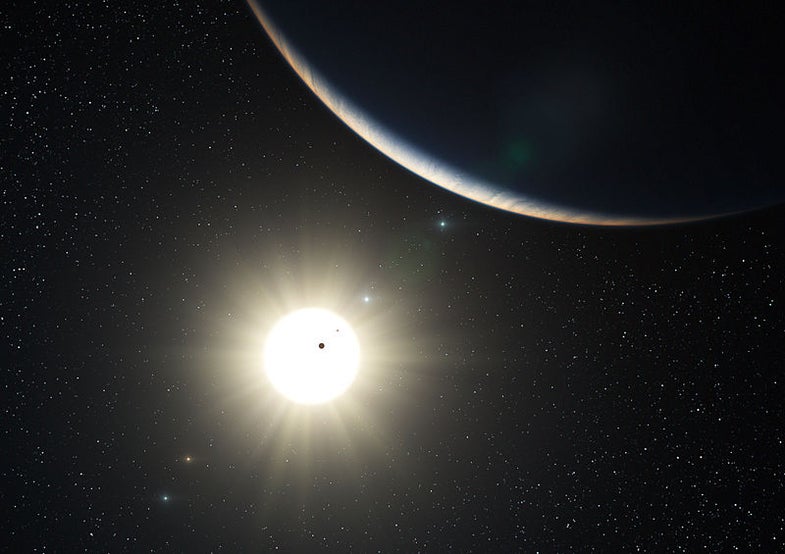
It’s a shame about Pluto. Now that the astronomical community has downgraded the once-furthest planet from the sun to non-planet status (technically it’s now referred to as a protoplanet or dwarf planet), our solar system is at risk of being unseated as the largest known planetary system in the universe. An astronomer at the University of Hertfordshire has revisited data related to nearby star HD 10180 and discovered that it very likely has nine planets, making it the most populous known solar system.
Astronomer Mikko Tuomi made the discovery by applying new kinds of statistical analysis to old data gathered when HD10180 first became a point of interest in the Hydrus constellation back in 2010. At that point the star--just 130 light years away--was thought to have five planets, all giants with masses akin to Neptune and Saturn. A sixth planet then surfaced in the data, which describe the way the star wobbles as the gravity of its planets tug on it.
By combing back through the data using different techniques for analysis, Tuomi found evidence for three more planets, all very small (ranging from 1.3 to 5.1 times the size of Earth) and all very close to the star (the closest of the new planets orbits the star in just 1.2 days, the furthest in only 68 days). That, of course, puts them way too close to the star to be considered potentially habitable. But they do put HD 10180 in a class by itself when it comes to planetary population.This, of course, all depends on the discoveries being confirmed. Tuomi thinks that his new findings confirm the existence of the seventh planet in orbit around HD 10180, but the other two still require more evidence before they can be considered fully confirmed planets.
[PhysOrg]
Five amazing, clean technologies that will set us free, in this month's energy-focused issue. Also: how to build a better bomb detector, the robotic toys that are raising your children, a human catapult, the world's smallest arcade, and much more.


Online Content Director: Suzanne LaBarre | Email
Senior Editor: Paul Adams | Email
Associate Editor: Dan Nosowitz | Email
Assistant Editor: Colin Lecher | Email
Assistant Editor: Rose Pastore | Email
Contributing Writers:
Rebecca Boyle | Email
Kelsey D. Atherton | Email
Francie Diep | Email
Shaunacy Ferro | Email
I maintain that a gas giant, which can be a 'system' unto itself, harbors more potential for life than do actual planets.
Why?
Lets assume for a moment that every star system out there has at least one gas giant and one Earth/Super-Earth. If that gas giant has at least 2 respectable moons then there are twice as many potentially life harboring moons than there are life harboring planets. You might wonder what I mean by 'respectable moons.' I guess here I will coin the term 'Europa-Class' Moons, which are natural satellites with near-earth gravity and a regular orbit, at a minimum. Europa also happens to have liquid water, crustal movement, and internal heat generated likely by tidal forces from Jupiter. As a body has more and more of these attributes it can be Europa Class I - III.
Anyway... I think we're looking for Pandora and not Naboo. Between Mars and Europa, I think Europa not only has life, but it has complex life. Mars likely has microbial life, but it highly doubt it sustains complex organisms. When we do finally pierce the ice sheets of Europa I think we'll find a highly diverse ocean. This is despite the fact Europa is so far away from the 'habitable zone' of this planetary system.
In short, gas giants play host to many moons and generally, greatly expand the realm of a 'habitable zone.' That said, I think we'll find EBEs on a moon before we find them on a planet.
I completely agree with you lawsonrw and have thought the same plenty of times, also. Honestly, the question is not IF we're gonna find life out there, but WHEN. I really don't think it's going to be much longer. And like you, I'm guessing microbial life under the surface of Mars first. Probably find evidence of more complex life at one time, but it's all extinct. Then more complex life in the oceans of Europa. My question is how intelligent that life is going to be...
With the history of humanity from one tribe, town, country concurring another perhaps we should not introduce ourselves too quickly, else we may find ourselves concurred.
And if that cosmic intelligent life sees us as we see our animals on earth, their maybe no guilt making humanity extinct or exploited in some fashion.
Maybe our cosmic intelligent aliens might find we taste good and just like chicken!
.............................
Science sees no further than what it can sense, i.e. facts.
Religion sees beyond the senses, i.e. faith.
Open your mind and see!
wow i thought of that movie 2010 odyssey, "all these worlds are yours except europa". wow maybe life does exist there. becuase planets have effects on moons and vice versa
"religion is like a prison for the seekers of wisdom"
-Killah Priest
JediMindset,
What planets have evil effects on planet Versa? I have never heard of this planet Versa and why do we Earthlings project upon it in an evil manner? Have they done us harm in the past? Do the Annunaki live there? I would not kick sand in the faces of the Annunaki. They made us and they can take us out and make new and improved versions for later!
By the way, is Europa nice? I think I like to visit there one day!
.............................
Science sees no further than what it can sense, i.e. facts.
Religion sees beyond the senses, i.e. faith.
Open your mind and see!
Robot says: "With the history of humanity from one tribe, town, country concurring another perhaps we should not introduce ourselves too quickly, else we may find ourselves concurred."
LOL! I think you must have meant 'conquering' and 'conquered' rather than 'concurring' and 'concurred'.
While yes I agree that we could become conquered by a more advanced species, I disagree that we would ever be viewed as we view animals on our planet. There are no animals on our planet that have even come close to displaying the same intelligence as mankind. We may be viewed as primitive by comparison but not as unintelligent animals.
@Robot chicken,
LMAO wow i said VICE VERSA. its a phrase. the mighty glorious Aunnuaki will make there presence known before 2013. i shall welcome my ancestors with open arms. i want them to give me the ability to glide like a flying squirrel. robots have the ability to live on any planet/moon. once we reach the Singularity will be be able to colonize every planet in the universe. even live on the surface of the Sun.
"religion is like a prison for the seekers of wisdom"
-Killah Priest
Concurring us for my poor grammar or poor choice of words would be a no brainer too, lol.
.............................
Science sees no further than what it can sense, i.e. facts.
Religion sees beyond the senses, i.e. faith.
Open your mind and see!
May I ad that a mission to mars is currently a long way off as NASA has other plans first and other agencies aren't current looking into the possibility. A mission to Europa would be far more costly, almost beyond our current capability e.g. drilling through surface to get to water, developing underwater equipment that can be transported through space and a craft that will take less than 2 years to get there. Its gonna be a long wait I think.