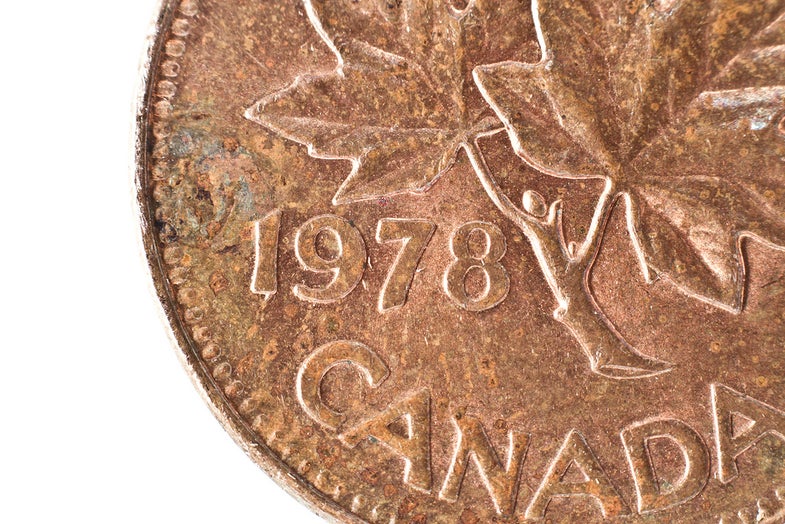
Canadian Penny Is No More mrgreen09 via Flickr

Next time you visit Canada, you might use digital currency to purchase your poutine, using something called MintChip backed by the Canadian government. The Royal Canadian Mint announced it’s getting rid of the penny and starting a new e-currency instead, and it wants the software community to help develop it.

The government just launched the MintChip Challenge — which was apparently so popular it’s already fully registered — to seek new digital payment apps for this new virtual currency. The idea is sort of a hybrid, combining the convenience of electronic transactions and the anonymity of cash. It will work via SD cards, but it will have no personal information or bank account data associated with it. It’s sort of like BitCoin but with actual, government-backed value.

The four-month contest includes 500 developers who will build apps that can demonstrate MintChip’s value. They’ll have to work on a variety of smartphone and desktop browsers. The prize: Solid gold wafers and coins worth about $50,000.

Its anonymity is a pretty unique idea. Other electronic payment systems — PayPal, Square, NFC-enabled phones, etc. — all connect to a person’s credit card or bank account. But cash is a great equalizer; you don’t need to have good credit to use it. MintChip would enable the same type of low-cost transactions for which you’d normally use cash. A Canadian banking group called Interac estimates that small-value transactions under $20 are worth $90 billion to the Canadian economy, the Toronto Star reported.

MintChip still has some kinks to be ironed out, including privacy, security of the currency and other questions. But it's certainly an interesting concept.

[via Slashdot]

11 Comments

Considering that determined and well-funded groups can hack just about anything on this planet that they choose, I'd be pretty concerned about someone figuring out how to create their own funds. It's hard enough to keep the counterfeiters at bay with the physical stuff, but this is like giving everyone who wants one a high-tech printing press like what the government uses for $2,000 and hoping they don't figure out how to make something that will fool a cashier at Wal-Mart.

This is destined to fail. As marcoreid points out hacking will be a serious problem, but there is even more to it than that. You can look at the US dollar (a very tangible thing) and see how its value decreased once it lost its backing in precious medals. If real world paper money can't hold value reliably what makes anyone think digital money will?

This seams like so much an April fools joke. Going digital because you don't want to produce the penny anymore? There was talk about merging the North American currencies into one like Europe and the Euro. I'll believe it when I see it.

I read the a few weeks ago 1.2 million credit card numbers were hacked and stolen.

There was a time long ago, when people saved gold and silver coins and put cash under the bed. Perhaps we should stock a little cash at home for emergencies.

As we keep moving to a digital cashless society to make our life easier, it also makes life easier for the thief too.

..........................................
See life in all its beautiful colors, and
from different perspectives too!

@antaro
They aren't going digital because they're removing the penny. They just happen to be announcing them both at around the same time. They are completely different projects.
The talks about the NA currency has never really been considered realisticly between countries. It's only really talked about by conspiracy theorists who make claims on one-world governments.

@Space
People can take the chips/cards that host this virtual currency and hide it beneath their beds if they wish. They won't have the 'backing of precious metals', but if the world economy crashes, no one will care how many gold coins you have, only useful things like food. So even precious metals are 'fiat currencies'.

The way I see this, is that they're looking to make reloadable cash cards like they have at many places like Tim Hortons. You can put value onto the card completely anonomously and no one can track your spending, the same as with cash. If they include ATMs into the system, you could put in a $20 bill and your card, and it will transfer the value from the paper to the card. All the convenience of unlimited money on one card, but the security of anonymity in your spending.

The anonymity is kind of iffy. The card will still be identified somehow, via a number or something. The only thing missing is a list connecting card id's to people. I forsee entire businesses revovling around trying to match up card id's to people for who knows what reasons.

@tertertert Never in the history of mankind have precious metals been considered worthless or "fiat". If the world economy crashes, it will be due a multitude of reasons and none of them will be "we had too much gold". In regards to the practical real world use of precious metals (the kind that would be considered in a disaster situation brought on by global collapse), any metal -precious or not- would be desired for the manufacturing of tools and weapons.

But this is all hypothetical, and the greatest influence on any economy is not what value people put on their money, but how wise they are in using it.

tertertert,
You make a most excellent point. When a person is starving for food or water, he has no desire to barter with for gold.
Bartering with real and practical useful items like food, water, clothing, tools, seeds, and etc. Then gold and silver for much later for bartering, after the chaos settles down.

..........................................
See life in all its beautiful colors, and
from different perspectives too!

All the negativity in the comments section is disappointing. Anonymous electronic cash for small purchases is a long overdue utility.

Privacy should be valued. The anonymity of cash has been enjoyed and taken for granted for thousands of years, and it is not something to be tossed away lightly. Anonymous electronic cash is a technical adaption of a system that has served humanity very well.

It is not simply a matter of concealing one's apetite for PBR tall boys and Maxim magazines. "The Man" doesn't need to know about anybody's daily purchases of food, fuel, and other supplies.

As for hacking, it may be a non-trivial problem, but it is not an insurmountable obstacle.

For starters, the cards can be rationed without losing their anonymous aspect. Sell the rechargeable cards off the shelf for a nominal fee to cover manufacturing cost, but require the presentation of ID and a separate fee to purchase an authentication card with two numbers: an audited number and a secret scratch-to-reveal number. This second number would activate the rechargeable card (sort of like Windows Activation). Pre-paid phones already use a similar system, sometimes checking ID. People who lose their cards too much could be audited or banned, just like people are who are suspected of cheating social welfare systems.

As far as preventing massive hacking of the database, the provision of safeguards is more of a political problem than a technical one. Think of voting systems: if system trustworthiness was the dominant goal, then voting systems would use open source software and hardware and be designed by Sanford professors. Clearly, no single server should have too much information on it, nor should any single server be able to authorize a purchase.

Widespread man-in-the-middle attacks should not be feared without strong documentation of their likelihood. In any event, if shrinkage is kept under 0.1 percent and cards can only store $100 (or perhaps $200), then consumers can be sold on the manageability of the risk of having their cards drained and bricked.

THe government does not need to steal from the working class to make people poorer, they simply create inflation and give more to the rich. It was done in most recent times as they gave billions, upon billions to the banks.

.............................
Science sees no further than what it can sense, i.e. facts.
Religion sees beyond the senses, i.e. faith.
Open your mind and see!

Unfortunately paper money will soon be a thing of the past in Canada. Especially in the cities. Speaking on behalf of the average Canadian that makes between 45-75K a year have a family two cars and a home. I can go all month w/o touching cash money unless it’s to buy something like a stick of gum from a vending mahine. We get paid via direct deposit, all of our bills are paid via internet or telephone banking, then the rest of purchases are done via debit or credit cards. Also many well known establishments have “meal” cards that you can refill online. Eg Tim Hortons, you can refill a $50 card online via credit card and never have to worry about carrying change. Also many stores including gas stations and beer stores don’t even except the $100 bill anymore??

Cash Money is only for the Rich or the Criminals, or the Rich Criminals. Drugs, Gambling, Prostitution are the only real cash business’s left in our country, and the politicians use them the most. So yeah bring on the digital currency so they can do away with cash once and for all.


June 2013: American Energy Independence

Five amazing, clean technologies that will set us free, in this month's energy-focused issue. Also: how to build a better bomb detector, the robotic toys that are raising your children, a human catapult, the world's smallest arcade, and much more.


Online Content Director: Suzanne LaBarre | Email
Senior Editor: Paul Adams | Email
Associate Editor: Dan Nosowitz | Email
Assistant Editor: Colin Lecher | Email
Assistant Editor: Rose Pastore | Email

Contributing Writers:

Kelsey D. Atherton | Email
Francie Diep | Email
Shaunacy Ferro | Email

circ-top-header.gif
circ-cover.gif
bmxmag-ps