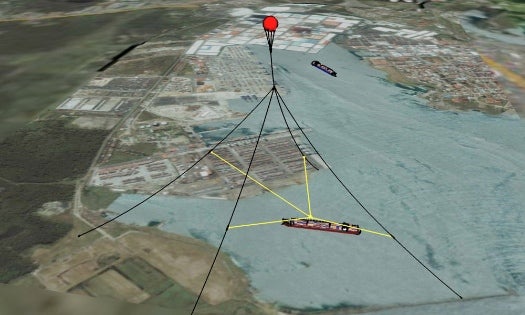
The future of seaports could be not having any seaports at all. At least that’s the vision of Jeremy Wiley, founder of Tethered Air. Wiley envisions a system of robot cranes tethered to huge heavy-lifting balloons that could deployed anywhere to ferry shipping containers or other heavy cargo from ship to shore, or vice versa. Such systems would be relatively inexpensive, he says, and could create a near-instant seaport just about anywhere water meets the land.
From a technical standpoint, Wiley’s idea is somewhat similar to the Skycam that zooms around overhead at NFL football games. Four anchor cables suspended from a lifting balloon connect with four payload cables that actually connect to the cargo. Those anchor cables reach from the balloon to the ground, and through the controlled shortening and lengthening of all of these cables by robotic mechanisms, the balloon and the payload can be moved around the space inside the four anchor cables.
Wiley dreamed up the idea as a U.S. Marine in Kuwait helping to move cargo from ship to shore prior to the invasion of Iraq. The military has long struggled with the logistics of moving all the men and materiel necessary to make war in a timely and efficient manner, and he started to see potential in a better way to quickly deploy a robotic crane. Likewise, in humanitarian crisis situations like the 2010 Haiti earthquake, moving cargo quickly into areas that have possibly been devastated (or developing areas that never had good deep water ports to begin with) can be the difference between life and death.Using a robotic balloon lift, you could have a heavy-lift seaport crane in place in a matter of hours just about anywhere. It could be used in places where shipping tends to bottleneck--like at the Panama Canal--without creating anymore costly permanent infrastructure. And, at an estimated $7-10 million for a robo-balloon-crane big enough to lift shipping containers from ship to shore and back, a working Tethered Air crane or something like it might just be a steal of a deal. That’s dirt cheap next to the cost of building an actual seaport, and for coastal cities that otherwise could never even dream about building a deep water port facility, it could quickly pay for itself. Much more at LiveScience.
Five amazing, clean technologies that will set us free, in this month's energy-focused issue. Also: how to build a better bomb detector, the robotic toys that are raising your children, a human catapult, the world's smallest arcade, and much more.


Online Content Director: Suzanne LaBarre | Email
Senior Editor: Paul Adams | Email
Associate Editor: Dan Nosowitz | Email
Assistant Editor: Colin Lecher | Email
Assistant Editor: Rose Pastore | Email
Contributing Writers:
Rebecca Boyle | Email
Kelsey D. Atherton | Email
Francie Diep | Email
Shaunacy Ferro | Email
This would be good for unindustrialized areas of the world, though I can't imagine it's very efficient when compared with a traditional dock crane. Additionally, at least based on the rendition, it looks like you could only use one per ship, while dock cranes, I believe, can have several working on a single cargo ship. But still, this would be useful for areas where, like Dillow says, there isn't the resources to have a fully functional seaport.
If it could work, put it to work now to get the Costa Concordia out it's crashed-berth!
This idea is so impractical, clearly a work of somebody who has never work in logistic. Ever port has one major enemy - the weather. This balloon lift concept is full of hot air because it is subjected to air turbulence, which will cause the cargo to swing. YOU DON'T WANT CARGO TO SWING.
You also don't want cargo be dropped into the bar because some kid 1/2 mile from the "port" saw a big fancy balloon in the sky and shot at it with his BB gun. Pop.
Where do u get balloons big enough to lift 30 tonnes of cargo container steadily? From the rendered photo there, the ship is quite far from land. I doubt the cables could move very fast and given the ship will be far away from land compared to traditional docks, it could take weeks to unload just 1 ship!
user64x,
If you need a balloon of this size you simply dial 1-800-Annunaki and they will connect you to the Egyptians contractors that moved their stones. If you need, they have a means to move a 1000 ton stone. The projected was actually started, but the project went unfinished do to higher priorities from ABOVE!
.............................
Science sees no further than what it can sense.
Religion sees beyond the senses.
@user64x: A hypothetical weightless helium balloon with a diameter of about 125 feet could lift 30 tons. Allow more for the weight of the balloon, cables, etc. and a balloon of about 150 ft. diameter should more than suffice.
It would not have to be a single balloon. A cluster of smaller balloons would work as well.
A hydrogen balloon could be smaller and a lot cheaper to fill.
I wonder if this could be used for civilian purposes. Quite a lot of expense and infrastructure required in setting up a bridge between two islands, to ferry people, goods and vehicles across from side to side. Usually a ferry is employed for this purpose, but they are a lot more restrictied by weather than a helium balloon is, and they are a considerably slow. the only constraints on this device, are the speed at which the winches can work and the amount of heat they generate on the guide cables, so you don't get a structural failure.
But if this is fast enough to logitically move things, when in a war, then surely the benefits can be applied to civilian use.
Over a billion dollars to build a tunnel under a mountain for people/cargo etc to get from one side to the other, and the time it takes to wind your way up and over the mountain make it more logistically expense and time consuming for those that need to make the journey, where as a tethered balloon that can hoist traffic from one side to the other, right up and over, may not be as quick as a tunnel, but could certainly be three times as fast as slowly taking a road up and around a mountain.
Then if things change, you can move it, without concerns about all the wasted infrstructure. Meaning your logistics capabilities can change with the demand.
Even better, how about one between two countries, assuming the winches can be fast, you could get people from say China to Hong Kong, in the same time as a jet, withouth the need for arduos takes offs and landings... As you are not limited by the aerodynamics of the ballon, you could essentially make this process as fast as a jet taxiing a runway, taking off and landing....
Just a thought...
@suddenmischief
BB guns have a max range of a few hundred feet... horizontally. That balloon would be a few thousand of feet in the air. You could stand directly below it and not even come close to hitting it with a BB gun.
@sokra
There will clearly be weather limitations. However, since all the cables are controlled robotically, a computer can monitor the position of each cable and actively counter any unwanted movement.
Yes, there will clearly be weather limitations. And yes, it is not very practical. However, it is not meant to replace port facilities. It is to be temporarily used when no other options are available. Perhaps you have a better way to transfer heavy objects from ship to shore without the benefit of a dock or crane.
@democedes, your points about weather limitations and the robotic responses to them are right on – we will have about the same weather restrictions as existing port cranes have, which are forced to shut down in high winds and other heavy weather. It’s encouraging to see you and plenty of the other commenters can already understand the general limitations and capabilities of this type of platform without even seeing a physical example. If you would like to see some of that robotic stabilization right now, go to cargolifter-operations.com, and you’ll see a video of CargoLifter’s recent AirHook demos – there is an interesting moment at 6:51 or so that shows a timelapse where the balloon is under wind effects, but the cabled apex is being held stable by the robotic control they are using.
@tundrasea, those are great calculations… very close to our own estimates. Back to CargoLifter, they used a 200-foot-wide balloon called the AirCrane, and demonstrated a 75-ton lift by holding up a military tank in the air. This is described more specifically in an article by Jeremy Hsu titled “Robot balloon cranes could revolutionize seaports” – by the way, please see the comments on that article to see answers to some of the questions about the similarity between CargoLifter and Tethered Air. The volume of a spherical balloon will cube as the diameter is increased linearly, so it doesn’t take long for them to get very powerful. Lindstrand and Aerophile balloons, which are about 72 feet in diameter, are used every day in 30-40 locations worldwide as tourism rides that support close to 10,000 lbs.
@Grant.Upjohn, a guy named Alexander Bolonkin (who is a very interesting guy, by the way) came up with a design a few years ago that is kind of like you are describing - he wanted it to be used in Indonesia, actually. It’s a cumbersome design because it requires runways at each end, and the vehicles have to have independent lift and control surfaces… but he could see, like I did, that when the balloons are considered as structural components rather than vehicles, there is no clear upper limit on how many balloons or cabled devices can connect together over various distances to create long-range infrastructure. I have a proposal for how to span the Strait of Gibraltar with a much simpler system, but I’ll save that for some other time.
@Auroria, you're right.. this concept actually was done 50 years ago by balloon loggers, but modern cabled robotics systems like I described above (and as you can see in the CargoLifter video I referenced) were not available then as they are now. Please see the discussion above on the commonly used Lindstrand and Aerophile balloons, and also note the Canadian radio telescope design, called the LAR, which used a multi-tethered aerostat like this over a ~10 year period, and demonstrated an incredible 2-cm accuracy under wind effects. There is a lot of evidence that shows that these are very stable and predictable platforms.
While I wouldn't put too much stock in the idea of these with hydrogen, it should be explored because it is inexpensive. But get away from the stupid hydrogen thing, huh? You are gonna lift hundreds or thousands of tonnes with a gas that becomes explosive when pressurized? And I know that more rednecks have .22 caliber rifles than bb guns, so don't go acting like your balloons can't be vandalized. A .22 round is both extremely accurate and goes a long way. I'm sure that there are niche areas where this tech can find a home if the bs is dropped.
@quasi44:
I'm replying to you, because I assume that your comment about hydrogen was directed to me (as the only one who mentioned hydrogen).
First, the lifting gas in a balloon (whether hydrogen, helium, steam, or whatever) is not under a lot of pressure. In fact, the internal pressure of a gas balloon is almost identical to the external atmospheric pressure.
Second, pressurized hydrogen is not explosive -- unless you were referring to very high pressures, where a tank could explode if heated or ruptured. Even helium is explosive under very high pressures. Once again -- the gas in an ordinary gas lifting balloon is not pressurized.
Hydrogen gas (pressurized or not) would be explosive, if mixed with the right amount of pure oxygen. A lifting balloon would be filled with pure hydrogen (or whatever lifting gas is used). Oxygen would not be used. In the event that the balloon envelope were ruptured, hydrogen gas would rise harmlessly. At the worst, it would ignite in an invisible flame as it escaped.
Helium is in very short supply. The potential supply of hydrogen is virtually unlimited. While it makes sense to keep hydrogen out of passenger balloons -- there is no compelling reason not to use it in cargo balloons that are not traveling over settled areas.