Video: 3-D Curling Method Creates Custom Structures From Flat Plastic Sheets
A flower petal, a heart and a caterpillar are all feats of self-engineering, morphing and deforming their soft tissues into...
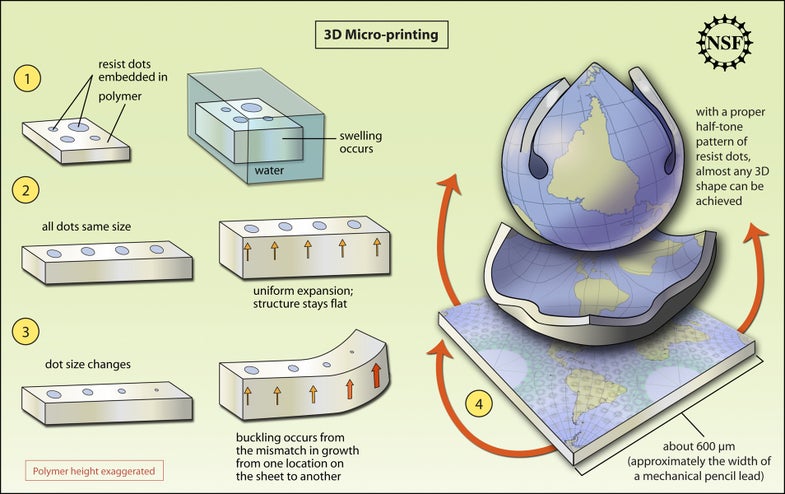
A flower petal, a heart and a caterpillar are all feats of self-engineering, morphing and deforming their soft tissues into a specific shape without the help of any scaffold or control framework. Their cells swell and stretch during the growth process, and the rest of the structure changes shape accordingly. For the first time, engineers have figured out how to induce this action in sheets of synthetic gel, creating self-curling and folding structures that can contort on command.
The new method, called halftone gel lithography, could someday be used in anything from soft robots to tissue engineering, researchers say. It’s like a new method of 3-D printing — call it 3-D curling.
Ryan Hayward, Christian Santangelo and colleagues at the University of Massachusetts Amherst worked with ultrathin sheets of an elastic polymer that shrinks when it’s heated. They spread a 10-micrometer-thick layer of polymer onto a substrate, and exposed patches of it to ultraviolet light. The light-exposed portions become crosslinked polymer chains, while areas that were masked will swell and expand when they’re exposed to water. This selective swelling causes the whole sheet to warp and buckle, mimicking the concept of cellular swelling that drives the growth of soft tissues. To start again, just dry out the sheet.
The authors created several shapes using this method, including spheres, cones and saddles. They were able to control the buckling and the shapes by controlling the light exposure, which they did using various sizes of photo-masks. The method can turn a two-dimensional sketch into a three-dimensional object. It could even work with a variety of materials — with electroactive polymers, for instance, you could send a current through some portions of a polymer and not others, forcing it to bend and contort. The research was published last week in Science.