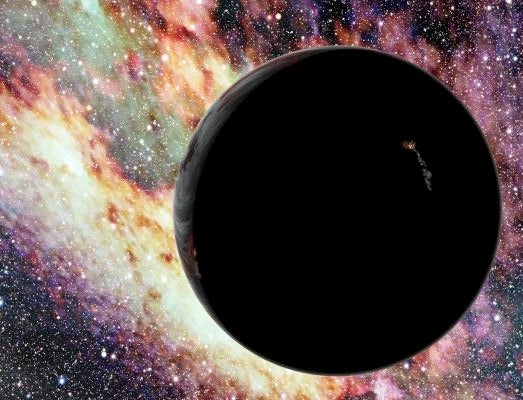
Runaway Planet! David A. Aguilar (CfA)

Astronomers have long known that when binary star systems wander too close to a supermassive black hole under the right conditions, they can be torn apart in such a way that one star is pulled into orbit around the black hole and the other is violently ejected outward, sending it speeding out of the galaxy and into interstellar space. Now it turns out individual planets can suffer a similar fate--and when they do, they can do so at up to 30 million miles per hour, making them some of the fastest-moving objects in our galaxy.

New research coming out of the Harvard-Smithsonian Center for Astrophysics and Dartmouth College shows that these “hypervelocity planets” are the fastest moving objects leaving our galaxy with the exception of subatomic particles. Typically they would be traveling 7 to 10 million miles per hour, but under certain conditions they might be spun out of the galaxy at much higher rates of speed.

The planets get kicked out of the galaxy when their stars do. The team modeled a binary star system approaching a black hole, with each star hosting a couple of planets. They found that in an instance where the star system is torn apart and one star is kicked outward, that star can take its planets with it. They also found that planets orbiting the star that doesn’t get booted from the galaxy still might be jettisoned from the galactic center at high speed.

Astronomers still haven’t seen one of these planets, because they would be dim and moving really, really fast. But if a planet started out in a very close orbit to its star and its star got the boot, it could remain in orbit around that star even as the star makes a beeline for intergalactic space. That means it’s feasible that astronomers could spot the planet transiting its star, the same way they spot exoplanets orbiting other stars in the galaxy.

19 Comments

This is ripe for all kinds of Sci-Fi stories.

But can they make the Kessel Run in under 12 parsecs?

Mh, not that fast only 10 times as fast as we are moving ... how would it feel to us, gravity wise, if we would be on it?

That's 44,000,000 ft/s... now that's moving!

---
In space, no one can hear a tree fall in the forest.

@david_forbus

Ever see "When Worlds Collide"?

A planet his earth at that speed and they won't even be able to find a dust spec afterward wow. That's what you call being cremated!

What if instead of a binary star system, it was another black hole? Now that is an impact I can't begin to fathom

~There's a difference between impossible and ridiculously unlikely

Hmmm, crazy perspective their gizmowiz!
What if a black hole did go rogue and was moving at extreme speed across the cosmos eating and growing in its travels! Now that is a science fiction horror flick!

At least solid object as they collide would become smaller bits. A rogue black hole would grow larger as it gravels growing in gravity too. It be one large pendulum and maybe at the end of a swing, it travel the opposite direction in the cosmos being bigger and eating more. Eventually this monster would eat all the cosmos itself in it pendulum swings!

.............................
Science sees no further than what it can sense, i.e. facts.
Religion sees beyond the senses, i.e. faith.

30 million miles an hour? That's from the sun to the earth in 3 hours! If something going that fast were to approach, I doubt we would see it in time.

@ cholin3947; I thought Belarus and Zyra right away as well.

An excellent sci-fi story with this theme is "Do Not Go Gentle" by Mark Millstorm (Amazon).

Works out to about 4.5 % of the speed of light.Not shabby.

BoronMoron / Robot

Since a black hole has much more mass then a planet the same force would accelerate is much less.

Our sun is orbiting our galaxy at 500,000 miles per hour. I see finding one of these planets going through our neighborhood and catching a ride on it. Colonizing a fast moving planet would help insure human genetics is spread throughout our galaxy. We would have all the raw materials on the planet to sustain a colony for millions of years.

Nine years ago on Space.com board I suggested about hitching a ride with the fast wondering star that will be paying us a visit within 1 million years from now, astronomers also claimed that it will to be passing as close as 1 light year from our sun. Living on a planet from the fast wondering star would be a great way to colonize other solar systems on our way through our corner of the galaxy especially if we are hitching a ride from an energy rich star, that is if we don't kill ourselves first....

Ron Bennett

Gliese 710 is the name of the star that is coming our way it will pass within 1.1 light years from our sun. Gliese 710 is currently 64 light years away traveling towards us at apx. 50,400 kilometers per hour. To find an extra-solar planet like earth in a habitable zone rbiting it would be cool however the problem is I want be around to see it happen...

Ron Bennett

You all realize this was all mathematical models and no observation?.....much like most of cosmology.

cholin3947,
My comment above was of a science fiction fantasy moment. Still it seems as we observer deeper into the cosmos and with more detail, we are always surprise to the extreme varieties we find every day. The old phrase, "Anything is possible!” seems always to be proved true as we observe the cosmos or the tiniest details of the elements! The only limitation seems to fall on us the observer!
AMAZING!

.............................
Science sees no further than what it can sense, i.e. facts.
Religion sees beyond the senses, i.e. faith.
Open your mind and see!

@ rlb2: I definitely agree that Gliese should be getting more study than it has been, that's for sure. Each thing we turn away from there is something we could be learning from. The thought of building a station from which to engage in a colonization attempt is appealing, but as it's a fast mover it's a one-way trip with no other payout. Ya can't just go throwing out the profit motive here, Ron. If you do, we might end up with world peace or something. That's downright unAmerican.


June 2013: American Energy Independence

Five amazing, clean technologies that will set us free, in this month's energy-focused issue. Also: how to build a better bomb detector, the robotic toys that are raising your children, a human catapult, the world's smallest arcade, and much more.


Online Content Director: Suzanne LaBarre | Email
Senior Editor: Paul Adams | Email
Associate Editor: Dan Nosowitz | Email
Assistant Editor: Colin Lecher | Email
Assistant Editor: Rose Pastore | Email

Contributing Writers:

Kelsey D. Atherton | Email
Francie Diep | Email
Shaunacy Ferro | Email

circ-top-header.gif
circ-cover.gif
bmxmag-ps