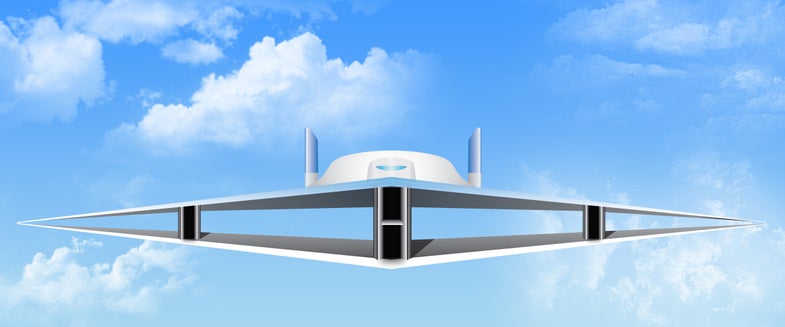
When supersonic travel inevitably returns to the skies, the airplanes are going to look a lot different. At least one design harks back to the early days of aviation with a biplane design, rather than a sleek delta-winged jet like the Concorde. This shape can apparently produce much less drag and therefore much less noise at supersonic speeds, MIT engineers say.
The decreased drag would make a supersonic biplane more fuel-efficient and it would produce a quieter sonic boom, because the shock waves propagating toward the ground would be canceled out. The trick is getting it to fly.
A German aviation engineer named Adolf Busemann came up with this idea in the 1950s, according to MIT. His design called for triangular wings, with the top and bottom pointing toward each other. As MIT News explains it, this design would cancel out the shock wave produced by compressed air as the plane moves toward Mach 1 speeds. But this quieter biplane could not fly — the gap between the wings would limit the amount of air passing through, causing incredible drag.To improve on this design, MIT engineer Qiqi Wang and his colleagues designed a computer model to test the biplane at various speeds and with 700 different wing configurations. With a smoother inner surface on each wing, the air channel could be widened. By adjusting the top edge of the high wing and the bottom edge of the low wing, the plane could fly at supersonic speeds with half the drag of the Concorde, they found.
Next, the team plans to design a 3-D model of this conceptual plane to test it for real. A Japanese team is also building on Busemann's designs, according to MIT — so the field could see a development boom in the coming years.
[MIT]
Five amazing, clean technologies that will set us free, in this month's energy-focused issue. Also: how to build a better bomb detector, the robotic toys that are raising your children, a human catapult, the world's smallest arcade, and much more.


Online Content Director: Suzanne LaBarre | Email
Senior Editor: Paul Adams | Email
Associate Editor: Dan Nosowitz | Email
Assistant Editor: Colin Lecher | Email
Assistant Editor: Rose Pastore | Email
Contributing Writers:
Rebecca Boyle | Email
Kelsey D. Atherton | Email
Francie Diep | Email
Shaunacy Ferro | Email
starting to look more and more like a star destroyer. Star Wars here we come!
Compare for yourself:
http://www.stardestroyer.net/mrwong/wiki/images/2/2b/Chimaera.jpg
I'm not against re-evaluating some of the old designs but I think this one should be kept in the past.
Look at the tradeoff, an extra wing would mean a heavier aircraft. Sure you cut the drag, but what do you lose in return fuel economy getting up to supersonic speeds, how far will you have to drive this thing in subsonic speeds before you can get up to sonic speeds?
Any variation in the wind during flight may change the dynamics of the flight, meaning simulation is one thing but real world crosswinds and turbulence will change the airflow over the wings on something that may happen only once over thousands hours of flying.
Ron Bennett
"The Supersonic Jet of the Future Will Be a Biplane"
I would say this is a little premature considering that this design has not yet seen the inside of a wind tunnel.
How do you figure Ron? Each of those wings top and bottom generate lift, and the more wing surface area the more efficient.
Your statement is similar to saying 747's huge wingspans are inefficient because the extra weight weighs them down.
In actuality the more lift generating wing area you have the better in terms of efficiency at subsonic speeds. Additionally this still maintains a delta wing shape, which is optimal for reducing drag. Im betting if this was put into a wind tunnel it would be efficient at subsonic speeds.
As for how it handles in the wind, they are extremely accurate simulators which are easy to use for simulating strong wind conditions in any direction (I don't know if they have been used for testing this plane but it could be accurately simulated).
I have drawings I made a while back for a RC plane prototype which is almost exactly like this in addition to being VTOL. I never started it though.
There is 1 problem the article does not address with this design... the distance of the top and lower wing. I cant recall the name of it, but there is a formula for calculating the minimum distance between top and bottom wings in a bi-plane in order for both wings to generate lift. The inner section may be the only place that the bottom wing will be able to generate lift, and there could be all kinds of wonkiness in its flight characteristics. If they made the two winds parallel, it would be more efficient, but look far less cool.
I'm wondering if triangular wings mentioned is referring to a delta wing format or if it is referring to a supersonic airfoil....I'll assume a delta wing.
@ Ron - There are actually several benefits to the biplane design. Primarily, for a given total width you get double the lifting surfaces.
The crosswind that you speak of is extremely easy to account for in flight. In fact, subsonic aircraft would have more issues with crosswinds than supersonic because of the shockwave that is created in supersonic flight. I agree that the turbulence that is present during trans-Mach conditions is very hard to model (that is actually part of my job) but once they reach supersonic flight it is considerably easier to model.
@ gathem - I can't say for certain, but at a glance i would say the wings not being parallel is either an effort to control wingtip vortices on the lower wing at subsonic speeds or an additional way to reduce the noise. With two separate wings like you are saying, there would be separate shockwaves at the wingtips and if someone were to be in the path of the shockwaves meeting it would basically double the pressure difference. It is kind of like atomic bombs detonating about one thousand feet above the ground. Doing this effectively makes two shockwaves (one primary and one reflected) intersect at ground level and increases the pressure difference.
Also, reduced drag on a delta wing is not technically true. The improved performance comes from being able to keep the wing leading edge inside the shockwave produced by the nose at supersonic speeds. This causes the airflow over the wing to be subsonic and produce lift. To me, the main benefit of a delta wing is an extremely high stall angle.
Remember the history lesson: the biplane planform postulates that the total lift being generated results in a shorter wingspan than if the wing were one long unit. That was important to WW1 aircraft because of the limited strength of materials available to them.
Creating semi-symmetrical laminar-flow wings at a certain spacing might produce a venturi effect that could be extremely beneficial. Coupled with connected wingtips to reduce vortices (less drag plus increased strength) and the concept has a lot to recommend it, particularly at subsonic speeds. The interaction of the shock waves at supersonic speeds for each wing was addressed in this study and resulted in the configuration presented.
Interesting conversation I will be back later to reply more in detail.
Ron Bennett
Im guessing the cabin would have to be shorter than conventional planes, but they could add seats by having multiple levels, or just jack the price up making it a 'high speed luxury liner' but that is less likely.
@ron~ thats a great attitude to have. If you don't know enough to provide valuable input you want to research & find out more. Curiosity is a good quality
Well how about 4 wings? With piston engines 4 is always better than 2 why not airplanes? Just a thought.
Shape a plane like a box kite! 4 sides to cancel each other out!
gathem wrote - Your statement is similar to saying 747's huge wingspans are inefficient because the extra weight weighs them down.
Ron's reply - Careful, I worked on the 747,757,767,777 before leaving Boeing. A 747 wing weighs over 100,000 lb. A 747-8 freighter wings maximum take-off weight is pound 975,000 lb fully loaded, that's a lot of lifting however 10 percent of that lifting is taken up by the wings. From all I read about biplane wings is that they are inefficient, not the other way around or else we would be flying biplanes today. It is just a novelty some engineer's revisit's every year at grad school. I do like the flying wing, that's a whole different story than the bi-plane...
gathem wrote - As for how it handles in the wind, they are extremely accurate simulators which are easy to use for simulating strong wind conditions in any direction (I don't know if they have been used for testing this plane but it could be accurately simulated).
Ron reply - The 777 was the first aircraft completely designed in a CAD Cam system, CATIA, the model went through computer generated program wind tunnel test with flying colors, and when it flew for the first time it was as the simulator predicted, however the wing design wasn't anything revolutionary it had many past years of actual flying data that made the program that we used reliable the biplane has very little data to go by to make a simulator program out of. Is the MIT engineering student smart enough to create one. While he is at it why doesn't he design one for the lifting body, we like them for their efficiency for 50 years yet we don't see any of them flying overhead today.
Raim wrote - subsonic aircraft would have more issues with crosswinds than supersonic because of the shockwave that is created in supersonic flight
Ron's reply - That's what I was referring too, laminar flow can be more dangerous than turbulent flow.
Raim wrote - There are actually several benefits to the biplane design. Primarily, for a given total width you get double the lifting surfaces.
Yes but it isn't equal, in reality the wings aren't as efficient from all I read about them.
DMorrisPE - good stuff.
I hope them all the best and I don't want to look like the negative boogeyman and demean peoples effort for trying something new, that's what the innovating spirit is all about, trying something new...
BoronMoron - thats a great attitude to have. If you don't know enough to provide valuable input you want to research & find out more. Curiosity is a good quality
Ron reply- thanks but my wife was nagging at me to go to the store, I had to leave or else I would be hearing about it for several more days. She's back...
Ron Bennett
@Ron the bi planes of the PAST were not very efficient. You as someone that has worked on planes should take note that with these bi planes as the article states at supersonic this plane will have HALF the drag of the concord. Therefore the fuel efficiency will be boosted (at least in SS). But at the same time, why are they building this plane. The only purpose seems to be getting a quieter supersonic plane
Yet another PopSci story giving MIT credit for the work of others. When will we learn that MIT is better at marketing than they are at engineering?
This looks like the perfect plane for "BATMAN!"
nananananana BATMAN!!!!!
.............................
Science sees no further than what it can sense, i.e. facts.
Religion sees beyond the senses, i.e. faith.
@Jaydawg121
Next thing you know they will be making a X-wing fighter from star wars. Now that would be cool
@ Ron - I'm finishing up my aerospace engineering degree so sorry if I have any mistakes in my statements.
In the past biplanes the primary inefficiencies came from the parasitic drag that was present in the wires and supports for the wings as well as interference between the wings. I can't remember the exact number but at a given subsonic speed the drag could be increased somewhere between 30% and 50% from the wires and struts alone.
As for the wing interference, it was lessened by introducing a forward stagger into the configuration. However, this interference is applicable at subsonic speeds. Without knowing the exact angle of the wings and the speed they want to fly at I can only guess about what will actually happen to this with the introduction of shocks.
I did read in another article that the current concern with this design is choking in between the wings, which means to me that the inner shockwaves from each wing are interacting (I could be wrong). Before I say anything else that is completely wrong, I'm going to go home and look through my fluids book :P
Ummm.....sonic boom is only part of the noise problem. Has anyone solved the takeoff noise problem? Actually this is the show stopper. If you study the High Speed Civil Transport (HSCT) work of the late '80s and early '90s at NASA, you will see this is a formidable problem.
Let me know when someone comes up with an engineering (re: viable) solution to make very high pressure ratio and low by-pass ratio engine quiet at takeoff. Doesn't have a chance at Stage 4 cert.
I wonder how this plane appears in radar? Is it naturally stealthy or just the opposite and glows like a fire fly on a radar screen; should this plane ever leave the blue prints that is.
.............................
Science sees no further than what it can sense, i.e. facts.
Religion sees beyond the senses, i.e. faith.
Raim wrote - I did read in another article that the current concern with this design is choking in between the wings, which means to me that the inner shockwaves from each wing are interacting
Ron reply - Good luck on the engineering degree, I have three of them, I'm still trying to figure out what I want to be when I grow up.
The above statement was my first concern, which would be a major concern of most aaerospace engineers. What happens to the airflow in between the wings such as in an updraft, which happens a lot at airports especially when you are landing. Besides the air flow rate and type the biplane wings have high pressure on the bottom wings, low pressure on the top wing's and an entirely different airflow problem in between. That's only one of the many different variables you will have to deal with when you fly this thing such as what happens when it flys through a wake, a downdraft, icing, etc, etc.
I wish them a lot of luck, a new design like the old record setting flying machine like the biplane means a whole new set of variables.
Ron Bennett
@ rlb2; Hi, Ron. I've done far too much work in my life on projects where people said it couldn't be done to ever believe that certain limiting conditions could never be accounted for and counteracted with ingenuity and dedicated perseverance. Having said that, it seems to me that the craft might be better served with something more akin to multiple airfoils than the triangular concentric wing configuration. But that's just me, and something to be considered if the configuration they've chosen doesn't work in their simulator. Now, having said THAT; a couple questions. While we all know that Boeing is primarily a commercial concern, the fact is that they do a large amount of education and educational assistance for many programs around the world, with two of the larger areas of assistance being in top-grade simulator time and design. My first question is; do you think Boeing would be unsuccessful if the U.S. government threw them this job on a plate? My second question is; just how many of the known war era German designs have been shown to have NO worthwhile explorable elements? Is that some kind of 'mark of approval' from me? Not at all; but when we know that these war era brilliant designers were often working with German gun to unwilling head, and them knowing their only chance at continued life was continued success, then I gotta say that there are PLENTY of fantastic advances that came from what humans learned from just building one of the damn things. We can't model everything yet, and you full well know it. We don't have endless substitution and comparison capability and even if we did, the capability of the fluid environment of air travel to show us something new is also still very real. While I have only worked on one airplane one time, I know that it has never taken long on any job I've ever done for those around me to begin doing things in new ways and advancing that job. On the outside, someone looking at my career might easily look at the hard value of the mainline work I've performed as the 'fact of the matter'. But the true fact is that I only worked and slaved to get the respect of my peers to be able to do what I REALLY DO, and that is acting as a catalyst for change, with improvement being my goal. I am almost never satisfied with the things around me, and I don't think the young people at MIT should be either. Give em their props, Ron. These kids might show us a whole new trade.
When I was a kid I worked on cars, tearing engines, transmission and carburetors apart and reinstalling them back into the car, I even rebuilt engine's, carburetors, that should tell how old I am. I have the greatest respect for what mechanics do and other people who specializes in their trade, because I've been there. I do know some arrogant engineers who don't even know how to put oil in their car yet try to school other people on their craft, so I can understand why you said what you did.
I don't like people telling me I can't do something when I think I can. You know if these new young engineers are like me they will find a way to make this work, it's not going to be easy, maybe all it will take is a certain coating on the inside of the wings or properly placed winglets that will assure a better airflow, etc, etc. The satisfaction of saying I told you so will be reward enough for them when they succeed when others tell them they can't do that.
Ron Bennett
Ok, not one person here has a clue about aerodynamics it seems.
RB2 has 3 degrees and is still clueless and yet opens his mouth. Brilliant. No wonder you are still in school. Do everyone a favor. Stay there.
Biplane will be great for landing, though maybe not as the small wing area required for supersonic flight will still mean a small area wing. Even with 2 partially efficient wings. There is no minimum distance for a biplane. They do get less efficient the closer they are together. Its gap to chord ratio at subsonic flight that guys up thread were thinking of. Essentially for non compressed fluid flow, aka, below 200mph or so, a Gap to chord ratio of 2 will achieve 85% efficient wings. Of course that depends on the coefficient of lift generated. The lower the CL, the higher the efficiency and conversely the higher the CL the greater the G/c ratio needs to be.
It will suck in the transonic region as its drag will be enormous. Its parasitic drag/profile drag will be enormous. The whole point is for supersonic flight. At which time there is no vortices formed by the wings to all of you ignorant posters up thread so the biplanes advantage here vanishes. The only reason they are looking at the biplane is that the shock waves cancel creating a quiet plane. Smaller shockwave = lower drag. Its the shockwave at supersonic that is the drag killer. That and profile drag. This will require very thin wings. Good thing its a biplane design meaning that its section modulus and rigidity will be extremely high unlike a normal airplane. This means it has the possibility of maintaining its gap ratio so the top leading edge wing creating the MAJOR shock wave will hit exactly at the nodal point of the shockwave from the bottom wing and hopefully canceling or muting it. Here is the rub though, shock wave angle is HIGHLY mach number dependent.
So, your top wing would have to MOVE to compensate for differing mach numbers. Or, they will have to fly ONLY at one altitude(pressure) and speed. How wide is that bucket? Flying isn't perfect. Low pressure systems. High pressure systems will change this "bucket" at which said biplane can fly. Therefore said airplane will have to be able to change altitude as well. Now maybe they design it so it flys HIGH(very likely) say 60,000 feet so it is not in standard civilian transport airspace and solves this problem. Still doesn't solve it but mitigates it.
The real question is it even economical to try and put so many engines on this plane that it is actually able to get through the transonic region. It will require FAR more power, especially as its a biplane, in this region than a "normal" single wing plane. So for the noise problem it could be that said engines would be running at only partial throttle at take off as such a plane will be so enormously overpowered to get through the high drag transonic region compared to its take-off needs. It could be they just go for a large turbofan with a variable opening taking the penalty in parasitic drag.
Said biplane is no free lunch. It has enormous problems and only helps "solve" the noise problem, if this is even true as stated in the article. Reduction by 50% sounds like a ton, but then figure on all the extra drag required for said biplane to begin with then add practicality on top of this and its probably an even toss.
This means it might be possible for supersonic flight at Concorde prices. It certainly won't be cheaper.
ohh i've read this that Researchers at the Massachusetts Institute of Technology (MIT) and Stanford University have resurrected Busemann's biplane using the latest advances in aerodynamic modelling and simulation
http://airsoc.com/articles/view/id/4f74699cc6f8fa924b000004/researchers-hone-supersonic-biplane?ev=10&evp=tl