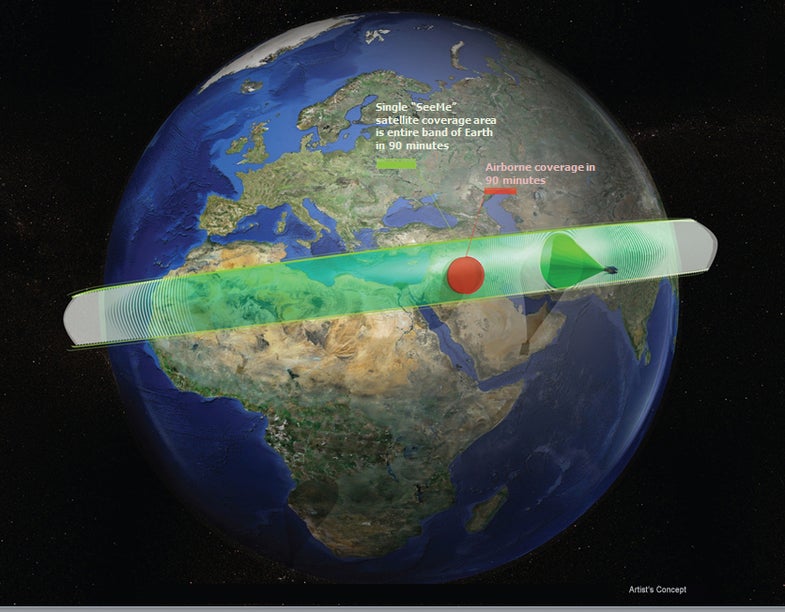
SeeMe Satellites The SeeMe program would give warfighters the ability to receive timely imagery of their specific overseas location directly from a small satellite, all at the press of a button. DARPA

Warfighters have plenty of eyes in the sky, with a massive drone fleet and a satellite network that can spot their locations on the ground. But satellites are only helpful when they’re overhead, and battlefield situations can’t wait for orbital physics. To solve this problem, DARPA wants a swarm of cheap satellites nestled between the big ones up above and the aerial drones down below. The satellite swarm would be positioned in tactical orbits and able to send a space-based image back to any individual who wants a picture.

The SeeMe program (Space Enabled Effects for Military Engagements, hooray for meaningful acronyms) would use a smartphone or tablet to send a command, according to DARPA. A soldier or marine would press “see me” on a handheld device, and a satellite above would find the person and send back an image within an hour and a half. DARPA is seeking proposals for these satellites from the mobile phone, optics and racecar industries, which could have some ideas about low-cost manufacturing, imaging and propulsion.

The SeeMe fleet would consist of a couple dozen satellites, costing no more than $500,000 apiece, according to Dave Barnhart, DARPA program manager. They would have to sweep around the Earth in a specific pattern to provide planetary coverage, and would be situated at low orbital altitudes. They would last just two or three months before re-entering the atmosphere and burning up.

Conveniently, there’s another DARPA rapid-launch satellite system, the Airborne Launch Assist Space Access (ALASA) program, which aims to launch lightweight satellites from aircraft into any required orbit. The SeeMe swarm could take advantage of this new system.

“SeeMe is a logical adjunct to UAV technology, which will continue to provide local or regional very high-resolution coverage, but which can’t cover extended areas without frequent refueling,” Barnhart said.

[DARPA via New Scientist]

8 Comments

Since they may be launched from aircraft, these satelites are likely to be aerodynamic. So when a satelite is nearing its use-by date, just find a convenient dictator or underground nuclear facility to drop in on.

well it fits our pax americana, "don't fight or we'll bring democracy to you"

to mars or bust!

Talk about a waste of tax dollars. Lets throw away 6 million plus dollars every 2 to 3 months, not counting launch fees.

Sounds like there will be more space trash to clean up. I am going to have to add coverage for falling space junk to my fire and flood insurance. That is a lot of money to let burn up in the atmosphere every couple of weeks.

AdamWM,
Interesting side note on comments space junk ' oh, do not worrry, it will just burn up in the atmosphere...'. Ok, so there is 1 to ka-jillion chance you will be bonk in the in head, no worries.

What about all those toxic, exotic things that are in satelites, metals, chemicals, plastics, nuclear energy sources? Now as it burns up, we get to breath this as dust and gas!!!!!!! And as you get sick and not know why some years in the future, who can you blame, no one? And all the doctors will be baffeled to your illness, too.

Just consider the chemical Dioxins! There was a time in USA history as dioxin was being used, it was thought completely safe. http://www.ejnet.org/dioxin/

They spend millions and millions of dollars to be the best of best exotic technology in outerspace years ago and present. All that technology from years ago is space junk now.

Why is it presented to the American public that if something burns up it is gone? When something burns up is it really ever gone or does it change form and into what?

.............................
Science sees no further than what it can sense, i.e. facts.
Religion sees beyond the senses, i.e. faith.

@hollycow

Maybe to you, but I'd be willing to pay for them. At least the money is being used for something instead of nothing.

We are going to need a steady stream of satellite replacements as time goes on anyway. No way is our government going to ever allow for less than full saturation sensory capability on LEO. Raw numbers of small sats ensures against overwhelming antisat attacks. If we make them launch from planes, it will keep costs down to the staggering profits typical of US government cost-plus operations. It really makes me think about US and China though. In less than 15 years, China will have attained their rough share of global airspace saturation, planeswise. The implications of what we are running headlong into as lines of contention are increased in number even as we are aware of the raw number capabilities that are staring us in the face in every conceivable arena make me think that we might be better served without creating more areas of contention than we are NOT going to be prepared to defend or keep secure. If we were talking systems that will lead us into a non-carrier wave based sentinel apparatus that can't be raided or jammed; then I'd say we were aiming at a more useful tool for the future.

Satellites in low Earth orbit are solar powered, so no bikes. They would most probably only be launched on an "as needed " basis. They could be boosted with any high performance fighter and have a solid fuel secondstage.


June 2013: American Energy Independence

Five amazing, clean technologies that will set us free, in this month's energy-focused issue. Also: how to build a better bomb detector, the robotic toys that are raising your children, a human catapult, the world's smallest arcade, and much more.


Online Content Director: Suzanne LaBarre | Email
Senior Editor: Paul Adams | Email
Associate Editor: Dan Nosowitz | Email
Assistant Editor: Colin Lecher | Email
Assistant Editor: Rose Pastore | Email

Contributing Writers:
Rebecca Boyle | Email
Kelsey D. Atherton | Email
Francie Diep | Email
Shaunacy Ferro | Email

circ-top-header.gif
circ-cover.gif
bmxmag-ps