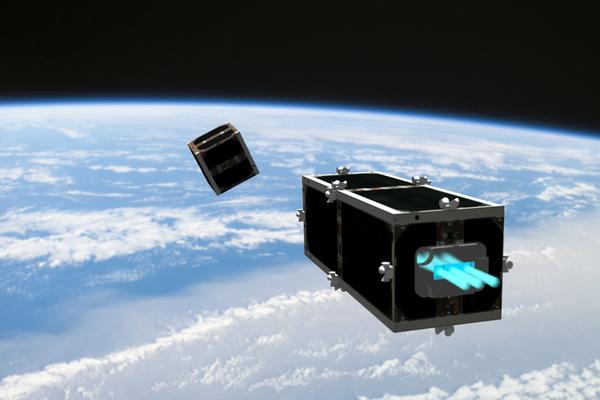
CleanSpace One, Chasing Down a Cubesat EPFL

The growing space junk problem in various orbits around the Earth gets plenty of ink these days, particularly when the ISS has to fire its thrusters to dodge a piece of a satellite, or when a defunct satellite smashes into a perfectly good, multimillion dollar piece of orbital communications hardware. Gathering up and disposing or all that fast-moving refuse makes for a difficult problem, but over at EPFL in Switzerland a team of researchers is developing a new kind of micro-sat that could help clean up low Earth orbit, starting by disposing of Switzerland’s own leftover space debris.

CleanSpace One is a project aimed at building a prototype for a family of satellites that would chase down and capture small pieces of orbital debris. NASA is currently tracking some 16,000 pieces of junk larger than about four inches diameter, but the agency estimates there are many more times that ripping around the planet at orbital speeds (call it 17,500 miles per hour).

Each one is a disaster waiting to happen; orbital debris threatens satellites, spacecraft, and astronauts moving within and through its orbit, potentially costing lots of money or even human lives. All kinds of proposals for dealing with the problem--everything from trash collecting satellites to ground based lasers that would zap orbital debris from the sky--have been put forward, but so far nothing has gained traction. EPFL (that’s the École Polytechnique Fédérale de Lausanne) hopes to change that.

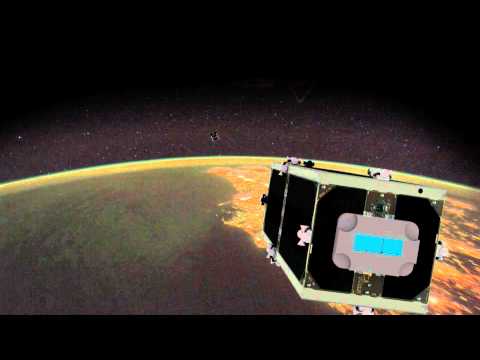
CleanSpace One would not be a massive trash-collecting satellite, but a tiny trash-chaser designed to destroy exactly one piece of debris. The first target will be one of two small Swiss picosatellites launched in 2009 and 2010 that are still in orbit up there though their scientific missions are done. CleanSpace One would track down one of the satellites in its orbit, latch onto it with some kind of gripper, and drag it back into Earth’s atmosphere where both would burn up on re-entry.

Simply doing so would require some key technology pieces, both of which EPFL is working to develop in-house, possibly employing a new brand of super-compact space motor currently in the lab there. It will also require some kind of gripping mechanism that can secure the targeted piece of debris and drag it downward.

Of course, at 10 million Swiss francs (that’s about $10.8 million) it seems like an expensive way to capture small pieces of orbital trash. But the idea is to develop a suite of technologies and then a family of satellites designed purely to clean up orbit. Economies of scale and putting many of these small debris chaser on a single launch could drastically drive the cost of deployment down. Get a full rundown of the problem and the EPFL program below.
[EPFL]

12 Comments

Hopp Schweiz!

While this is a solution of Switzerland Satellites, would it be allowed to capture old satellites of other countries?

I believe there are those paranoid countries that would want to keep their secrets of their own broken down satellites and do not want USA or other countries grabbing onto their broken satellites, even to clean up outer space orbits.

.............................
Science sees no further than what it can sense.
Religion sees beyond the senses.

It would be correct to issue some kind of worldwide convention that every company that send a sputnik to the orbit should be responsible for bringing it down.

.............................
Sorry for the off-topic, couldn't help it:
>Religion sees beyond the senses.
Religion sees what science call "imagination".

-TC- Its a good idea, but a reusable satellite would work better. id imagine a large sat with small ion thrusters that can redirect itself. A grabbing mechanism obviously, then a catapult to launch the unwanted trash into sub orbit(launching itself back up slightly) then move on to the next piece. would take time but get the job done efficiently

very admirable and typically swiss to clean up after themselves. However I would have thought that they would go for a solution that employs some sticky chocolate or hot cheese. Just grabbing it seems to be out of character, unless of course a banker was involved in the design

Of course, if we *do* get a disastrous amount of orbital debris, it would be a great excuse to develop space shields and armor for protection and eventual human/human or human/alien war.

I like Titanium's grab it and throw it down approach.

I am also thinking that having a semi-permanent blasting station in orbit could be considered. Put it up "above" most space junk, maybe around an altitude of 500-600 miles. That should be high enough to look "down" on virtually all the space junk. Then it can use a powerful laser to easily target each piece of junk. Use solar panels and/or small nuclear for power (if nuke, make sure it has enough propellant to send the nuclear fuel at the sun when its mission is over or its laser is no longer functional). Like some earth-based laser concepts, it would shoot the piece of junk with a laser powerful enough for a small piece of the metal/material to start to vaporize. This would in turn exert a force (ideally directed opposite the earth) on the junk, pushing it into a lower orbit or slowing it down. Thus speeding up vastly the amount of time before it re-enters.

If you put the laser in space at 500-600 miles, you'll actually be just as close or closer to most of the junk you want to shoot anyways. Plus you won't have to worry about clouds or atmosphere or humidity redirecting/diffusing the beam. It will be easier to target, control.

YEY, We need to clean up all the junk...in space, and on the earth.

Check out the following article in Space Review: http://www.thespacereview.com/article/2020/1

Grandpa

I thought of how the problem of a macro matrix like the ocean is approached..and then thought of the multimile space tether experiment.. Even though the tether failed the stress test and snapped ( and even had famous or infamous ufo photo phenomena recorded with the incident. however , I thought of a method of deploying a huge net to catch lots of junk..but then interpolation of the debris would be critical but disbursing the net would be feasible at least with multiple guided NDD'S or net dispersal drones to push or pull the net to proper dimensions . avoiding the good satellite's are another problem? details! always with the details...back to the slide/rule..'The bar tender slides Me a cold one..'A`Hemnn..It RULES>>exponentially~|~(:{)>Your's (((OO)))OMNIBUS1

How is it You look so familiar "GRAMPA DAVE"? My Mother inlaw maybe?..(((OO)))OMNIBUS1


June 2013: American Energy Independence

Five amazing, clean technologies that will set us free, in this month's energy-focused issue. Also: how to build a better bomb detector, the robotic toys that are raising your children, a human catapult, the world's smallest arcade, and much more.


Online Content Director: Suzanne LaBarre | Email
Senior Editor: Paul Adams | Email
Associate Editor: Dan Nosowitz | Email
Assistant Editor: Colin Lecher | Email
Assistant Editor: Rose Pastore | Email

Contributing Writers:

Kelsey D. Atherton | Email
Francie Diep | Email
Shaunacy Ferro | Email

circ-top-header.gif
circ-cover.gif