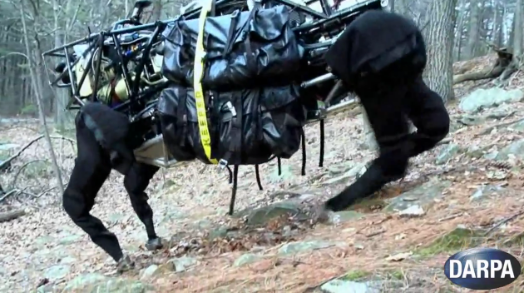
Here at PopSci, we’ve been fascinated by Boston Dynamics’ Big Dog ever since it was an adorable robotic puppy that couldn’t even open its eyes. Now that the technology is all grown up, repackaged, and rechristened the Legged Squad Support System (or LS3), its eyes are very much open--and fixed firmly on the soldier in front of it. The new LS3 prototype has just undergone its first outdoor exercise, demonstrating the ability to “see” its surroundings and distinguish between objects and humans.
Over the next year-and-a-half, DARPA plans to prove out LS3’s technology and get it ready to support warfighters in the field. Its main battlefield role will be little more than that of a robotic pack mule, carrying hundreds of pounds of gear so that dismounted Marines and soldiers won’t have to. These days, a lot of that weight is batteries, and here LS3 provides a two-fer: Not only can it carry troops’ various batteries and battery powered handheld devices, but it also serves as a mobile power source that can recharge them on the move.
The idea here is to create an animal analog--something that can haul lots of gear over rough terrain and interact with personnel naturally, in a way that is intuitive to the soldiers and Marines around it. In addition to its “eyes,” DARPA wants to give it auditory sensors that can respond to simple voice commands like “come” or “stay.” And ongoing tests aim to refine the vision system so it can distinguish between humans and learn to track specific individuals.At the end of the 18-month proving period, LS3 will embed with Marines conducting field exercises to see how it gets along in real maneuvers. Here’s hoping those Marines don’t require the element of surprise. As you can see below, LS3 can see and move better than ever, but it is still very, very loud.
[PhysOrg]
Five amazing, clean technologies that will set us free, in this month's energy-focused issue. Also: how to build a better bomb detector, the robotic toys that are raising your children, a human catapult, the world's smallest arcade, and much more.


Online Content Director: Suzanne LaBarre | Email
Senior Editor: Paul Adams | Email
Associate Editor: Dan Nosowitz | Email
Assistant Editor: Colin Lecher | Email
Assistant Editor: Rose Pastore | Email
Contributing Writers:
Rebecca Boyle | Email
Kelsey D. Atherton | Email
Francie Diep | Email
Shaunacy Ferro | Email
Of course this is groundbreaking technologically speaking but I can't help to think that they should use a real mule. Whatever.
They need to make a saddle attachment.
So much for stealth Recon, that thing is noisy as hell. Clearly running off a fuel generator. They should look at a more quite electric generator system..
Who else wants to give this a hug?
-Spouting a fountain of nonsense since 1995-
This is way too loud. It should not be much louder than humans walking on the rocks. It's sole purpose is to save lifes by providing reinforcement and shielding, but this stays this loud, no matter how much shielding it provides, 'cause everyone in a mile radius will know where the soldiers are.
wow its come a long way but has a looonnng way to go, how noisy is it at double time? Bullet proof? Mine sensing? stealthy? Good luck
-TC- Kinda reminds me of an immortal from SC2, just needs an turret attachment.
I'm sure they're planning on using batteries. They're probably developing long lasting batteries or fuel cells in parallel with this project. They're probably using a gas engine right now because it's an off the shelf part. With a project this advance, I'm pretty sure they are aware of the noise issue.
For whatever interest there may be in asking for "scientific" proof, where is the evidence this was actually reacting to the soldier's position and not being maneuvered from a distance? Then, when the time came for actual deployment, other "problems" would be announced, requiring the device not being put in service and millions more dollars being funneled into it. And is this so traditionally tactically better than a vehicle that could cover ground much faster and provide a degree of cover in case of enemy fire?
Attach a mechanical man-eating head and the Hell Hound is born!
I think we are forgetting the whole point of DARPA.
The point is to keep the US from being surprised from a defense technology standpoint.
It is easy for US experts to sit around a table and say, “that is not possible”, or “that would never work”. And then someone else builds it in a rival country. While the US is beginning the R&D phase, their rival is already fielding a finished product.
DARPA is looking 20+ years into the future and seeing which technologies are going to be practical, with the possibility that some of that tech is possible now (gravy).
Somebody asked the question: Can we make a robotic pack mule that follows soldiers on foot? It is now DARPA’s job to see what the possibilities are. The DARPA team came up with a robust and functional walking proof of concept. Next they are going to test it in field conditions.
It is not a prototype. DARPA is not a contractor. They are not looking to mass produce this thing. DARPA is going to see all the good and bad of the technology in practical terms. If there is promise there, the DOD will approach defense contractors, who would reengineer the concept to fit a specific purpose.
Even if an actual mule proves to be more efficient, this project would have been successful. The goal is to gather data, not to field a functioning prototype.
That is the dumbest thing I have ever seen:
- Can't cross a river or stream
- Is an easy target
- Requires someone trained to fix it in the field
- Can't climb steep rocky terrain
- Requires 2 or more to carry if broken or to transport across non-nogotiable terrain
Very impractical and immature technology for the field
@sybaris
all i have to say is you are a fool my man
big dog: self destruct sequence initiated...
marine: wait no i said stay!
big dog: 3....2...
@Delkomatic
you obviously have never spent a day in the field
Here's an idea lets start beating a drum ever time we move.
@sybaris
One doesn't need to spent a day in the field to realize the shortcomings of Big Dog (or LS3 as it is called now). Building robots that depend on legs for movement instead of wheels/treads are harder to build, because they need a way to keep balance during movement. In this way, the LS3 is a very mature system, in that it has had auto-balancing built into it for years.
If I wanted a drone to follow me around, and haul extra equipment and provide some type of cover for me, I'll take the Ripsaw thank you very much:
http://www.youtube.com/watch?v=tlcenWPzsUU&feature=fvst
I could see a re-emergence if cavalry just in a robotic horse version . seriously a platoon of guys moving around on theese might have a speed advantage aswellas maybee carry a couple mk-19s or 47's in