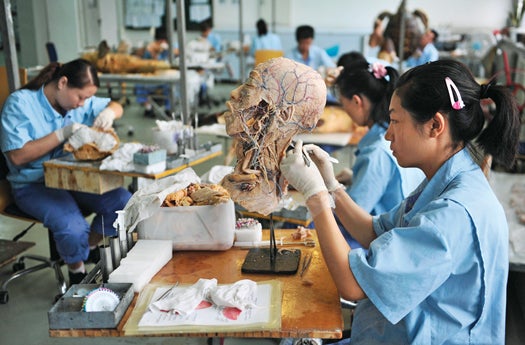
At Dalian Hoffen Bio-Technique Company in northern China, people turn other people into plastic. Plastination is a four-step process during which polymers replace water and fat molecules in biological specimens.
Plastinated bodies don’t decompose, and museums and medical schools can display them with exposed muscles, veins and brains in exhibits around the world. One such exhibit, called “Bodies,” has visited dozens of cities worldwide since it opened in 2005. Hong-Jin Sui founded the Dalian facility in 2002 after he studied plastination under the man who invented it, Gunther von Hagens. Sui says the human bodies processed at Dalian Hoffen come from medical universities and the animals from zoos and aquariums. It can take more than two years to plastinate large animals, such as whales, but humans take only eight to 12 months.

140 years of Popular Science at your fingertips.
Each issue has been completely reimagined for your iPad. See our amazing new vision for magazines that goes far beyond the printed page
Stay up to date on the latest news of the future of science and technology from your iPhone or Android phone with full articles, images and offline viewing
Featuring every article from the magazine and website, plus links from around the Web. Also see our PopSci DIY feed
The 6th annual Invention Awards are here, from an inflatable tourniquet to a better lobster trap to spring-loaded hocket skates. This issue is all about the celebration of invention.
Plus: Making synthetic biology breakthroughs in a garage, building a constantly-moving ping-pong table, and a ridiculously overpowered barbecue.
creepy?... -.- i guess not ^^
---
bored? lets go mine the stars... ^^
Wow! So now we'll be getting all of our research specimens from china? Wonder where they're gonna slap the made in china sticker at?
from Sioux Falls, South Dakota
I've actually been to the "Bodies" exhibit and it was really really interesting. They have cross sections of brains that are normal and ones that have experienced a stroke. You can actually see the dead areas. And then there is all sorts of bodies in different positions so you can see all the different ways the muscles and bones interact and then even ones that have everything washed away except the veins. Its one of those things you're almost silent and respectful because you realize that these are peoples remains you are walking around but at the same time it is fascinating. If you have the chance I would highly recommend going.
from Sioux Falls, South Dakota
I've actually been to the "Bodies" exhibit and it was really really interesting. They have cross sections of brains that are normal and ones that have experienced a stroke. You can actually see the dead areas. And then there is all sorts of bodies in different positions so you can see all the different ways the muscles and bones interact and then even ones that have everything washed away except the veins. Its one of those things you're almost silent and respectful because you realize that these are peoples remains you are walking around but at the same time it is fascinating. If you have the chance I would highly recommend going.
Fascinating! This turning bodies into plastic thing, could be a horror movie! House of Plastic?...err wait House of Wax did that sort of, LOL!
I went to a Bodies exhibit and learning about the processes they use to plasticize the bodies was the coolest part!
The polymer of long chains of fattyacids have consistency of plastic nature to operate and synthesize the different forms of human structures for study model or for shelf purpose in differnt museum and laboratories.