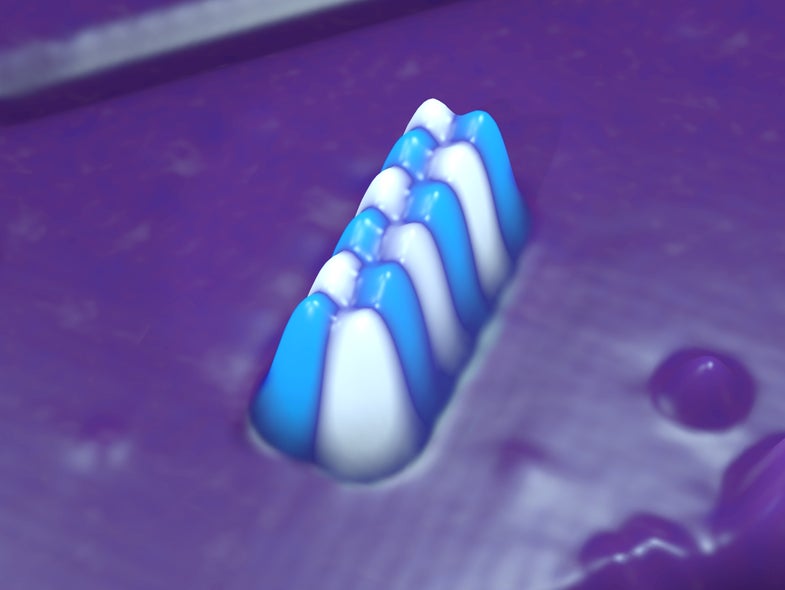
Smallest Storage Unit Spin-polarized imaging with a scanning tunneling microscope reveals the structure of the world's smallest magnetic data storage unit. It consists of just 12 iron atoms ordered in an antiferromagnetic structure. Sebastian Loth/CFEL

The world’s smallest magnetic data storage unit is made of just 12 atoms, squeezing an entire byte into just 96 atoms, a significant shrinkage in the world of information storage. It’s not a quantum computer, but it’s a computer storage unit at the quantum scale. By contrast, modern hard disk drives use about a million atoms to store a single bit, and a half billion atoms per byte.

Until now, it was unclear how many (or how few) atoms would be needed to build a reliable, lasting memory bit, the basic piece of information that a computer understands. Researchers at IBM and the German Center for Free-Electron Laser Science decided to start from the ground up, building a magnetic memory bit atom-by-atom. They used a scanning tunneling microscope to create regular patterns of iron atoms aligned in rows of six each. They found two rows was enough to securely store one bit, and eight pairs of rows was enough to store a byte.

Data was written into and read out of the bits using the STM — so it’s not like this type of bit will be integrated into hard disks anytime soon. But it answers some fundamental questions about the nature of classical mechanical systems, said Andreas Heinrich, the lead investigator into atomic storage at IBM Research Almaden and an author on a new paper describing the teeny bit. The team was interested in the transition from quantum to classical behavior, he said.

“If you take a single atom, you have to look at quantum mechanics when you describe its behavior,” he said in an interview. “As you make the (system) bigger and bigger, several iron atoms start talking to each other, and at some point you can ignore all of this quantum behavior and just think of them as a classical magnetic structure.” It turns out that point is around 12 atoms big.

“Many people would anticipate you would have to use quantum mechanical systems to describe these structures,” Heinrich said. “That was the most surprising thing to me.”

At the smallest scales, quantum effects blur stored information. A bit using six atoms would switch magnetic states — switching from “0” to “1” — about 1,000 times per second, for instance, which is much too frequently to be useful for data storage, Heinrich said. Eight atoms switch states once per second. But 12 atoms switched their states infrequently enough to be usable for storage — instead, an outside magnetic influence (in this case, the STM) changes their states. The nano magnets are only stable at a chilly 5 degrees Kelvin, or -450 degrees F.

The other breakthrough in this paper is the bits’ antiferromagnetism — this marks the first time antiferromagnetism has been used to store data. Ferromagnets, used in most modern data storage and other applications, use magnetic interactions between iron atoms to align all the atoms in a single direction. This creates a magnetic field that can be read out. This becomes a problem at the teeniest scales, however, because tightly packed magnetic bits can interfere with each other — this limits the downsizing of data storage systems. But this new 12-atom bit uses antiferromagnetism — the atoms are aligned in opposite directions, meaning they spin in alternating directions. The iron atoms were separated by nitrogen atoms and induced with the STM to spin differently, Heinrich said. This allowed them to be packed closer together, greatly increasing storage density.

The researchers switched the bit's magnetic state five times to store the ASCII code for each letter of the word “think,” one of Big Blue’s slogans.

Sebastian Loth, who left IBM for CFEL four months ago and is lead author of the paper, said the 12-atom bit raises plenty of new questions for classical computing at quantum scales.

“We can now use this ability to investigate how quantum mechanics kicks in. What separates quantum magnets from classical magnets? How does a magnet behave at the frontier between both worlds? These are exciting questions that soon could be answered,” he said.

The paper appears in this week’s issue of Science.
Tiny Think: A white signal on the right edge corresponds to logic 0 and a blue signal to logic 1. Between two successive images, the magnetic states of the bits were switched to encode the binary representation of the ASCII characters "THINK."  IBM Research

12 Comments

Someone is bound to ask, so I suppose I'll beat the question to the finish line.

The storage unit uses 12 atoms to store 1 bit. 1 bit is 1/8th the size of one byte.

Therefore it takes 12 atoms x 8 to store 1 byte of data, or 96 atoms. ;)

With this, knowing full well the reader is huge, but this could be the basis of a computer that you wear, like a watch that wirelessly transmits to a projector on the inside of your glasses so you can see the screen. Obviously this is a stretch, but when we can read this storage medium efficiently, the sky's the limit.

When mentioning the temperatures in this article, the Kelvin scale does not use degrees but rather kelvin is the primary unit of measurement.

How do we go from 1 bit == about a million atoms, but 1 byte == 500 million atoms on a modern hard drive? Shouldn't it be roughly 8 million atoms for a byte?

Is there really about 500 bits stored for every byte due to crc & error correction? Is this counting wasted space between each bit?

Imagine a hard drive with 1 million times the capacity of today's 3 TB drives ! Wow. That would be 3000 PB's (Petabytes) or 3 EB's (Exabytes). Long way off before we get there but it will happen someday and then each person would only need two storage devices for their entire home and that would last for centuries of family memories, photos, movies, etc. Kool.

Wow. I don't think I'd be able to see a 1-terabyte hard drive using this size storage. With my microscope. Well, at a lower setting.
-Spouting a fountain of nonsense since 1995-

I have a problem with this, someone(the article poster) maybe hasn't considered yet. Describing just how reliable this storage is? I mean, it would take just one stray alpha/beta particle, gamma ray to send your atomic bits to kingdom come.
How would one shield these reliably? Having 5Kilograms of lead around a flea size 'atom' drive isn't exactly cool.

With this, I could download the entire internetz! XD

what is more interesting to take from this is that we "only" have 5 orders of magnitude to go in storage density

or 13.288 doubling cycles
or 20 years of moores law (in storage density not transistors)

How about just using normal existing atoms or other material to store your quantum info? Your brain is a quantum computer and it is postulated that it stores its memories in a fractionalized way that puts pieces of the same memories in different parts of your brain. However, these parts, regardless of where they are, are accessed at the same time when the data is retreived.

So, impressively small yes but, nature is already storing information in smaller bits. Perhaps it accesses the information through entanglement. As the brain stores a memory it embeds a quantum pointer to where the other pieces are? Hmmm? In any case, this research may be important in discovering what the smallest piece data can be and what the density for data can be. Ironically, I bet the density of data will be the same as that of matter. Matter and data are the same. So, the big bang was a giant quantum harddrive that maybe went critical when it couldnt hold anymore data? I dont know. Could any matter be a quantum harddrive? It could be. :)

"Do not try and bend the spoon. That's impossible. Instead... only try to realize the truth. There is no spoon."

Just wait this is only (the start) Memory Storage, soon this will be happening with Flash drives, SD Cards, Graphics Cards, Processors and more. Smaller, Faster, Stronger, Smarter, and more Reliable


138 years of Popular Science at your fingertips.

Innovation Challenges


Popular Science+ For iPad

Each issue has been completely reimagined for your iPad. See our amazing new vision for magazines that goes far beyond the printed page


Download Our App

Stay up to date on the latest news of the future of science and technology from your iPhone or Android phone with full articles, images and offline viewing


Follow Us On Twitter

Featuring every article from the magazine and website, plus links from around the Web. Also see our PopSci DIY feed


March 2012: The Future of Medicine

A 10,000-rpm, no-pulse heart is completely revolutionizing how we think about transplants. Plus: rapid-response virus hunters, a shocking cure for migraines, the world's youngest person to have achieved nuclear fusion (in his parents' garage!), and much more.


circ-top-header.gif
circ-cover.gif