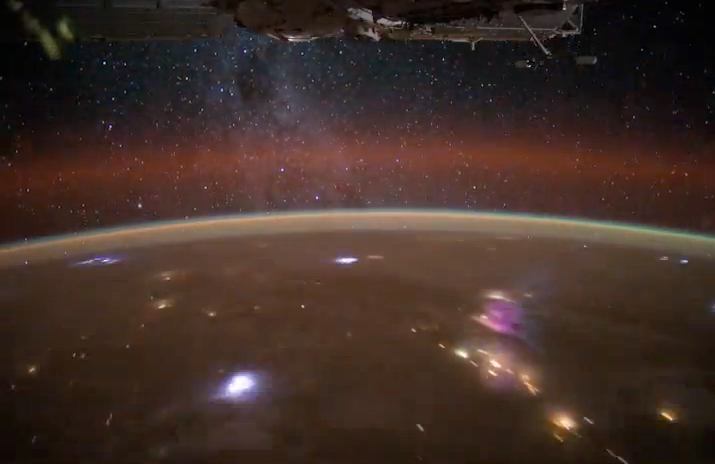
The best space images are the ones that put our humble place in perspective, whether it's an image from the moon or a particularly stunning nebula. This one accomplishes the task brilliantly, giving a glimpse of the arm of our galaxy hovering over the limb of our little planet. Watch a timelapse video below.
This video was taken by the crew of Expedition 30 on board the International Space Station, over a 15-minute period Dec. 29. The space station is passing over central Africa, near southeastern Niger, toward the south Indian Ocean and Madagascar.
The Milky Way appears as a haze in the middle of the screen, with a brief appearance by Comet Lovejoy.
Five amazing, clean technologies that will set us free, in this month's energy-focused issue. Also: how to build a better bomb detector, the robotic toys that are raising your children, a human catapult, the world's smallest arcade, and much more.


Online Content Director: Suzanne LaBarre | Email
Senior Editor: Paul Adams | Email
Associate Editor: Dan Nosowitz | Email
Assistant Editor: Colin Lecher | Email
Assistant Editor: Rose Pastore | Email
Contributing Writers:
Rebecca Boyle | Email
Kelsey D. Atherton | Email
Francie Diep | Email
Shaunacy Ferro | Email
Is anyone disappointed by the ending of the video? The sun is about to rise. The glow through the atmosphere, the anticipation is building and then... aaawwww :( fades away.
Leaveing you in suspense for the sequel
Antaro,
The video is good and incrediable in vision and incrediably short. Yes, it could of been much longer. :(
..........................................
See life in all its beautiful colors, and
from different perspectives too!
most popsci bloggers are incredibly negative with their comments (very rude), awesome video, this video couldn't be any longer or you would just get a big bright white screen, negative cheers (cheers to popsci)
@drchuck1
Wasn't meant to be a negative comment about the video or Popsci. Unlike your generalizing of the visitors to this site.
I'm sure most of us would have like to see more of the video. It would have been a "white screen" for 2-3 sec. as the sun moves into view and out again. Then you would see the light reflecting off the clouds and the water and you would see the ground below. But you wouldn't be interested in seeing that now would you?
I wish I was born in a space station or a space colony.. *sigh*
@vidar:
Why would you? Space stations are cramped, enclosed spaces, and space colonies wouldn't be as shiny and glamorous as the planet that spawned them for centuries after founding. And after centuries, they would probably be very similar to the mother planet.
Let me rephrase that wish into something infinitely better: 'I wish I was born in a society advanced enough to have space colonies and more than one or two minuscule space stations.' *sigh*
antaro,
I agree with your opinions.
Second, there are direct compliments and then there are indirect compliments. I and you gave direct and indirect compliments to the video.
We like it! We loved it! “We wanted more of it! – indirect compliment”
Only a complete idiot would attempt to twist it into something negative, cheers.
..........................................
See life in all its beautiful colors, and
from different perspectives too!
Uh, the video is cut perfectly. It would overexpose as soon as the sun broke the horizon.
I was doing a look at Dr. Don Pettit's bio and a few mission articles on him; and he had something over 13 hours of EVA time as of the last one I was looking at and I couldn't help but wonder about just how much time he had to maybe put his back to the Earth and moon and look around in that much time. Then I had a thought; just how much true work are they getting out of the environment, other than solar and cooling? How much vacuum do they use overall? Can they collect hydrogen and oxygen and generate say, exterior lighting? Little nanotubes to carry it and use vacuum to pull it to little microlenses to magnify the effect of burning it? They could be put anywhere and everywhere an astronaut cannot possibly fit a finger in. Re-invent the lightbulb once again, but smaller yet. Maybe I'm nuts, but the mere idea of endless, albeit small power potential going to total waste bugs me. What other combinations and uses are there, just using the environment's potential? Little bots cleaning the solar and glass and every lens? Chuggin along with their little bitty internal combustion engine...Store up for different lengths of time for different duties; other than the lighting which I see as continuous. Anyone wanna jump in here?