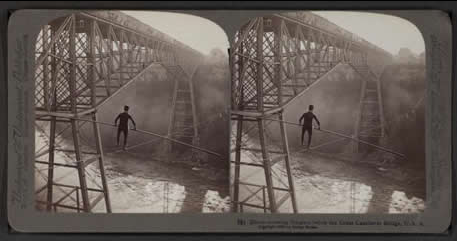
Stereogranimator, Pre-Stereogranimation NYPL

The New York Public Library has an archive of over 40,000 historical stereographs, many well over a hundred years old. Stereographs are regular photographs, except in pairs, with the perspective very slightly different. Essentially, stereographs are what you were looking at through your ViewMaster as a kid. And now the NYPL has created a pretty amazing tool they're calling the Stereogranimator that lets users create animated 3-D GIFs from the photos in the archive.

Moving the image back and forth between the two perspectives tricks the eye into seeing depth--it's kind of a lo-fi way to get around that problem of both eyes seeing the same thing. (Regular 3-D beams a different image to each eye.) Here's a recent example:

GIF made with the NYPL Labs Stereogranimator - view more at http://stereo.nypl.org/gallery/index
GIF made with the NYPL Labs Stereogranimator

It's especially cool that the tool, while easy to use, isn't really automatic--you still have to play around with it to get the perspective and speed just right. Go check it out!

[NYPL Stereogranimator]

5 Comments

I... feel like... I'm... having... a... seizure looking... at this... photo.

" Science without religion is lame, religion without science is blind." Albert Einstein

Why not just learn the crossed eyed 3D technique, it has a much better effect.

Free-View Stereo Images: http://www.starosta.com/3dshowcase/ihelp.html

Starchild_1,
I agree with you and I do not think this is practical technology we can all use.
If this was not POPSCI but the GONG show, I bang the GONG!

@Jib- crosseyed viewing doesn't work with old stereograph images like these. They're in parallel view mode - left eye = left image, right eye = right image. Same as those annoying Magic Eye posters that were big 20 years ago. But I agree with you that free-viewing is best if you can get the hang of it. This flickering technique is nothing new - it's been around for decades. Digital images make it easier though.

An interesting experiment but no more than a novelty I'm afraid.

Jib is absolutely correct about cross-eyed viewing and it can easily be learnt from the this tutorial.

http://www.neilcreek.com/2008/02/28/how-to-see-3d-photos/

Having learnt this simple technique, it's then quite a simple process to swap the left and right images on these old cards.

This is a stereophotograph of the Colosseum in Rome.

http://www.flickr.com/photos/burryport/6620823425/

by simply copying the card, separating and the left and right images and then swapping them around you obtain an identical looking card which can be used for cross eyed viewing.

http://www.flickr.com/photos/burryport/6620812567/

The advantage of cross-eyed viewing is that you can view stereophotographs much larger than the originals which is restricted because the eyes cannot diverge but can easily converge.

This method is preferred by most fans of 3D photography especially here on the web, here's just one example.

http://www.flickr.com/photos/burryport/6623983189/


June 2013: American Energy Independence

Five amazing, clean technologies that will set us free, in this month's energy-focused issue. Also: how to build a better bomb detector, the robotic toys that are raising your children, a human catapult, the world's smallest arcade, and much more.


Online Content Director: Suzanne LaBarre | Email
Senior Editor: Paul Adams | Email
Associate Editor: Dan Nosowitz | Email
Assistant Editor: Colin Lecher | Email
Assistant Editor: Rose Pastore | Email

Contributing Writers:

Kelsey D. Atherton | Email
Francie Diep | Email
Shaunacy Ferro | Email

circ-top-header.gif
circ-cover.gif
bmxmag-ps