The Navy’s Gremlin Uses Sonic Waves to Find Underground Bombs
The tools for safely disposing of explosive threats like improvised explosive devices (IEDs) have come a long way over the...
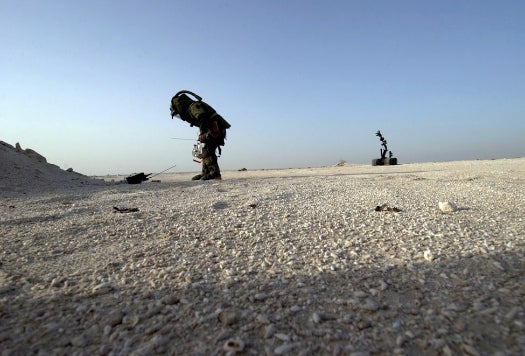
The tools for safely disposing of explosive threats like improvised explosive devices (IEDs) have come a long way over the last decade, but one rule of explosives ordnance disposal (EOD) holds fast regardless of how much technology you throw at it: you can’t terminate a threat if you don’t know where it is. To that end, the Office of Naval Research is hoping to field a new sensor package that can see bombs buried under the ground or otherwise obscured from view by blasting them with sound waves and seeing what kinds of vibrations come back.
The imperfectly acronymed GREMLIN (for Ground-Based Explosive Ordinance Disposal Mobile Laser Interrogation) is an augmentation for ground robots already employed by EOD units in places like Afghanistan that would–if all goes to plan–allow EOD operators to see beneath the ground before they start digging around looking for a suspected IED. Defense contractor BAE Systems already has $2 million in Navy cash on hand to help it look into possible GREMLIN technologies.
The idea: Using some kind of acoustic source, the robot could blast the ground in front of it with sounds waves and study the way those waves are disrupted in order to form an image. A patch of freshly disturbed dirt–especially a patch of freshly disturbed earth concealing a large plastic jug full of chemical explosive or some such–would return different patterns of waves than a nice solid patch of undisturbed hard-packed earth. And with some clever computing work, GREMLIN could turn those vibrational patterns into an image that would give the robot operator some clue as to what’s beneath the surface.
In other words, it allows the robot to see underground–like ground-penetrating radar but with a whole new layer of resolution (GPR can detect inconsistencies in the ground like those described above, but it doesn’t paint a nice visual picture like GREMLIN presumably would).
That’s not bad, considering IEDs have become the single biggest threat to coalition troops over the past decade of counterinsurgency. With GREMLIN, the robots do the up-close work, and the humans get a clearer picture of what’s going on beneath the ground–when and if they finally get GREMLIN. Danger Room reports that the system has at least three years of initial tests in front of it before a prototype even surfaces.