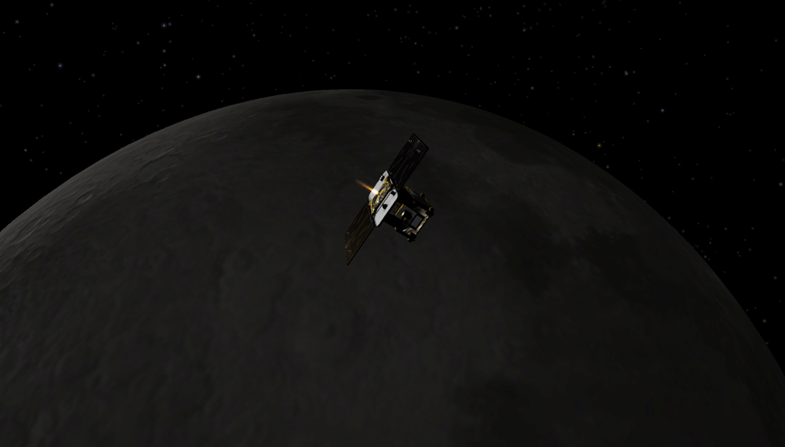
GRAIL At the Moon NASA

Happy New Year! NASA may not launch any people into space in 2012, but a successful robotic mission just as the new year dawned sets the stage for the space agency's near-term future. The twin Grail probes arrived at the moon on New Year’s Eve and New Year’s Day, and are preparing to study our only natural satellite's past.

The moon probes will spend a couple months adjusting and lining up with each other before starting their main mission in March. The Gravity Recovery And Interior Laboratory (GRAIL) probes are designed to map the moon’s lumpy gravitational field, which is stronger over the maria (facing Earth) than in the highlands (on the dark side).

Learning about the moon’s gravity field will tell scientists a lot about its interior, and possibly whether it did in fact swallow a smaller sibling sometime in its past.

The washing-machine-sized Grail-A and Grail-B will orbit the moon in tandem, measuring tiny changes in the distance between them that will result from gravitational fluctuations. Sloshing fuel could introduce some error into those ultra-fine measurements, so the probes took a super circuitous route to the moon after their September launch, ensuring they burned as much fuel as possible before arrival.

After several weeks of instrument checks and calibrations, the probes will start their three-month observation period. During this time, they’ll also snap images of the lunar surface using a camera controlled by schoolchildren. You can follow the mission here.

[NASA]

6 Comments

"the probes took a super circuitous route to the moon, ensuring they burned as much fuel as possible"
But you know what else minimizes the sloshing of fuel inside a sensitive space probe? A smaller fuel tank with less fuel.
Or just dump some fuel.

I too considered to myself storing less fuel, but happen if I need more fuel for courses corrections. I too consider the dumping of fuel, but the put out of fuel\ejecting or dumping fuel in itself is a possible force to consider. I decided to keep my thoughts to myself, thinking the engineers who made these things are smarter than me.

.............................
Science sees no further than what it can sense.
Religion sees beyond the senses.

I believe the author is mistaken. The "super-circuitous" route was taken to minimize the amount of fuel needed for the trip (see Interplanetary Transport Network).

@Robot

Wow...how ignorant. I am sure the Nasa "smarter then you" engineers felt the same way...right before they ignored a new team member and the space shuttle challenger blew up. Good work.

Science sees no further than what it can sense.
Religion sees beyond the senses.
Humanity is ignorant regardless...

OneYRleft,
I see your point of view and I also give to respect to NASA and it's engineers.

.............................
Science sees no further than what it can sense.
Religion sees beyond the senses.

Engineers are not always smarter than us. As YRleft pointed out, Challener, along with Columbia, and the Lockheed Martin people who forgot to convert english to metric and embeded a martian probe into the planet instead of having a feather soft touchdown. Thousands of others too. At the same time, it's better to have too much fuel than not enough fuel. They probably erred on the side of caution.

I'd love to see a bunch of those NASA/GM R2 robots send to the moon for an "articial human" mission. I'm sure Robot would love to see his/her fellow robots sent there for the glory of earth!

Science always asks "can we," but doesn't seem to ask "should we."


June 2013: American Energy Independence

Five amazing, clean technologies that will set us free, in this month's energy-focused issue. Also: how to build a better bomb detector, the robotic toys that are raising your children, a human catapult, the world's smallest arcade, and much more.


Online Content Director: Suzanne LaBarre | Email
Senior Editor: Paul Adams | Email
Associate Editor: Dan Nosowitz | Email
Assistant Editor: Colin Lecher | Email
Assistant Editor: Rose Pastore | Email

Contributing Writers:
Rebecca Boyle | Email
Kelsey D. Atherton | Email
Francie Diep | Email
Shaunacy Ferro | Email

circ-top-header.gif
circ-cover.gif