Mars Rover Curiosity
Radiation data gathered by the rover's instruments could inform future manned spacecraft designs
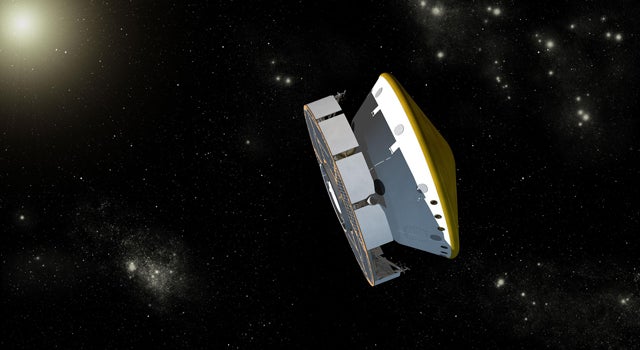
MSL, Cruising NASA/JPL-Caltech

Last week’s solar eruption and resulting radiation bombardment--the biggest recorded in seven years--made its presence felt here on Earth via altered flight paths for some planes in the Northern Hemisphere and a certain degree of hand-wringing over the health of satellites in the solar storm’s path. But it also made an impression far from Earth aboard the Mars Science Laboratory spacecraft, currently cruising the interplanetary space between Earth and Mars.

Tucked inside the MSL spacecraft, the Curiosity rover’s Radiation Assessment Detector (RAD) registered the effect of the solar radiation burst. The radiation storm doesn’t appear to have damaged the spacecraft or the rover inside. But the incident does present researchers with an unprecedented opportunity to study the effects of solar radiation on the inhabitants of a spacecraft, lending them insight into the challenges inherent in any future manned interplanetary space mission.

RAD was designed to measure the impact of radiation on the surface of the Red Planet, but for the duration of MSL’s nearly year-long journey to get there it is downlinking data gathered along the way once every 24 hours. According to mission handlers, the data recorded during the solar surge hasn’t been completely parsed yet, but the event itself is very apparent in the numbers streaming back from MSL.

That data could give scientists a far greater understanding of the severity of radiation exposure to subjects inside a spacecraft and what kind of radiation shielding would be necessary for sustained human space travel (like that necessary to reach another planet like Mars). That in turn will inform future spacecraft designs and--hopefully--pave the way for manned missions into interplanetary space.

Call it a stroke of cosmic good luck (assuming that the radiation burst really didn’t damage any systems aboard Curiosity) that the solar radiation burst and MSL crossed paths. Here we thought Curiosity wouldn’t start yielding meaningful science data until it touches down on Mars in August. It looks like the rover is already hard at work.

5 Comments

I can't wait for this thing to become operational on Mars. One thing I would like to know, but haven't heard anything on is when this does become operational on Mars, what is going to happen to Opportunity? Are they going to just shut the little guy down or run it till the wheels fall off? Considering how well its stood up and the wealth of information, I think they should do the latter.

Science always asks "can we," but doesn't seem to ask "should we."

If the MSL fails to land successfully on Mars, I will feel very compelled to dismiss the notion of solar storms and blame Russia, for sabotaging our spacecraft using Tesla-based technology, long hidden away in Siberia.

From there, I think NASA/JPL should demand a series of tests at Russian radar sites to determine exactly what that technology means in regards to every single failed US space mission.

Keep going, Curiosity! Can't wait 'til you land!

Most of us Baby Boomers have allowed ourselves to be brainwashed into believing that "Mom, apple pie, and launch the Mars Rover!" is the way to go.

In the process, the planet is being trashed by more and more launches, as the industry WORLDWIDE increases, to launch even PRIVATIZED space vehicles, based upon the tried and tested technology of the environmentally-disasterous Space Shuttle era.

At this point, I question the need to go into outer space at all, to accomplish the very thing that we're collectively seeking to do in the first place.

This veil of hypocrisy of the space program being for the 'betterment of all Mankind' must be lifted, to reveal what is REALLY going on with the trashing of the environment at large.

I've just written an article about what I feel are "Four Factual Errors about the Space Program" - including a much better, cheaper and more reliable way that NASA already had to land their 'Curiosity' rover on Mars.
h t tp:// darin selby. 1hwy. co m/ 4spaceprogramerrors. ht ml
(remove the spaces^)

Do share with me your thoughts.


June 2013: American Energy Independence

Five amazing, clean technologies that will set us free, in this month's energy-focused issue. Also: how to build a better bomb detector, the robotic toys that are raising your children, a human catapult, the world's smallest arcade, and much more.


Online Content Director: Suzanne LaBarre | Email
Senior Editor: Paul Adams | Email
Associate Editor: Dan Nosowitz | Email
Assistant Editor: Colin Lecher | Email
Assistant Editor: Rose Pastore | Email

Contributing Writers:

Kelsey D. Atherton | Email
Francie Diep | Email
Shaunacy Ferro | Email

circ-top-header.gif
circ-cover.gif
bmxmag-ps