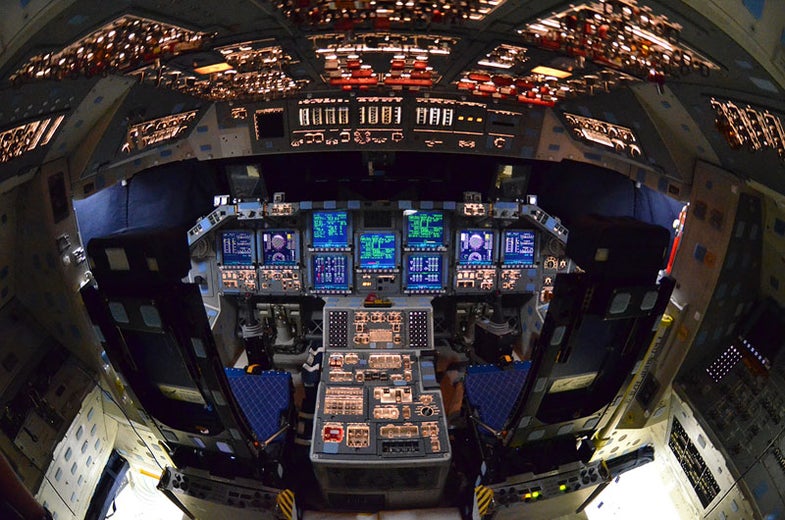
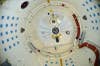
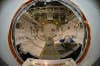
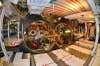
Space shuttle Atlantis, which only five months ago flew the final mission of NASA's 30-year shuttle program, is now being prepared for its public display at the Kennedy Space Center Visitor Complex in Florida. That means, sadly, that Atlantis is scheduled to be powered down for the very last time this week. Its insides are being shamelessly pulled out to ensure it's safe for exhibit--it's important to lighten the shuttle's weight, since it'll be displayed on a steep angle at Kennedy.

collectSPACE.com had the rare opportunity recently to tour Atlantis and photograph its preparation for display. This is one of the last times anyone will be able to capture Atlantis's glass cockpit all lit up like this--and you're privy to the pictures.


Click to launch the gallery.

The following photo gallery starts on Atlantis' flight deck, and then proceeds to its now mostly empty middeck, out into and above the 60-foot payload bay, and then around and under the winged spacecraft.

These photographs were taken inside Orbiter Processing Facility-2 (OPF-2) at the Kennedy Space Center, where access platforms envelop Atlantis.

This post was syndicated from collectSPACE, the leading news source and online community for space history enthusiasts. The full post can be read here, with even more photos.

12 Comments

I can easily imagine looking at this dash board, the joy of flying the Space Shuttle with all the switches and pretty lights and exciting thrust of rocket thrust, it is Christmas Joy on each flight!
WOWzers!

.............................
Science sees no further than what it can sense.
Religion sees beyond the senses.

How about some hi-res versions of the cockpit pictures?! They would make a pretty awesome desktop background...

Imagine how much time is spent just trying to familiarize yourself with the layout of the cockpit. Since the consoles are being pulled out, I would love to see them set up for display. Absolutely beautiful. I am still saddened to see their retirement. I wanted to be able to see a launch with my son. Hopefully by the time he's older there will be a replacement.

Science always asks "can we," but doesn't seem to ask "should we."

Having seen several shuttle launches, a truly thrilling sight, I'm sad to see the end of shuttle program. It's retirement was well past due; I look forward to what the future holds!

Ah the variety of controls and light indications. Perhaps in the not so far future all this will be eliminated as the Astronaut plugs an interface from the Outer Space Vehicle to the back of his brain and sees in his mind all that is needed and controls all that is needed with thought, coupled with the space craft computer and communications and computers on the ground.

The Astronaut may not even have to plug in interface, but simply switch on the wireless device attaché to his brain too.

.............................
Science sees no further than what it can sense.
Religion sees beyond the senses.

I hate to see it go. But I'm glad it finally did!

The delivery trash truck was getting old, klunky and most of all it wasted fuel into orbit!
It was only really needed for ISS assembly anyway...

@rg-5

In point of fact the Space Shuttle is the only surviving component of the STS Program proposed during the late 1970s that would utilize multiple components to revolutionize and enhance the use of space.

The Space Transportation System (STS) was composed of an orbital space plane that would be used as a work horse for orbital device placement and construction (as yours truly has been operated), an Earth and lunar based space tug system, a nuclear powered shuttle (not to be confusioned with the space shuttle that was created but rather a nuclear reaction powered rocket that would function as a shuttle in the truest sense to the meaning of the word) for fairying people and supplies between our Moon, Venus, and Mars, and two Earth and lunar orbitally based Space station that would act as intermediate launch and docking ports for the nuclear shuttle flying between Earth and it's moon.

The cost overruns of the Apollo program were so great that the only concept to survive the cutting board for the STS Program was the Space Shuttle itself (also why each Shuttle flight is designated with a mission number preceded by STS). As a result the next space station project that NASA would pursue following Skylab was the Freedom Space Station. After years of congressional blocks in supporting the preposal, the concept died off in the late 1980s but was given new life with international support from 13 other countries. This project then became known as the International Space Station which didn't get approval until the mid 1990s.

Had the events of history played out differently, we might have already established an infrastructure for an interplanetary existence, or more reasonably, worked toward the next big thing beyond the moon. Because the Space Shuttle was but a small piece of the next big thing, NASA's focus over the years (mostly based on the limited extent to which Congress would support it) has been on scientific research and exploration supplemented from the human experience. The time after Apollo was characterized by manned research projects conducted in orbit in the Skylab or the Space shuttle, the launch of several space based observatories, and remote controlled and robotic probes sent to other worlds in the solar system for close study.

Minus Skylab, the Space Shuttle had a hand in extending the latter for the reach of scientific progression in the past few decades. Now NASA really has to move on to the next big thing, and let the private industry do the truck work. That compination equals government tax dollars well spent, and private industry stimulating economic prosperity. The Shuttle has done it's job well.

The Shuttle still has only been paid for in 'Virtual' US Dollars anyway...
And no, I know what you mean. The Shuttle though never had any chance of going beyond low earth orbit anyway. With the lack of NASA interest and Congressional cuts starting soon after Apollo succeeded getting men on the moon. There were no more big Government funded projects on the table for NASA and no ambition of getting anywhere soon, they lost all the momentum when Apollo ended.

So all it could possibly ever do was build up the ISS, only to be scrapped soon afterwards. Atleast there's now finally the idea of making something better.

Amazing, it looks so much more high tech than in the movies. Sad to see it go. I hope this is truely just the beginning and not the beginning of the end. While the oportunity for robotic rovers, satellites, and other unmanned probes make so much sense, the exploration of space without manned space flight ultimately reduces such accomplishments to video game like quality.

$ FASHION space shuttle ISS-DISCOVERY-30 is at its functional retirement but is self monumental precious moiety for the space family

This just makes me think my home-spun space vessel is still a long long long way off! So many more light bulbs to purchase!


July 2013: The Future Of Flight

The incredible innovations, like drone swarms and perpetual flight, bringing aviation into the world of tomorrow. Plus: today's greatest sci-fi writers predict the future, the science behind the summer's biggest blockbusters, a Doctor Who-themed DIY 'bot, the organs you can do without, and much more.


Online Content Director: Suzanne LaBarre | Email
Senior Editor: Paul Adams | Email
Associate Editor: Dan Nosowitz | Email
Assistant Editor: Colin Lecher | Email
Assistant Editor: Rose Pastore | Email

Contributing Writers:

Kelsey D. Atherton | Email
Francie Diep | Email
Shaunacy Ferro | Email

circ-top-header.gif
circ-cover.gif
bmxmag-ps