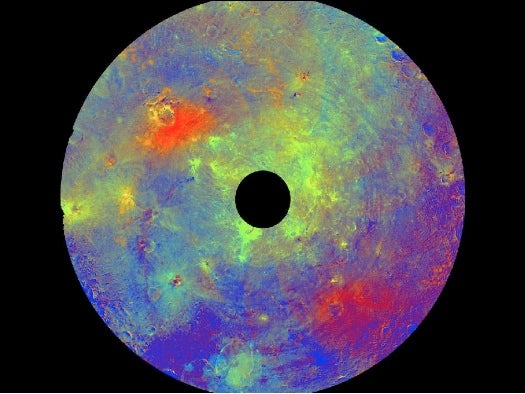
Today in pretty space pics: the asteroid Vesta, captured in all its multicolored glory by NASA’s Dawn spacecraft. The colors, of course, aren’t true. Rather, they’ve been assigned by scientists to show different mineral and rock types as data streaming back from Dawn is informing the analysis of this unique asteroid.
Vesta is unique because astronomers believe it lives in a grey area between the terrestrial inner planets and the average rocky asteroid--hence, the wild coloration you see above. Rather than being one-note, Vesta exhibits a varied composition marked by well-defined layers and ingredients. Dawn’s visible and infrared mapping spectrometer show that Vesta contains pyroxene, a rock-forming ingredient also present in things like iron that is also very much present in the Earth’s upper mantle. And the dispersion of minerals indicates that rocks on the surface cooled quickly while lower layers cooled more slowly.
All that points back to the prevailing idea that Vesta is more like a planet than your average asteroid, with a layered composition like that of the Earth’s: core, mantle, crust. That’s pretty cool for an asteroid. And in case you were wondering, the black hole in the center of the image is simply data that has been omitted because of the angle between Vesta, the sun, and the spacecraft. Get your wallpaper-sized version of the above over at NASA.
[NASA]
Five amazing, clean technologies that will set us free, in this month's energy-focused issue. Also: how to build a better bomb detector, the robotic toys that are raising your children, a human catapult, the world's smallest arcade, and much more.


Online Content Director: Suzanne LaBarre | Email
Senior Editor: Paul Adams | Email
Associate Editor: Dan Nosowitz | Email
Assistant Editor: Colin Lecher | Email
Assistant Editor: Rose Pastore | Email
Contributing Writers:
Kelsey D. Atherton | Email
Francie Diep | Email
Shaunacy Ferro | Email
Neither the Pop-sci reference here-in, nor the original article tell us what the colors mean, or what minerals are on the asteroid. The only one mentioned was iron.
Sigh. So much for wanting to know what it's made of.... seems there could've been more information given to us.
@shutterpod, I read this on NASA.gov the other day and wondered the same thing and their excuse for the giant missing(left blank) section seemed odd as well. The 3d images are pretty neat though.
Playing Devil's Advocate since 1978
"The only constant in the universe is change"
-Heraclitus of Ephesus 535 BC - 475 BC
Everyone, the light to dark spectrum of color does not display mineral deposits, nor a color of the rock, rather it is depth of the asteroid. Pictures of Mars and Venus can look like this color as well, yet a reference of altitude is set on these rocks like we would on earth (say sea level). Yet due to the lack of a liquid floating on those surfaces that we can't see (yet), it is possible that to make depth, you base it off a geological location, landmark or otherwise. This asteroid is no exception.
5 years an astronomer ^^.
" Science without religion is lame, religion without science is blind." Albert Einstein
Seems to have all the right materials, eh. Let’s put some rockets on it, move it closer orbit with the sun (goldy locks zone) and make some oxygen with algae and other local recources, plants some seeds and grow our own little planet. ;)
Starchild_1 that's awesome that you've been an astronomer for 5 years, however that fact doesn't make you correct in your statement. This is a cut and paste directly from Nasa.gov, where you can clearly read that it is in fact NOT altitude measurements but radation measurements and it specifcally isolates that Green is Iron rich.
"Scientists assigned different colors for the ratios of two wavelengths of radiation detected by the framing camera to indicate areas that are relatively redder or bluer. The red indicates wavelengths at 750 nanometers divided by 440 nanometers. Blue indicates areas at 440 nanometers divided by 750 nanometers. Scientists are still studying why certain areas look redder or bluer. Green indicates areas at 750 nanometers divided by 920 nanometers, suggesting the presence of the iron-rich mineral pyroxene or large-sized particles."
Playing Devil's Advocate since 1978
"The only constant in the universe is change"
-Heraclitus of Ephesus 535 BC - 475 BC
When I first saw the picture in this article, I thought it was going to be about a "Cosmic Psychedelic Music LP".
Who knew it was just a picture of a planet?