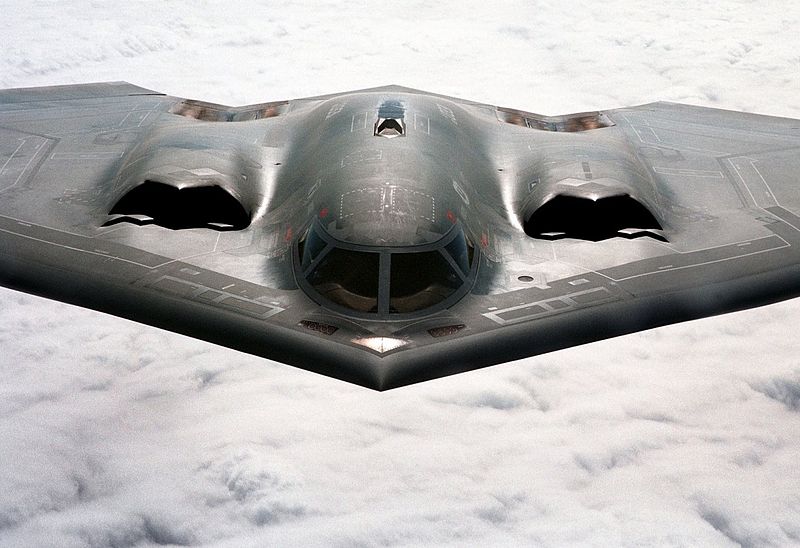
Blacker-than-Black Nano-Stealth With a coat of carbon nanotube stealth paint, any plane could absorb radar just like the B-2. USAF

Another day, another blacker-than-black materials science breakthrough aimed at making stealthy objects even stealthier. A U. of Michigan researcher and his colleagues has created a new kind of nanostructured coating made of carbon nanotubes that could cloak an aircraft in complete blackness, concealing it in the visible range and beyond (think: radar). Suspended in paint, the nanomaterial could be rolled right onto aircraft to turn them super-black and super-stealthy.

The Michigan team’s tech taps one of the many amazing characteristics of carbon nanotubes--tiny yet long tubular structures made of pure carbon that have some pretty amazing conductive properties--to more or less absorb every bit of light that strikes an object. Grown on the surface of an object, they can absorb an extremely broad spectrum of light, from radio right on up to ultraviolet. That means that, unlike other metamaterials that are more spectrum specific, they can cloak an object not only from visible light, but from things like radar as well.

But it’s not as easy as simply slapping a coat of paint on an aircraft. In order to ensure that the nanotubes neither reflect nor scatter any light, the nanotubes have to be grown with some space in between them so their refraction index is very similar to that of the surrounding air. This keeps light from scattering out of the little forests of nanotubes without being absorbed, but it’s also kind of painstaking.

Thus far, the Michigan team has only grown nanotubes on a variety of small, three-dimensional objects because doing so is a high-temperature, high-pressure process--one that you wouldn’t want to put a multi-million dollar fighter jet through, even if you could. But the team thinks it should be possible to grow the nanotubes on tiny particles and then suspend them in paint that can be rolled onto larger objects like aircraft.

[Technology Review]

19 Comments

So I can just cover myself in this if I don't want my boss to see me walking out?

In seriousness though, if it can really be applied like regular paint that would be great, and an improvement over current radar absorbing material. One thing a lot people never think about is that these materials have to cover every panel seam and screw head. But planes are machines that require maintenance. Anytime you need to do anything, you have to cut through the material, take off the panel, and repair it afterwards. The repair also has to be easy enough for a 19 year old to do.

Is it really stealth tech if everyone has it? Cuz apparently the US likes to give it out free-ly

i remember hearing that the army wouldnt say what was being used to make them stealthy, so there is probably already something like this

-Knock knock
-Who's there?
-The Doctor.
-Doctor Who?
-Yes

Brolin, just because it's public knowledge doesn't change the fact that the aircraft cannot be detected by any anti-aircraft detection systems. As a trained Electronic Warefare Technition, I've studied aircraft detection and the methods used to prevent detection, adjust actual location, create smaller or larger or more aircraft than is actually there, right down to full on jamming the detection equipment. Visual systems cannot locate aircraft with enough reliablity to be feasable. By the time you can actually SEE the aircraft, assuming you can track it, it's still far too late to do anything to deter the aircraft itself, which is why radar, lidar and other detection and range finding systems are used. Since current (read public) stealth knowledge still renders these systems handicapped if not disabled to proper location, anti-aircraft weapon systems do not have the time nor proper naviational guidance to warrent wasting expensive ammunition. Just because you know the tech exists to prevent your early warning and tracking systems from locating, tracking and ranging the aircraft does nothing for helping you locate and engage the target.

This "update" to the steath paint isn't really a change, just a tweek to the material already used. What used to make the above aircraft look like merely a large bird, now makes it appear as a small bird, if it appears at all.
Playing Devil's Advocate since 1978

"The only constant in the universe is change"
-Heraclitus of Ephesus 535 BC - 475 BC

@mbrd71

You'd be amazed at what 19 year olds can do these days.

@Brolin

If by that you mean the seriously lagged pace at which U.S. Government agencies keep up with the need for more robust cyber-security measures to protect sensitive and classified data, then yeah the U.S. does like to give things out freely.

That or sell it for a price, and more people have sufficient money to afford the price these days. Remember, the U.S. is about capitalism (initially) anything worth value that can be turned into profit is on sell to the highest bidder.

Everyone knows what a sucker punch is. Doesn't save you from taking one if it's thrown at you. Doesn't matter if everyone has it or not. It's all about when it's used, and not everyone knows that information. Imagine what you don't know about it's use right now.

I hope the drone that landed in Iran wasn't covered in this stuff...that...would be sad.

And then once the jet's been painted... crash it in Iran!! Dumb ID10T's!
Only 'nothing' is undetectable!

Anyone ever bother to check if an object is so black it doesn't fit in with photon radiation from around and behind it?? Also known as: 'Contrast', radar should be able to do that.

@rg-5

This could work with aircraft radar looking down into the ground clutter. A stealthy aircraft would show up as a dark spot. However, I am fairly certain this would only be reliable at close range, so you would have to be at a higher altitude than the stealth aircraft and at relatively close range.

Most radars look up from the ground or horizontally across the sky where there isn't enough background noise to detect the absence of background noise.

Visually, black is not the best color scheme if you want to go unseen. The F-117 was to be painted in pastel colors to make it less visible:

"One Lockheed engineer recalls that the commander of Tactical Air Command 'didn't believe that real fighter pilots flew pastel-colored airplanes.' One Air Force source close to the program says that some senior officers doubted the F-117 could survive in daylight, and wanted to ensure that nobody would try it."

It's not pastel...it's...ummm...sky blue.

I with rg-5.
If it doesn't reflect radio waves then just look for a hole in the radar image, because the radio waves will bounce back off of everything except the plane. Also if it would ever fly low enough to be seen it would be picked out as easy as a falling comet could be because it is so black or in other words the contrast as rg-5 said. Also this article, as I understood it, is wrong about things disappearing, they just look extremely BLACK.

@quantumLeaper

It specifically states radio...

"And then once the jet's been painted... crash it in Iran!! Dumb"
it doesnt really matter...
just like with most technology.
its not like they can take the paint and put in a Xerox machine and get some more.

even IF they can make carbon nano tubes, it isnt that simple.
they have to be suspended (or is emulsed a better word because of their size.. I think so) in a special chemical or paint. the process and formula are what are secret. I seriously doubt they can just take a scrapping and bam make stealth paint. plus it is costly. its not like even the USA can make buckets and buckets of carbon nano tubes.

this is the case with most technology. just look at Iran and a nuclear bomb. they can not even enrich the uranium to a pure enough level. its takes such an high level of industrial ability to do so.

if it was so easy to backwards engineer things, then the North Koreans would be walking around with North Korean ipads and such. and thats CONSUMER technology.

have you seen Chinese bootlegged technology??? its looks like the real but doest perform like the real thing, and most of those are from trade spies that work at the factory, not some backward engineering example, but a copy of the original plans, and even still with out the factories and know how to make the highest level products its still impossible.

just go back to WW2. we had captured v2 rockets, but could not build them until we had the V2 scientist. the examples are endless.

not to mention ANY and all past and future stealth planes also have many other ECMs.

Is this the same thing as http://www.popsci.com/technology/article/2011-11/new-super-black-material-absorbs-99-percent-all-light-dares-strike-it

with that said doesn't this mean it could be used to make better solar panels as well as stealth

It is the same thing... And that's not going to work as well or for as long as they would like it to, before someone (I GUARANTEE IT) finds a way around it.

This would seem to be somewhat vulnerable to electricity as it applies to it's stealth capability. I'd imagine that to get the carbon nanotubes to stand up, which would be giving it the ability to absorb the waves directed at it; there would be a definite polarity induced on the paint. Wouldn't that make it vulnerable to detection in any electrically charged environment where there is a high degree of flux?

@quasi44 You are onto something mate! :D

Since they cannot put aircraft part surfaces through the harsh conditions needed for growing nanotubules, to be able to find the perfect concentration of dispersed nanotubules adhered onto particles in a paint formulation that, when applied, will still give rise to stealth (i.e. absorb all wavelengths of the EMS from radio through UV rays) will be the challenge. So they have not yet done this on the surfaces of aircraft, only with isolated 3-dimensional surfaces, correct? Sounds good on paper, but it's gonna be a while...

weren't WWII night fighters black ?

I love these discussions , but when y'all smarter fellas start bouncin ideas around that could theoretically defeat these advances sorta makes me nervous. Only cause ...ah the walls have ears and the hills have eyes. And since thinkin outside the box is SERIOUSLY not a strong point for some ....potential threats (I'm on the ground ---> I KNOW !) Could be a - NO , WOULD BE a direction of research not dabbled in. Like when Dyson came clean about the damaged chip..."RADICAL STUFF - THE TECHNOLOGY TOOK US IN A DIRECTION WE HAD NEVER CONSIDERED " All my subsequent research was based on it. inaka_rob I know it isn't easy to recreate or backward engineer a functioning effective piece of usable military tech. Even with an undamaged piece of Hard or Soft-ware but when your talking about several Billion US dollars of available funding and a hundred million researchers "ON IT" bein paid $25 or much less probably an hour and the threat of death looming if they fail....? Frankly speaking, you could give most countries ALL of our technology and teach em how to use it and make more, and they still wouldn't F with the Big Dog. I've been ALL over the world and am presently not on home soil and THEY ALL think we are fricken nuts and realize it is NOT advisable to try and steal our bone.


June 2013: American Energy Independence

Five amazing, clean technologies that will set us free, in this month's energy-focused issue. Also: how to build a better bomb detector, the robotic toys that are raising your children, a human catapult, the world's smallest arcade, and much more.


Online Content Director: Suzanne LaBarre | Email
Senior Editor: Paul Adams | Email
Associate Editor: Dan Nosowitz | Email
Assistant Editor: Colin Lecher | Email
Assistant Editor: Rose Pastore | Email

Contributing Writers:
Rebecca Boyle | Email
Kelsey D. Atherton | Email
Francie Diep | Email
Shaunacy Ferro | Email

circ-top-header.gif
circ-cover.gif