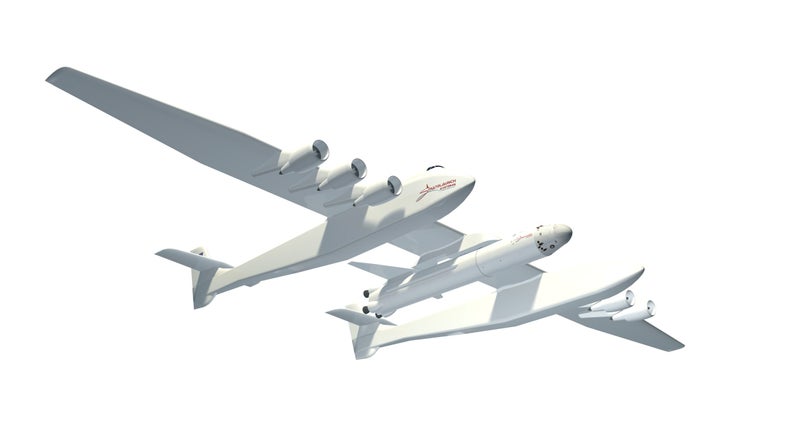
The people who built the first private aircraft to fly into space are teaming up once again to construct the largest aircraft ever flown, a behemoth air-launched orbital cargo delivery system called Stratolaunch. And SpaceX, the first company to launch a privately built spaceship into orbit, will build the rocket. As a reusable rocket-plus-glider system, it certainly seems like a potential replacement for the space shuttle.
Startup Stratolaunch Systems aims to build a humongous mothership-rocket combo craft, like a super-sized version of SpaceShipTwo. The effort combines the money of Microsoft co-founder Paul Allen, the aeronautical wizardry of Burt Rutan and the rocketry success (and, once again, money) of Elon Musk. Allen announced the plans at a news conference in Seattle Tuesday.
“I have long dreamed about taking the next big step in private space flight after the success of SpaceShipOne — to offer a flexible, orbital space delivery system,” Allen said. “We are at the dawn of radical change in the space launch industry. Stratolaunch Systems is pioneering an innovative solution that will revolutionize space travel.”
As if to punctuate Allen’s dream of providing a reusable orbital launch vehicle, former NASA administrator Michael Griffin is on the new company’s board of directors. Rutan, who retired from his company Scaled Composites earlier this year, is also on the board.
Allen and Rutan won the Ansari X Prize in 2004 for building SpaceShipOne, the first privately developed vehicle to reach outer space. The effort led to Virgin Galactic’s SpaceShipTwo effort and ignited the space tourism industry. This new venture will extend the plane-launch system to orbit and beyond, Rutan said in a statement.The concept involves a massive parallel-fuselage carrier airplane, weighing in at 1.2 million pounds with a 385-foot wingspan (that's longer than a football field). It would be powered by six 747 engines and could fly up to 1,300 nautical miles to reach its launch point, and would require a 12,000-foot runway for takeoff and landing.
The second part is a multi-stage rocket booster, based on SpaceX’s Falcon 9 rocket, and manufactured by SpaceX. It would be mated to the carrier plane with an integration system manufactured by Dynetics, an Alabama-based company. After the booster is released, the 490,000-pound rocket would heft cargo into orbit, on behalf of the government and commercial interests.
“Human flights will follow, after safety, reliability and operability are demonstrated,” a Stratolaunch news release said.
The huge aircraft’s space requirements will probably require it to operate from a launch facility like the Kennedy Space Center, but Griffin said the system would enable launches from a wide range of locations.
“We believe this technology has the potential to someday make spaceflight routine by removing many of the constraints associated with ground launched rockets,” Griffin said.
The announcement comes just months after the final space shuttle flight, and a few weeks before the first privately built spaceship docks with the International Space Station. The plane will be built in a Stratolaunch hangar, which will soon be under construction at the Mojave Air and Space Port, the company said.
The aircraft's ambitious dimensions will likely invite comparison to another secretive wealthy aerospace enthusiast, Howard Hughes, who built the Spruce Goose. That airplane only flew once and is now on display in Oregon. Here's hoping Allen's effort fares a little better.
138 years of Popular Science at your fingertips.
Each issue has been completely reimagined for your iPad. See our amazing new vision for magazines that goes far beyond the printed page
Stay up to date on the latest news of the future of science and technology from your iPhone or Android phone with full articles, images and offline viewing
Featuring every article from the magazine and website, plus links from around the Web. Also see our PopSci DIY feed
A 10,000-rpm, no-pulse heart is completely revolutionizing how we think about transplants. Plus: rapid-response virus hunters, a shocking cure for migraines, the world's youngest person to have achieved nuclear fusion (in his parents' garage!), and much more.
Howard Hughes would be happy, I think.
one complain about this article... no metric units?! c'mon put some SI... please ^^
---
bored? lets go mine the stars... ^^
If anybody can do this certainly Burt Rutan is at the top of the list of innovative engineers with the ability to pull this off. Add Paul Allen and Elon Musk with their dollars and I'd say this is a pretty sure bet.
Popsci had an article about how the USDD was looking to consider this concept as an option for operationally efficient launch operations of space assets through mobile aerial launch platforms (i.e. airplanes). If these guys succeed they might be on the line for some serious Defense contracts. More profit for the powers that be at Scaled Composites, Space-X, and Stratolaunch Systems.
The real question is the cost per launch. Usually things of grandiose conception cost a lot of money to operate. Check out the Space Shuttle. This thing definitely looks like it could increase the traffic flow of orbital operations, but the cost would definitely make or break these companies. At least these are profitable ventures not bound by legislative squabbles over the parameters of a law governing what they are to do in an ambiguous way, or the insufficient tax funds from people who can barely afford it and others who want to cop out of giving money to the government in the first place. It's about time spaceflight go to private industry to that effect. The bigger projects will, however, remain the works of national governments, but the big projects eventually become common place. In our children's or grandchildren's lifetimes they may witness the first marketable private space vehicle. Why have flying cars when you can just fly an airplane? Why become an astronaut if you can own your own spacecraft? Think about.
It's funny that Michael Griffin, who ardently opposed the fledgeling private space industry, is now a privateer himself. I guess all it takes is a little money to change someone's mind (MAYBE HE'LL VOTE FOR OBAMA IN 2012!). And by the way, this goes to show that NASA is wasting billions on a rocket that will be obsolete technology BEFORE IT EVEN GETS OFF THE GROUND!
NASA JUST NEEDS TO COMPLETELY GET OUT OF THE WAY AND ALLOW PRIVATE SPACE TO RUN AWAY WITH THE SPACE LAUNCH BUSINESS.
@pheonix1012,
Nothing from the private industry will EVER! be as expensive as the space shuttle. And if you ask me, re-usability is key. This alone will make it successful.
it somehow seems more complicated than say an atlas V, yet at the same time so much simpler...
nice idea , but its gotta cost a ton to get throught he thick lower atmosphere.
Since a space elevator is unlikely atm, how about a tower as tall as we can make it economically that can haul a plane like this up real far and launch it
The way i see it is a four towers with a big launchpad connecting them. perhaps wires leading to the ground at a angle for stability at the top, or one of those really big pendulum like things.
Planes would take off and land there perhaps never come down on the ground, just the cargo would come up and down.
To save even more fuel they could create the worlds largest nuclear powered airplane catapult, instead of pointing horizontally it would be vertical.
Im sure ther`ed be lots of fuel saved and you could use the tower for lots of things cell towers,meterlogical stations radio and such.
I'll give them from free advice.
A biplane would be much better for this. The only point of this is to raise weight to high levels. They could save a lot on the structure with two superimposed main wings.
For every hundred feet above sea level the amount of fuel it takes to exceed escape velocity is greatly reduced. A winged craft uses energy but not to lift in a vertical manner.
They might still look at launching from mountain tops using terrestrial energy for part of the launch process.
2004... It's almost 2012 and what's the hold up? Same could be said with my flying car, Dr. Moller.
What's the problem making the future happen?
Yes it looks like a copy of the spruce goose flying boat.
It's no Spruce Goose - and for the metric folks the wingspan is a full 115 meters, or 385 feet. A 747-400 is about 211 feet.
There is a 5-15 percent advantage launching from above most of the stmosphere which lets them use a shorter, lighter 4-5 engine SpaceX Falcon variant. The air-launch also lets them exactly match the orbital inclination desired, which saves both fuel and the time it would take to match, for example, of the ISS's orbit. Not to mention being able to fly above weather issues and the carrier being an immediately reusable 'zeroeth' stage that could do several launches a week (or day!)
There is also that this is not just a launcher, it's also a long range heavy lift cargo carrier. This could deliver wide format (8-10 meter) rocket stages or other wide cargo from factories to locations that now have to be shipped by barge or ship, but much faster.
What really strikes me is how wide that space is between fuselage pods. Much wider than is needed even for shipping a 10 meter rocket stage. Almost as if it's capable of carrying a very large orbital spaceplane, something akin to a subscale Venture Star which has enough fuel to get to orbit in large, internal tanks. Just saying...
DocM
Could also use this baby as a bomber. Replace the capsule with a bomb and that's one mother of a hole you could make in that Iranian bunker.
This design is almost exactly what was used in the 1970s TV program UFO for their moon-base shuttles.
Space planes is our best way to move to space.
Go go George Jetson!
so are they going to use Rolls Royce ,Prat and Whitney,
or GE engines on it?
Looks like a twin hulled Spruce Goose with a rocket in the middle!
I think this is awesome, but also that it will reduce the cost of launching things into space significantly, down from the price of a rocket to the price of essentially, an airplane ride. Nasa should allow these private companies to excel, and focus themselves more on instrumentation like rovers, and probes.
How about using in flight tankers to fuel the rocket at cruising altitude reducing takeoff weight of the rocket plus mother ship? Perhaps for safety two or more tankers one or more carrying Liquid Hydrogen and the second or more carrying Liquid Oxygen. Indeed this is complex compared to jet fuel tankers in use for 50 plus years. Maybe using another fuel combo such as jet fuel and LOX? And just using tankers for the jet fuel.
@DickOvens
"Maybe using another fuel combo such as jet fuel and LOX?"
The SpaceX Falcon's Merlin 1D engines already use RP-1, a rocket grade kerosene that is very much like the JP-1 used in jets.
That said - SpaceX is supposed to announce a new staged combustion engine soon, and there is speculation that it may run on liquid methane or a blend of methane with another fuel. If so this would deliver a high specific impulse (an efficiency index) which would be ideal for this application.
DocM