What Are You Doing Today, iForge?
Private industry needs to supercompute too. Today, Rolls Royce takes NCSA's iForge out for a spin
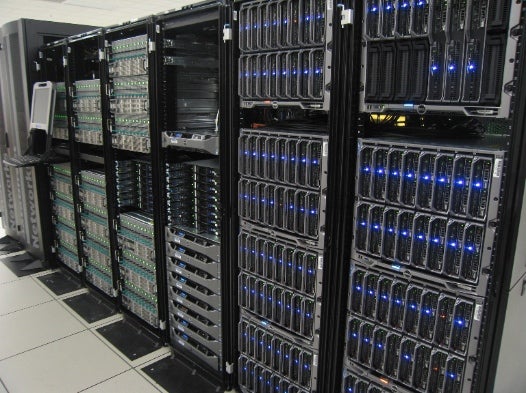
Over the last week, we managed to get some of the nation’s biggest and baddest supercomputers to take a moment away from their gigabusy schedules and tell us what they were working on. They were happy to share.
Now: a word with iForge, the pride of the National Center for Supercomputing Applications.
Name: iForge
TOP500 Rank: Not Available
Vital Stats: System: a mix of 121 Dell servers, including 116 PowerEdge M610 servers featuring dual-socket/six-core (12 cores total) 3.46 GHz Intel Xeon x5690 processors, 96GB of DDR3 memory, and 292GB of storage; Three PowerEdge M910 servers featuring quad-socket/eight-core (32 cores total) 1.86 GHz Intel Xeon L7555 processors, 192GB of DDR3 memory, and 292GB of storage; and PowerEdge C6145 servers, which actually combine two complete servers in a single chassis. Each of these four nodes features quad-socket/12-core (48 cores total) 2.5 GHz AMD Opteron 6180SE processors, 256GB of DDR3 memory, and 600 GB of storage.
In English, that’s a 22-teraflop high-performance computing cluster that University of Illinois’ National Center for Supercomputing Applications (NCSA) farms out private sector partners, like Rolls Royce, Boeing, and Caterpillar.
What’s Happening: Supercomputers aren’t all about supernova simulations and super-hot plasma interactions, iForge will have you know. Roughly half of the supercomputers in the TOP500 work with private industry helping to make cars safer, materials more durable, or things like the Boeing 787 Dreamliner inexplicably stay aloft. Today iForge is in the employ of Rolls Royce, which you probably know as an automobile maker but should also recognize as a maker of all kinds of power systems, including jet aircraft engines.
Rolls Royce is running more than 50 supercomputing jobs, most of them lasting several hours and some rolling over into the next day. Most modeled complex fluid flow though aircraft engine designs, simulations that will help Rolls Royce design more powerful and more efficient engines. That in turn will make aircraft more reliable and less wasteful. That’s good for everybody. And it’s particularly great for Rolls Royce, which now doesn’t have to prototype every engine concept to see how it will stand up to real world conditions.
iForge also notes that the NCSA is part of XSEDE, the Extreme Science and Engineering Discovery Environment, a collection of integrated supercomputing resources that helps find the right computers for the right jobs so that all of the computers in the network are working toward optimum output at all times. Other members of this network of supercomputing resources include Oak Ridge National Labs and the Texas Advanced Computing Center, from whom we’ve already heard this week. But don’t try to think about how powerful such a network of interconnected supercomputers really is, iForge warns. Unless you are actually a supercomputer, it will blow your mind.
Catch up with more supercomputers here.