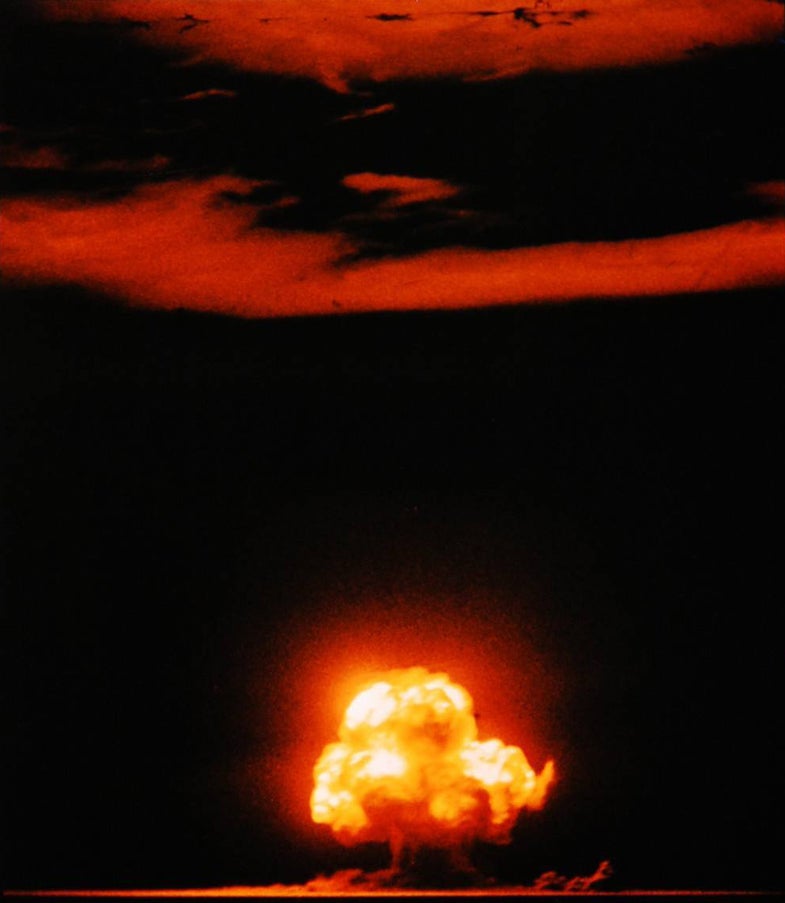
While our friends Jaguar and Ranger toil to model the Earth’s atmosphere, star formation and battery chemistry, other supercomputers are working on classified national security problems. Namely: What happens when a nuclear weapon explodes? Are we sure our nuclear arsenal would actually work, should, God forbid, we decide to use it?
After live nuclear testing ended (or at least was supposed to end) in 1992, supercomputers supplanted explosions so scientists could continue studying how they work. The nation’s stockpile stewardship program, run by the National Nuclear Security Administration at three national laboratories, checks the nation’s nukes for any problems. Supercomputers at Los Alamos, Sandia and Lawrence Livermore national labs conduct tests that can in some ways go beyond the detail of any live explosion, as the Washington Post reports.They have found some good news and some bad news, as Sen. Jon Kyl, R-Ariz., puts it: “The good news is that it tells us a lot more about these weapons than we ever knew before. The bad news is that it tells us the weapons have bigger problems that we realized,” he tells the WaPo.
For example, several years ago scientists at Lawrence Livermore National Laboratory modeled the life cycle of a nuke, from the moment it leaves storage to the instant it impacts its target. They found some fatal flaws that would cause the warhead to “fail catastrophically,” as the Post quotes Bruce T. Goodwin, Livermore’s principal associate director for weapons programs. The military has since fixed the problem, the Post reports.
The flaw lay in the weapon’s ballistics handling, not its explosivity, so this is something that could never have been revealed in a physical test, the Post notes. The power of supercomputers to model these types of things could negate the need for physical testing, some officials say — but Congress has still not ratified the Comprehensive Test Ban Treaty (although the U.S. abides by it). It turns out not everyone trusts supercomputers. Kyl believes while they are helpful, they’re not a substitute for testing, the Post quotes him saying. “That’s why, even though we’re not testing right now, we should not give up the legal right to test,” he said.
Click through to the Post's account for the full story on how supercomputers are helping model the most explosive forces in nature.
Five amazing, clean technologies that will set us free, in this month's energy-focused issue. Also: how to build a better bomb detector, the robotic toys that are raising your children, a human catapult, the world's smallest arcade, and much more.


Online Content Director: Suzanne LaBarre | Email
Senior Editor: Paul Adams | Email
Associate Editor: Dan Nosowitz | Email
Assistant Editor: Colin Lecher | Email
Assistant Editor: Rose Pastore | Email
Contributing Writers:
Rebecca Boyle | Email
Kelsey D. Atherton | Email
Francie Diep | Email
Shaunacy Ferro | Email
@ D13- Brand-new-off-the-assembly-line nukes don't need testing, but the US stockpile has many 30+ year old nukes whose components have been bombarded by radiation for all that time. There is a program to refurbish/replace the components on these older weapons, but there is a backlog. Politicians don't like nuclear testing, but many nuclear experts don't trust the computer simulations.
Not to mention the spontaneous degredation of the fissile and fusable elements that are the true heart of the bomb. Over time, there is less of the U-235 and Deuterium and or Tritium that would produce a lower yield in the best case or prevent a chain reaction altogether in the worst case.
well thats not extremely good that when its in mid flight it decides to take out the u.s. military base than the enemies. atleast the terrorrists would be dead in the explosion too
-Knock knock
-Who's there?
-The Doctor.
-Doctor Who?
-Yes
D13,
Any and all electronic components as they are stored degrade. Some electronic components simply stop working all together sitting on the shelf. With that said, consider how old the original nuclear bombs, missiles and arsenal are. The active ones we have need to be constantly pulled and the electronics constantly test, simply because they are aging.
Besides, over the course of time as you know, there have been many improvements in electronics and so upgrades are made to the weapons too.
The US want to further develop nuclear weapon but if any other country wants to explore nuclear weapons for a deterrence just like the US. We call them "TERRORISTS" with WMDs, and we attack. The many, many faces of The United States of America.
Would you rather trust the US with nukes or a country like afghanistan?
So going from this article, we can have our nuclear explosions in simulation; blow up the world and still be home to eat chicken pot pie!
Oh the simulation was going well. The computers were computing and the data was crunching, then Jameson showed up with this big set of speakers and decided to plug them into the mainframe simulation computer while the nuclear simulation program was running.
BOOM!
Once the nuclear simulation was over, the scientist was heard to say, "WHAT? HUH? I can't hear you? WHAT?"