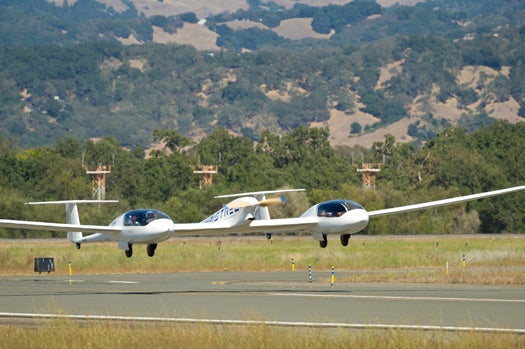
Pipistrel's Taurus G4 NASA HQ Photo

NASA has awarded the single largest prize handed down in aviation history to Team Pipistrel-USA.com for designing and demonstrating its Taurus G4 electric aircraft. Per the rules of the NASA- and Google-sponsored CAFE Green Flight Challenge, Pipistrel’s Taurus G4 covered 200 miles in less than 2 hours and did so on the electricity equivalent of less than one gallon of fuel per passenger, scoring $1.35 million for the effort.

But the cash, substantial though it may be, is only part of the story here. The CAFE (that’s Comparative Aircraft Flight Efficiency) Challenge was created to push aircraft engineers toward new, more efficient airplane designs that would perhaps usher in a new era of ultra-efficient flight, based on either electric engines or extremely efficient fuel-burning engines.

So while you can argue the day belongs to Pipistrel--and we certainly don’t mean to diminish that achievement--the CAFE Foundation and NASA are the real winners here. Consider: The challenge asked teams to average 100 miles per hour over two hours, and to do so on the equivalent of one gallon of gas. Not only did Pipistrel manage this, but so did California-based e-Genius with its electric-powered plane (for which it netted a second place prize of $120,000).

The kicker: both teams did so on just a little more than a half-gallon of fuel equivalent. That means both Pipistrel and e-Genius did twice as well as NASA and CAFE asked them to do (and Pipistrel slightly better than e-Genius, hence the distribution of prizes).

That’s pretty amazing, considering that just a few years ago engineers were still trying to figure out how to get an all-electric powered plane into the air for any considerable length of time, much less at sustained triple-digit speeds and while using very little energy.

Our jetliners aren’t going green just yet of course. But the winning teams in the CAFE Green FLight Challenge collectively spent just two years and $4 million on two aircraft that have pushed the electric airplane field forward by a considerable step. Imagine what ten years and some serious investment might do for the electric aircraft space.

More background/details on Team Pipistrel-USA.com’s winning Taurus G4 in the video below.

[NASA]

13 Comments

Awesome accomplishment.

My only question is: Does the 1/2 gallon figure include take off and climb to altitude?

If so, consider my mind blown.

It's basically a glider with a propeller to get it into the air and out of bad situations by the looks of it.

Because cars and planes (aside from jets) conceptually use the same powerplants, would not the accomplishment of an all electric car be equivalent to being able to make an all electric plane?

"The person is smart. People are dumb, panicky, dangerous animals and you know it. Fifteen hundred years ago everybody knew, the Earth was the center of the universe. Five hundred years ago everybody knew, the Earth was flat, and fifteen minutes ago you knew we were alone in this universe. Imagine what you know, tomorrow.
-- Tommy Lee Jones as Agent K, Men In Black, 1997

The picture in the article is better than the video. At least in the picture we see the plane flying.
I was really hoping to see the plane flying in the video.

Kudos and applause to the team who built the plane! YEA!

@pheonix1012...not really, much easier to roll on 4 wheels than to fly-@dquad...i would think that would be a product of needing maximum lift and minimum drag at a minimal speed (probably just over 100mph), i also would like to know if it included take off and landing (which would cancel each other out in energy costs and savings?), probably 200 miles at a level altitude, cheers

@drchuck1

There is no difficulty. If you look at the engines of a vechile and a standard general aviation aircraft in the normal or utility category (aside from the fact that they only have four cylinder engines, horizontally apposed), you'll notice that mechanically they are exactly the same.

For this, simpler aircraft such as a Cessna C172 should be able to fly on the same type of electrical engine as an economy class two door coup.

Now a more complex aircraft with more devices requiring greater electrical input and output would definitely be more difficult. Such an engine would have to be capable of producing a revolutionary amount of energy to run the powerplant while powering electrical instruments, lighting and the starter/ignition system, and then some.

@pheonix1012 "Because cars and planes (aside from jets) conceptually use the same powerplants, would not the accomplishment of an all electric car be equivalent to being able to make an all electric plane?"

The efficiency of the powerplant, while important, wasn't the real challenge here. Keeping the weight of the aircraft down to maximize aerodynamic efficiency, is the challenge. Particullary the batteries. It is hard to compete with aviation fuel in terms of energy density.

future of aviation.
_________________
The people of the world only divide into two kinds, One sort with brains who hold no religion, The other with religion and no brain.

- Abu-al-Ala al-Marri

If not for the feet upon the ground, we have no sky. If not for the sky we have no clouds. If not for the clouds we have no dreaming. If not for dreaming about clouds we have no flying! Its funny how our feet led us up to fly! It was dreaming about clouds, they help us to comply.

@pheonix1012...i meant the amount of energy needed to move on wheels compared to lifting and them moving, of course an electric motor can fly a plane as this is not the first plane to do so. the problem is how far, the record distance for an electric car is 1,013.8 miles, these are two extreme examples of electric vehicles, neither of which are of much use except to push battery technology forward, comparing cars to planes is comparing apples to oranges, cheers

@drchuck1

Actually, comparing cars to airplanes is more like comparing armadillos to ardvarks. There are very few differences (especially due to the fact that some cars can fly).

@democedes

I wasn't taking that into account. That would make this more engineering news than aviation news.

i am getting the feeling you just like to argue (a type of trolling?), a flying car is niether a plane or a car but a hybrid of the two, cars and planes are so differenr about the only things similar are the engine, wheels and brakes.

i guess this electric planes and or solar plane are really expensive :)) i've heard this solar plance have crossed mediterranean.

"http://airsoc.com/articles/view/id/4fbe9c63c6f8fa3553000004/solar-powered-plane-flies-over-mediterranean?ev=10&evp=tl"


July 2013: The Future Of Flight

The incredible innovations, like drone swarms and perpetual flight, bringing aviation into the world of tomorrow. Plus: today's greatest sci-fi writers predict the future, the science behind the summer's biggest blockbusters, a Doctor Who-themed DIY 'bot, the organs you can do without, and much more.


Online Content Director: Suzanne LaBarre | Email
Senior Editor: Paul Adams | Email
Associate Editor: Dan Nosowitz | Email
Assistant Editor: Colin Lecher | Email
Assistant Editor: Rose Pastore | Email

Contributing Writers:

Kelsey D. Atherton | Email
Francie Diep | Email
Shaunacy Ferro | Email

circ-top-header.gif
circ-cover.gif
bmxmag-ps