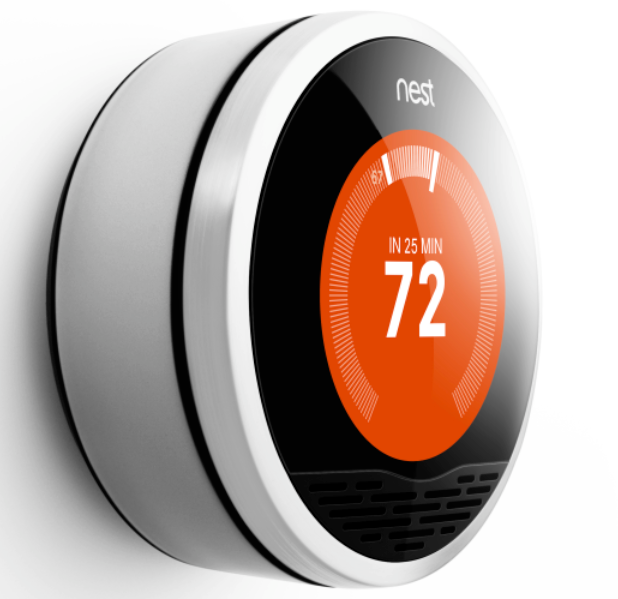
A new thermostat designed by the brains behind the iPod promises to save money by learning your household habits, encouraging energy efficiency while looking snazzy on the wall. The Nest looks like a 21st century version of the circular Honeywell heat controls many people grew up with, and it promises a modern, simple solution for lowering utility bills.
The Nest’s key function is its ability to learn your personal schedule and adjust its settings accordingly, which its designers say is much more efficient than programming it yourself. A single-degree difference here and there can add up to significant savings over time; to encourage smarter settings, Nest displays a friendly green leaf when you’re turning the dial in the more efficient direction. It also helpfully displays how long it will take to set your house to the desired temperature, a handy function for those of us who turn it up way too high to expedite warming. It keeps refining its learning habits over time.
It has a motion sensor that enables an auto-away feature, lowering the heat or raising the air conditioning when the sensor detects that no one’ home. It has built-in WiFi, so you can even control the Nest from a smartphone or tablet app. The dial glows red when the heat is on, and blue when the A/C is on. The brushed stainless steel dial picks up the color of the wall where it’s mounted, seamlessly blending in with your house like the best gadgets should. It goes on sale next month for $249, available at hardware stores and electronics stores.Now this sounds pretty cool, but remember that other smart, catchy connected home energy-savings projects have failed to make a splash; Microsoft’s Hohm and Google’s PowerMeter both faded after lackluster reception, and other energy-efficiency gadgetry is already available from Panasonic, GE and others. These products were also designed with the goal of educating consumers about their own energy habits, and hopefully motivating them to live more efficiently.
They didn’t involve a closed-loop gadget, however, instead using software that integrated with existing home tech. Is a cool gadget the answer? If so, it may not be surprising that its creator also brought us the iPod. Tony Fadell is founder and CEO of Nest, which he started after leading the design team that developed the iPods and the first three generations of iPhones. “Together with the team, co-founder Matt Rogers and I set out to reinvent the thermostat using advanced technologies, high-quality manufacturing processes and the thoughtful design elements the iPhone generation has come to expect,” Fadell says in a company news release announcing Nest.
Could this Apple-rooted product succeed where Microsoft and Google haven’t? Tell us what you think in the comments.
Five amazing, clean technologies that will set us free, in this month's energy-focused issue. Also: how to build a better bomb detector, the robotic toys that are raising your children, a human catapult, the world's smallest arcade, and much more.


Online Content Director: Suzanne LaBarre | Email
Senior Editor: Paul Adams | Email
Associate Editor: Dan Nosowitz | Email
Assistant Editor: Colin Lecher | Email
Assistant Editor: Rose Pastore | Email
Contributing Writers:
Rebecca Boyle | Email
Kelsey D. Atherton | Email
Francie Diep | Email
Shaunacy Ferro | Email
I think this sounds interesting, especially if you can control it from your phone. I just hope that the app they design is also for androids. It would be very handy when the weather takes a sudden turn while your at work. It may be comfortable when you head out, but a cold front moves in while your out and now you need the heater. You could tell it to come on before you get home and it could be nice and comfortable when you walk in. :o)
The Dome Diva
All the world is a stage and I get to play with it.
That's nice, but I'm comfortable keeping the temp at 64 for the whole winter.
It doesn't say 'APPLE' or 'iTHERM', so for $250 I'm pretty certain it too shall 'iBOMB' like the others...
I like it and would try it, if it were 1/3 the price!
My opinion is much like 'kjszeliga' said. The only reason Apple is sold in such high quantities is because they know how to market their goods. Apple succeeded by advertising as being 'different' (even though they are hardly different in any meaningful way) and that got the attention of the 'hipsters' who do things because it's unconventional. Then being a hipster became cool and with it, iProducts. Then they advertised that it's the new cool thing.
Essentially, if they can market it as the next cool thing, it'll fly off the shelves.
IF: It's compatible with an electric heat pump and
it doesn't require a special app to control it and
the price is adjusted to reality, then it might have a shot at success.
Ah, the same old claptrap from 'tertertert.' Apple has sold over 100 million iPhones to people of all demographics from all over the world. Could it possibly be that they make a quality product, one that demonstrably innovated the entire smartphone industry? Making a great product and being good at marketing it are not mutually exclusive.
This pathetic and limited view that anyone who owns an Apple product is just a hipster is laughable. Like them or not, Apple has innovated multiple markets by making great products.
250 Dollars! in this economy?!?!
Seriously, I have an electronic thermostat that does the job efficiently, it lowers the temperature of the house in the wintertime when I am away at work and when I am sleeping.
I do not need an app for that, nor do I even thick about it and it cost me less than $10 well over a decade ago.
250 dollars to do a job I do not need a thermostat to do.
I want one. I have a pretty sophisticated thermostat with like 28 programs (4 per day, 7 days per week). It is a tedious pain to set up. And as schedules change, you have to go update it or it's cold when you get up or warm when you're not there or in bed. Even at $250, it is quite possible that it could pay for itself AND keep the house more comfortable where and when it matters.
And for those who think setting the thermo to 64 and leaving it is best, well, I have zones go to 60 when unoccupied (about 16 hours a day) and yet I don't have to wear a coat inside. Overall it's at least as energy efficient as constant 64 and much more comfortable.
WoW! Imagine having just ONE high tech light switch to control all the lights in your home. Even if it is a dimmer from your phone, I would opt for sensors in the room you are in,or will be in.