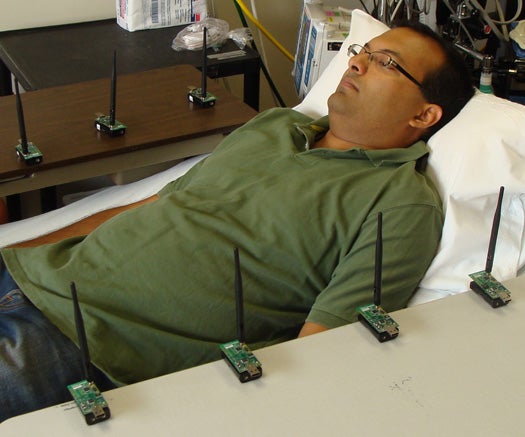
Neal Patwari Measures His Breathing Yang Zhao, University of Utah

A couple years ago we saw wireless technology that would allow us to see through walls. Now, the same team of researchers, from the University of Utah, is putting that motion detection technology to work monitoring breathing patterns. So not only can the network see through your bedroom wall, it can hear you breathing. Less sinisterly, the system could help doctors keep better track of patients with sleep apnea, surgery patients or babies at risk for sudden infant death syndrome.

Team leader Neal Patwari demonstrated the system by lying in a hospital bed surrounded by 20 wireless transceivers operating at a frequency of 2.4 gigahertz. He timed his breathing to be about 15 breaths per minute, confirming this measurement with a carbon dioxide detector. The algorithm accurately measures respiration within 0.4 to 0.2 breaths per minute based on only 30 seconds of data, much better than most monitors, which round off to the nearest full breath.

The system will also be cheaper than existing breath monitors, as it uses off-the-shelf wireless transceivers similar to the ones used for home computer networks. The next step for its development is for the team to determine if a different radio frequency could detect breathing better than 2.4 gigahertz and if the system could detect two people breathing at the same time, but not in unison. In addition to providing technology for use in hospitals, Patwari hopes to integrate the system into at-home baby monitors in five years or so.

[University of Utah via Engadget]

6 Comments

I suddenly had a vision of the sick bay on Star Trek. One day closer to non-intrusive monitoring tech. Keep it up guys! :)

@Everyone

Please, everyone, instead of feeding trolls by replying, ignore them. Don't treat them as cancers, since they're not that serious or important to warrant attention. Treat them like a small scratch on the hand. It stings for a while (because it's annoying), but if you COMPLETELY ignore it, the problem will go away and heal. If you see a reply directed to you, and you KNOW it's irrelevant beforehand, don't even bother to reply it. Squash the thought. There's no reason to feed. I will say this little speech and re-post it because honestly, it's worked in other forums. It takes a while, but they do go away. Why? They lose interest. Simple as that. Examples we DON'T want happening again is the BubbaGump incident. We CAN avoid that!

Article: I'm just curious what kind of effect this would have on a person. I'm just an average reader, but wouldn't the radio waves be bad for the person? Especially for an infant. Like babies raised near a power plant have more chance of getting certain mental disabilities. Would this apply? Wouldn't there be some damage to the brain? I don't know. As much as I like technology, I wouldn't want radio waves scrambling my brain. But if it benefits outweigh the risks, then I suppose it's legitimate.

While I agree that I am not a fan of passing random energy I don't understand through the body, I believe that the potential risk that could be avoided by this type of monitoring tech by far out ways the risk of it causing damage. (This would apply to hospital/medical usage) X-ray still images and fluoroscopy are generally accepted, and the effects of those are known to cause damage if over used.
For the home use aspect I would like to see more studies on the long term effects, not just of this tech, but of all the other forms or radiation (which technically include TV, radio, wireless networks we already have, your computer screen and light, to name a few.) Who knows? I am sure that the studies are out there. I've seen some flaky ones, but none that stand up to logical and statistical analysis.
I'm sure someone will correct me, and I welcome any valid information.

I guess this gentleman has no fear of RF energy like the topic of POPSCI a few articles ago.

I wonder how this much RF would effect a person with internal pace maker and other electronics.

My earlier post may have been unclear. I believe that there are risks that have not been identified or quantified.
I have heard of (but not read) studies that compare cancer rates between 1st world and developing nations, where one of the factors could be the exposure to large amounts of RF energy. However, given the large number of significant variables, I believe that the studies were inconclusive on this point. Again, I would welcome any leads if anyone knows of a solid study.

Hope that people get more benefit from it.But I thought 2.4 GHz frequency get more crowded all time.Anyways this technology will surely lessen or helpful for Doctors in diagnosing their patients.


June 2013: American Energy Independence

Five amazing, clean technologies that will set us free, in this month's energy-focused issue. Also: how to build a better bomb detector, the robotic toys that are raising your children, a human catapult, the world's smallest arcade, and much more.


Online Content Director: Suzanne LaBarre | Email
Senior Editor: Paul Adams | Email
Associate Editor: Dan Nosowitz | Email
Assistant Editor: Colin Lecher | Email
Assistant Editor: Rose Pastore | Email

Contributing Writers:
Rebecca Boyle | Email
Kelsey D. Atherton | Email
Francie Diep | Email
Shaunacy Ferro | Email

circ-top-header.gif
circ-cover.gif
bmxmag-ps