Buy one next year for just $100,000

The Jetpack Blasts Off Courtesy The Martin Aircraft Company

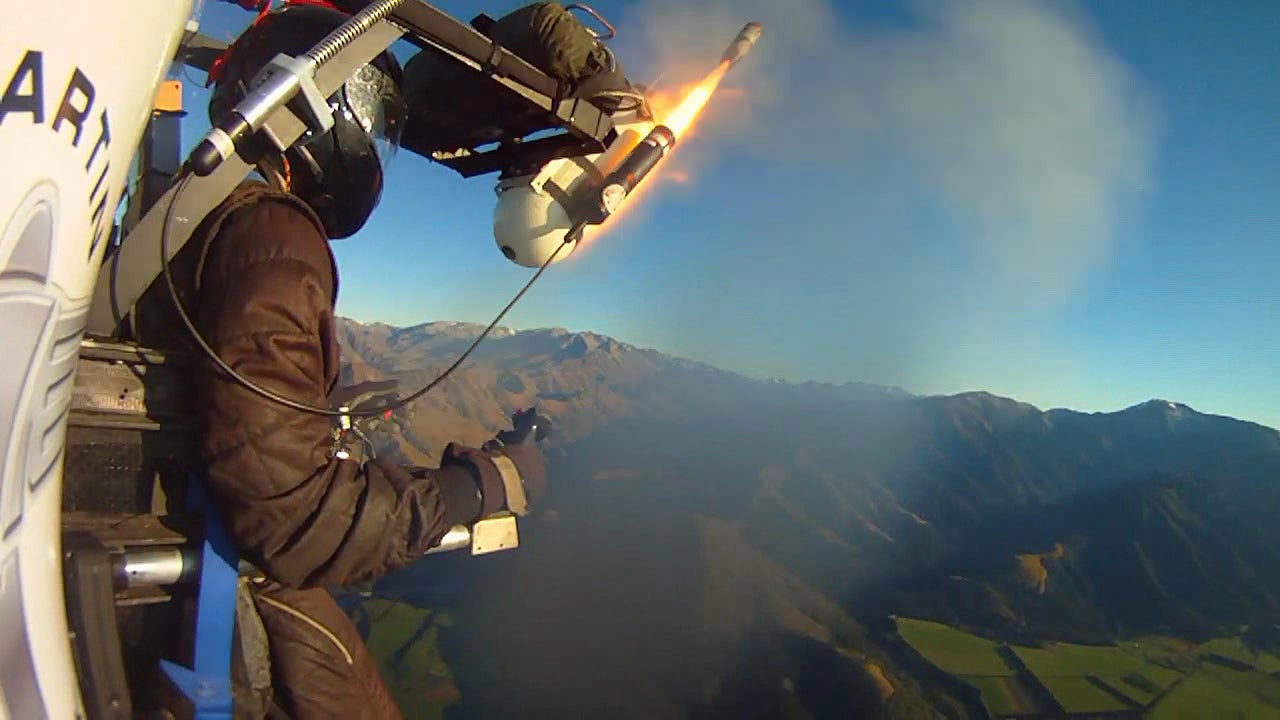
In May, inventor Glenn Martin—along with fire-rescue officers and crews on board a pair of chase helicopters—watched as his jetpack flew for nine minutes and 43 seconds, soaring 3,500 feet into the New Zealand sky. Had the machine been holding a live person instead of a 150-pound dummy, it would have smashed the record for the longest and highest jetpack flight ever. Every other such device in history has managed to be airborne for, at most, only a minute or two. But Martin was out to do more than set records with his demonstration. He wanted to prove that his design was safe enough to become the first commercial jetpack—one anyone could buy and fly.


Click here to launch a gallery looking at the finally airborne jetpack.

Martin had flown his machine thousands of times before the May launch, but never higher than a few feet. Since the jetpack’s first public flight in 2008, Martin and his team of 10 engineers haven’t changed its basic design: a two-stroke, custom-designed gas engine spins a pair of ducted fans that generate thrust. They did, however, convert the original cable-and-pulley steering system to an entirely electronic, fly-by-wire system. A cellphone-size flight-control unit made by defense contractor Rockwell Collins and commonly used in Predator UAVs allows Martin to set bounds on pitch, roll and yaw, and generally steadies flight, canceling out a new pilot’s jerky maneuvers (it also means no backflips, unfortunately). By adding remote control to the jetpack, its applications expand. A search-and-rescue team, for example, could remotely pilot a Martin Jetpack to a hard-to-reach spot in a disaster zone, instruct a victim to strap in, and fly him to safety. Or soldiers could use the jetpack to fly a mini cellphone tower to a hilltop for temporary communications.

Martin says that he hopes people will also use his jetpack for recreation. He’s designing it to meet FAA ultralight standards, which will limit the speed to 63 mph and flight time to around 30 minutes. Flyers won’t need a pilot’s license, but they will need about $100,000 to buy the rig, which includes a mandatory two-week training session. The first units could ship as early as next year.
The Prior Pack:  Courtesy Martin Aircraft Co.

THE PRIOR PACK

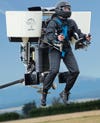
When Glenn Martin first unveiled his jetpack in 2008, it could hover only a few feet off the ground. He earned a PopSci Best of What’s New award that year, but critics argued that the jetpack would never get much higher than a few feet. The design’s fans, they said, were pushing air down off the ground for lift. Martin’s jetpack actually speeds flow to alter air pressure, generating lift at any height.
15 Comments

This is why I ride a motorcycle with such a hefty price tag how can i ever hope to fly :(

Why do you passively submit to the seller's marketing scheme of calling this device a jetpack? It uses propellers, or fans, not jets, and isn't a jetpack.

You should call it a proppack, or even better, a FANNYPACK.

i asked the last time this was in the news what made it a jet pack, the answer is obviously nothing, however, it is very cool, too bad it isn't less expensive

@kbeery

lol FANNYPACK

@kbeery
FANNYPACK is exactly what it needs to be called! lmao I think its a cool device but not really a jetpack. I wouldn't even know what I would do with one of these if I could afford one.

Does this mean that the jetpack will fly for thirty minutes at a time or that you will only be able to fly for thirty minutes in a certain period of time?

There was real jetpack several years back which was powered by a Williams gas turbine,if memory serves.The reason it didn't go into production was because Williams' total production was committed to cruise missiles,which use the same engine.

@GSXR I agree. thats why I got into bikes. my need for speed. I can go as fast as $100,000 super car for 1/10 the price. but this???? no way to match flying on a bike unless....

you have the 600 or 750? just watched a new video review for the 2011 mid range bikes. they say the GSXR 600 is the new king of mid range bikes. still out of my price range for now. sick bike though.

The Fannypack is 'much' like the history of the car. Cars were very expensive and it was way cheaper to get a horse. Cars then became commercialized and far more used, ultimately becoming common use. Just give the cool Fannypack time. (hopefully not a century)

IDGA# !

it flys and it can be mine ! oh yes it will be mine !

http://www.youtube.com/watch?v=bw4uj_ZPHvY

bored? lets go mine the stars... ^^

@GSXR_Fanatic

Overtime getting a pilot's license is fairly inexpensive (compared to buying a fannypack or a sports car). Once you achieve that feat, you can rent a plane by the hour whenever you want to fly. If you want to buy a plane, their are some that cost as much as an economy class automobile.

Flying can be cheap depending on how you do it. The fancier it becomes the more expensive it tends to be (i.e. private & corporate jets, decommissioned military aircraft, & fannypacks).

"Why do you passively submit to the seller's marketing scheme of calling this device a jetpack? It uses propellers, or fans, not jets, and isn't a jetpack.
You should call it a proppack, or even better, a FANNYPACK."

Well most are actually supposed to be called rocketbelts anyway since they dont use jets.

this thing while impressive and certainly not a waste of time compared to those 30 second rocketbelts, is closer to a personal helicopter than a jetpack

we finally have our jump jets, and their bulky to boot but still thirty minutes in a straight line is faster than thirty minutes in any car.

to mars or bust!

While I think this has potential, there will still be those who will say that gas engines do stall at inoportune times.
Wonder if there are electric motors that can equal the rpm's needed to get airborne?

What this technology needs is some type of failsafe. One stall or sputter which decreases RPM's and you go down like a falling rock.

@seeker72

That is a great idea. it does need a fail-safe on it.

To everyone else: THANKS FOR BUMMING ME OUT! I WANTED A JETPACK! well, back to the drawing board.


June 2013: American Energy Independence

Five amazing, clean technologies that will set us free, in this month's energy-focused issue. Also: how to build a better bomb detector, the robotic toys that are raising your children, a human catapult, the world's smallest arcade, and much more.


Online Content Director: Suzanne LaBarre | Email
Senior Editor: Paul Adams | Email
Associate Editor: Dan Nosowitz | Email
Assistant Editor: Colin Lecher | Email
Assistant Editor: Rose Pastore | Email

Contributing Writers:
Rebecca Boyle | Email
Kelsey D. Atherton | Email
Francie Diep | Email
Shaunacy Ferro | Email

circ-top-header.gif
circ-cover.gif
bmxmag-ps