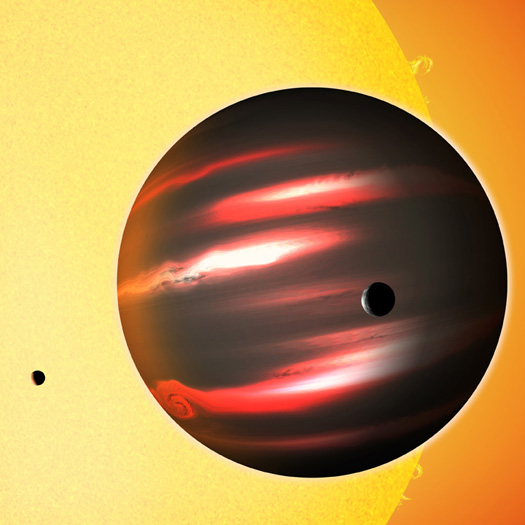
TrES-2b, the Blackest Planet We've Ever Seen David A. Aguilar (CfA)

Kepler has found the darkest known planet in universe--a Jupiter-sized exoplanet some 750 light-years away that is so black that it reflects just one percent of the light that reaches it. TrES-2b is so black that it’s darker than coal, or any other planet or moon that we’ve yet discovered. It’s less reflective than black acrylic paint. To summarize: it’s really, really black.

But TrES-2b is not completely black. It emits an extremely faint red glow, like that of a hot ember. And it turns out that heat is the main culprit behind this darkest of dark planets. TrES-2b orbits its star at a distance of just 3 million miles (by comparison, we’re about 93 million miles from our sun), which leads to surface temperatures on TrES-2b of more than 1,800 degrees.

That’s too hot for the formation of ammonia clouds that would reflect some of that incoming radiation as they do on Jupiter. Rather, TrES-2b’s atmosphere is made up of things like vaporized sodium, potassium, and titanium oxide--things that actually compound the problem by absorbing heat. But even these don’t fully explain the planet’s extreme blackness, which is still puzzling astronomers. There's some kind of strange chemistry going on out there that even Kepler can't see.

22 Comments

the planet itself isn't black, its just protected by a massive Langston Field.

Let's point Hubble at it, maybe it'll prove its usefulness to NASA.

...who am I kidding?

and who's to say it isnt black? until Abremms goes there himself and can say, 'yeah, its really a big pink planet with a black coat on' - then i'll stick to the 'its a black planet' theory.

Be careful it could be the 5th Element 'pure evil' laying low to strike unexpectedly....

Wouldn't it make sense that its extremely close proximity to its star make it burnt to a crisp? We all know what happens to things that are burnt that badly, then turn...black. Its probably just far enough away to not be constantly molten but close enough to be permanantly burnt to a crisp. The thing I'm wondering though is: if its that close, wouldn't the gravity of its star pull it towards it?

Nice.

"Do not scorn a weak cub; he may become a brutal tiger."

The only thing blacker is Smell the Glove.

I have a theory if the mass of the planet is considerably less than that of the star the planet could be tidally locked with the star(one side always facing the star). this would make major temperature fluctuations and could have profound changes in the chemistry that is happening in the planets atmosphere. this might chemically explain what compounds or gases we are dealing with that could make this planet so black.

UPDATE: "Sorry guys, turns out we have a cluster of dead pixels on our screen - My bad!"

lol, "ten days after observing the star it has started moving towards us away from it's parent star. we would be sufficiently creeped out but our own sun will have died with us along with it by the time it gets here. no news on how it can think faster than the speed of light..."

to mars or bust!

Close Abremms,

It's a dyson sphere.

Though it isn't designed to encompass a star, it is designed to absorb a greater intensity of the star (because of it's close proximity), while shielding the planet it surrounds.

..well that is if it's unusually spherical.

@ScottG
Try a Jupiter Brain via Wikipedia. That's a theoretical structure that'd be built around planets, although whether you'd build one around a planet that warm, I don't know.

Can they tell it is not a kind of device gathering a lot of energy?

So that means that the photons being absorbed are then being stored or reproduced into some type of negatively charged particle? Assuming that is possible of course. Ideas?

If not that, then definitely that evil planet/force from The 5th Element. I hope everyone has they're Multi-Pass.

@Solomon13

That would be really cool. If a civilization were using it to safely harvest energy from a distance. Who knows what kind of technology is involved that we just can't see.

i think a far more advanced alien civilization is using it as a star-gate. maybe there's another one in another dimension.

Some other interesting items.

The potential volume is huge. Many times that of Jupiter (..which alone could "contain" more than a thousand "Earths").

The orbit is *prograde* around its star - and however slight its movement is away from it's star. (..which one would think is a positive virtue being so close to a star, and also highly peculiar given the gravity of the star and the gravity of this "planet". Note that "hot" gas giants usually form at the outer system and move into close proximity of its star with a *retrograde* orbit)

The orbit (or "year") is also very *fast*. This isn't uncommon with plants close to a star. BUT again, something perhaps advantageous when considering solar flares.

It really makes me wonder what the "day" is like. If it's relatively fast (like ours), that again would be advantageous with respect to distributing heat across it's surface.

Other oddities: it's in a binary system, though presumably the secondary star is relatively far away.

Once you go black planet, you don't go back planet

where there is light, there is darkness- everything has a balance.

One day, we will play ball with the planets

I don't know, therefore aliens.


June 2013: American Energy Independence

Five amazing, clean technologies that will set us free, in this month's energy-focused issue. Also: how to build a better bomb detector, the robotic toys that are raising your children, a human catapult, the world's smallest arcade, and much more.


Online Content Director: Suzanne LaBarre | Email
Senior Editor: Paul Adams | Email
Associate Editor: Dan Nosowitz | Email
Assistant Editor: Colin Lecher | Email
Assistant Editor: Rose Pastore | Email

Contributing Writers:
Rebecca Boyle | Email
Kelsey D. Atherton | Email
Francie Diep | Email
Shaunacy Ferro | Email

circ-top-header.gif
circ-cover.gif
bmxmag-ps