A Sensor-Packed Shipping Container That Folds Flat in 30 Seconds
Let's see how it works.
In the half-century since Malcom McLean, an entrepreneurial former trucker from North Carolina, first began packing freight onto ships in uniform steel boxes, shipping containers have transformed the way we move most of the goods on Earth. As McLean recognized, cargo with consistent dimensions becomes a commodity. Any box can go anyplace on any ship, and therefore can be moved and stored far more cheaply and quickly than cargo that comes in a hodgepodge of shapes and sizes.
How It Works
Composite Body
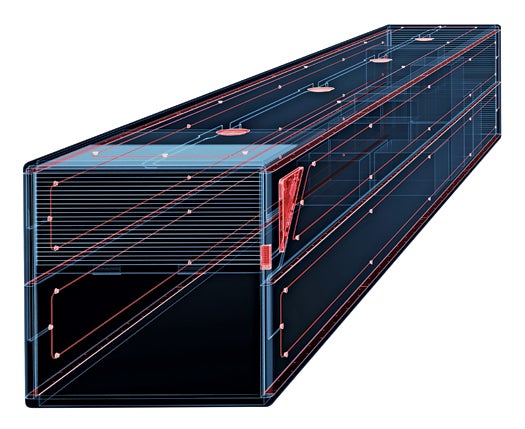
As strong as steel and up to five times as corrosion resistant, fiber-reinforced polymer walls make the box lighter and easier to scan than today’s containers.
Monitors
Internal sensors measure humidity, atmospheric pressure, oxygen level, radiation and temperature to detect food spoilage, smuggled nuclear material or even the presence of humans inside.
Collapsible Frame
For more efficient storage and transportation when empty, the box can be folded to a quarter of its full height in just 30 seconds. The doors roll into the roof, and the walls collapse inward.
Tracking Tag
Tamper-proof RFID tags secured within the box transmit owner identification, origin, destination, inventory and travel history.
Padlock Alarm
If the container is opened at an unscheduled time, by an unauthorized person, or outside a designated trusted zone, an alarm is triggered and transmits an alert.
Tamper Protection
A small electrical current runs through mesh embedded in the composite walls. Any breach that disturbs the flow of current will send an alert to the shipper, the receiver and the authorities at the destination port.
Communications Sensor
An onboard computer draws data from monitors and sends encrypted updates by satellite or cellular network to the appropriate parties—owners, shippers, customs officials or port operators.