Someday, our cars will all be connected to each other, sharing traffic information, connecting us into “road trains,” and swapping position info so that collisions become a thing of the un-wired past. But even if new cars came equipped with such networking tools tomorrow--and they won’t--it would be decades before every car on the road was wired into the system. So MIT researchers are taking a different tack, modeling human driving behavior to create algorithms that can help computerized cars predict what human drivers are going to do next.
To suss out the patterns in human driving, the team first had to break down the act of operating a moving vehicle into its most basic parts: accelerating and decelerating. Using onboard sensors, the computerized intelligent transportation system (ITS) first determines which state another vehicle is in. From there, there is a finite (but sill large) number of positions on the roadway the vehicle can be after any given duration, be it one second or ten.
It’s here that the human behavioral modeling comes into play. The computer assesses other factors (is it an intersection or an onramp?) and other data about where human drivers tend to accelerate or slow down. All this, filtered through an algorithm, gives the ITS a pretty good idea of where a vehicle might be immediately headed.The ITS-equipped vehicle then quickly figures out the areas in which the two vehicles could theoretically collide (this is termed the “capture set”) decides what it thinks the other car is going to do, acting accordingly to avoid those “capture set” areas where the risk of collision is remarkably more pronounced.
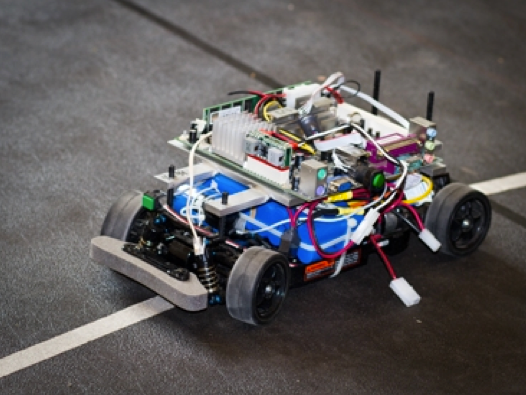
To test the system, the MIT team built two miniature cars--one equipped with ITS, the other controlled by human drivers--and put them on circular, overlapping tracks. They then ran 100 trials, changing up the human driver to compensate for any particular driver’s style. The result: collision was avoided 97 times. Vehicles entered the “capture set” three times, and only one of these instances resulted in collision.
Not bad. Of course, all or this has to take place in an instant in the real world, and adding more cars and more variables (pedestrians and cyclists, for instance) compounds the challenges. But the work is important for reasons that go beyond the roadway. If we’re truly going to learn to live alongside our robots, we don’t just need to know what they are going to do next. To some degree, they need to be able to predict our next moves as well.
[MIT News]
Five amazing, clean technologies that will set us free, in this month's energy-focused issue. Also: how to build a better bomb detector, the robotic toys that are raising your children, a human catapult, the world's smallest arcade, and much more.


Online Content Director: Suzanne LaBarre | Email
Senior Editor: Paul Adams | Email
Associate Editor: Dan Nosowitz | Email
Assistant Editor: Colin Lecher | Email
Assistant Editor: Rose Pastore | Email
Contributing Writers:
Rebecca Boyle | Email
Kelsey D. Atherton | Email
Francie Diep | Email
Shaunacy Ferro | Email
So the drones flying over the devastation will have an easier time tracking the last few remaining humans tearing desperately over the blasted landscape in their homemade bajas because we've already written an algorithm for it?
How nice of us! :-)
@combatko - that's funny.
Why don't the cars just communicate with one another. I can't read another drivers mind. But what if my car could just read the other car's mind. If it's 8:30am on a monday, odds are that other car is going to work. It knows the path to work, it knows when I'm going to make the next turn and it knows if I'm running late or not (it has sync'd with my outlook calendar). Just seems like a car could drive down the road and say - I'm making a turn in 15 minutes, everyone prepare to change lanes or slow down.
A learn function would be nice coupled with an internal GPS that is networked to the traffic signal matrix. You "teach" your car the route then future trips can be accessed via voice command and then your car will interrogate the network and find alternate routes to avoid congestion. There are many variables that industries can play with.
I have an idea. Why don't we do away with all these algorithms, robots, and other junk, and start driving with more courtesy and respect. Maybe take away the ability to drive a vehicle from those who don't deserve it. Like kill them, or at least, maim them. I swear, we are getting so impersonal and disrespectful of each other.
@Cybegor...i agree, but you are pushing getting personal to a whole new level, kill and maim, cool...@combatko, exactly my thoughts...@beantown179, it is the herd like you that think nothing bad can come from AI ensures that it will
@beantown,
I totally agree... cars should just communicate with each other to figure out where they are going.
However, that's not very "backwards compatible" to the poor people who can't afford high-tech cars.
So, the high-tech cars have to (at least initially) be capable of being on the street with the '71 mustangs driven by meatbags--erm, humans.
@drchuck,
LOL! and you were going off about how I'm Mr. Negativity?
I think we're in much greater danger of a single human ruling the world than a single AI system...
And, I don't think anyone claims "nothing bad will come from AI".. bad things come from all technologies, when it's abused by bad people.
Bad things come from the Internet, the printing press, electricity, cars, guns, drugs, etc.
i tend to think of it as being real, but you are correct, we may create our demise before the machines do it for us, i know many people who believe there is no danger with AI or that it is even possible, sorry, i can be a little kranky
Really? You know people who can't possibly imagine a situation where an AI miscalculates and crashes a plane, or has a hardware failure and shuts down the power grid?
Do these people use computers? Have they ever had an error or virus or problem using one?
That just sounds incredibly naive...
yes, they are incredibly naive
i hope i can speak for more people than just myself when i say that it's scary how little privacy we have anymore. but yes, let's keep shaving away at what little privacy we have left. let's do all our banking on our smartphones, using them as our credit cards. let's share our exact location in real time, where we are going, what we are going to do, etc. you can call it "safety", i'll continue to call it giving up our privacy.