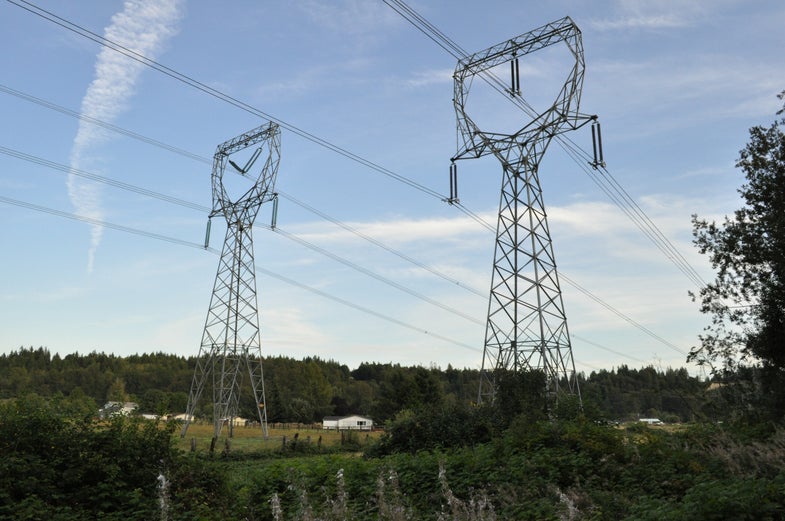
Power Lines Wikimedia Commons

Soon, when you sleep through your Monday morning alarm, it may be Uncle Sam’s fault. Federal officials are considering an experiment on the nation’s electrical grid that could interrupt the way your appliances tell time — from your bedside alarm to your automatic coffeemaker.

Once they’re programmed, electrically powered clocks tell time based on the rate of the electric current that feeds them, as an Associated Press story explains. Electrical utilities keep the current’s frequency stable in part to keep clocks precise, the AP says. But utilities could save energy and money by allowing for greater frequency variation, so the Federal Energy Regulatory Commission is considering allowing the change.

Joe McClelland, head of electric reliability for FERC, wondered whether anyone really uses the grid to tell time.

“Let’s see if anyone complains if we eliminate it,” he said.

Renewable energy is one primary reason FERC cares about frequency variation. Power sources like wind and solar energy will ramp up and drop off with great variability, inducing spikes and valleys in the energy flowing through the nation’s electrical grid. Adjusting for those differences is expensive, and can be wasteful, according to FERC. Forgetting about it would just be easier — unless all the nation’s clocks are suddenly off.

With a more variable current, wall clocks and appliance clocks, like the one that’s programmed to brew your coffee every morning, will become less accurate every second, a phenomenon that can get much worse over time. One trade group that has studied the potential effects says East Coast clocks could run 20 minutes fast over a year, and timepieces on the West Coast clocks would be off by about 8 minutes.

Officials from FERC said they are tentatively planning to test a more variable frequency in mid-July, AP said.

It’s a good thing we have ridiculously accurate atomic clocks to keep us all on track.

[Associated Press ]

15 Comments

Crystal oscillators are very cheap, I hope very few clocks sync from the grid.

This seems unlikely. Digital electronics require DC power, which in turn requires a DC power supply. That power supply is responsible for providing "clean" power to the solid state device. If variations in current are so great as to upset the function of the power supply, it is more likely that it would actually cause damage to the power supply. "Dirty Power," as it is typically called, can be responsible for blowing out computer power supplies if it is dirty enough - which is a reason to have a good surge protector and UPS for applications that tend to cause the type of instability responsible for killing computer power supplies.

I am no expert, however, the circuitry used to polarize AC current into DC current, to my understanding, not only divides the current into negative and positive polarities, but makes use of capacitors to buffer the pulse resulting from the sine wave. If this pulse becomes erratic, it would seem to me that a great many other aberrations would ensue as a result, and not just a problem with digital timing. I could be wrong about this, and if so, hopefully someone with sufficeint expertise in the field of electronics can enlighten us.

Thanks.

...instantaneously jail cells and bank vaults randomly situated across the US opened up at 2am.

ok, so just make a clock that keeps time according to the grid and compare it with an atomic clock keeping accurate time, and once a month (or week) vary the frequency during the middle of the night to offset the the inaccuracy introduced by the grid. it would be cheaper than constantly varying the frequency, but still keep all of our clocks on track. (or just put a note on everyone's electric bills to adjust the times on all of their appliances' clocks)

it's great to know the government is finally serious about the integration of renewables to the power grid and trying to take ample measures towards it's eventual implementation.

You will also find that radios can be affected as well. There are several devices which use the 60hz of AC mains as a reference clock.
Like with most things though, I am sure we can live through the process ;)

I'm not so sure about this. From what I understand, they need to keep the frequency and phase fairly precise to allow them to bring additional resources on line. Adding power doesn't work as well, if it's not in sync.

This is one of the problems with people willy nilly dumping power on the grid via solar or wind.

Also,
In days of yore, they used power line frequency to sync the vertical sweep on TV sets -- thus one of the differences with European and American TV. I doubt that it's an issue with LCDs etc, but whatever CRT sets remain (including a couple of mine), may see an impact.

However, this may not be what they're talking about
http://www.ferc.gov/whats-new/comm-meet/2011/021711/E-4.pdf
may be tre actual source of this discussion, and it seems to be somewhat different from what's descrived here.

We need to update our power grid for mobile billing smart batteries today, because we are updating it anyway, and we can bust the price of oil doing it. The reason the power metering system is being updated is because it is cheaper then paying a massive staff of meter readers going home to home. We simply take those meters and make a low level home network on your home power lines. A network any hybrid or battery powered car can plug into for a partial or full charge. That home plug network created by the home meter connects into the power lines that establish an internet like connection to the power company. That network creates a billing network for the power used by your home less the power of mobile batteries like those in hybrid vehicles. Now your car can store the power created by your solar panels at home while you are plugged in at work, and those batteries are more effective and less expensive because of it. Why have two sets of batteries and less vehicle range?

The full or partial charge allows your hybrid vehicle to reach an alternate fueling station farther away reducing the infrastructure needed to make alternate fuels possible. Gasoline has ten thousand fueling stations for the US, and with a thirty mile range that batteries give, introducing an alternate fuel would only need hundreds of stations. Let’s say new natural gas stations cost 2 million dollars each that would be about a billion dollars for hybrid cars to run on natural gas, gasoline or ethanol in the same vehicle. Most of the problem is that the tubing in standard engines cannot stand up to more corrosive fuels like natural gas or ethanol. This is cheap to fix at manufacture only costing an additional hundred dollars vs. three or four thousand dollars to convert a vehicle latter. The feasibility to introduce more alternate fuels will force the price of gasoline down.

This strategy also puts the commute onto electric power with cheaper local sources like coal, or cleaner sources like nuclear or your own home solar. Plugging in hybrid vehicles overnight to power a commute is well established, but plugging in at work too would double the range, or half the batteries and cost. This would make almost all commuting coverable by local electric power. Since sixty percent of all carbon emission come from gas used for commuting to work this represents a significant savings and control of emissions. This savings would double the use of existing oil reserves busting the price of oil. At about seven percent new vehicles introduction per year it would only take about five to seven years to move the price of gas down. This would also make the smart batteries to regulate our electric power grid feasible as well because it would cost effectively connect lots of batteries onto the power grid for the power companies to draw on to smooth out peak moments. This would actually create even less overall emissions. The solution to carbon emission and the gas crunch is only a solution if it saves all of us money at the same time.

President C., varying the frequency only at night isn't an option. The concern expreased in the article is minimizing the occurance of cascade power outages caused by variations in the line frequency. The testing will attempt to find the 'happy medium' where frequency fluctuations caused by power from alternate sources cycling in and out of the grid
cause the least disruption. If the trip point protection for 60 cycle AC is currently +- 3 cycles, how many more trips will occur if the setting is increased or decreased?

While solar power may be primarily a daytime resource, wind and geothermal generation can operate 24/7 in most locations.

There's always time to do it better NOW.

Expert here:

Almost all of your home electronics that have an AC power source uses the power line as a clock source. AC clocks are very accurate and VERY cheap. It is the difference between $.30 and $.70. When you are designing million-unit designs, that is $400,000 profit that the company will lose if you need an external oscillator. Add in the fact that industrial automation and communications rely on the 60Hz to synchronize their clocks, and you get a very resistant userbase.

Power companies are very concerned about this, so if they accidently run at 59Hz for half of the day, they will run at 61Hz for the other half.

With that being said, most electronics are built to withstand 5% variation. If you are designing for international markets, you need to worry about 10% variation. I look forward to reading their test results.

Frequency affects clocks, lighting and any rotating machinery connected to the grid. But more imporatanty, it affects grid operation and the devices that rely on accurate frequency measurements:

"Generators can only be interconnected to operate in parallel if they are of the same frequency and wave-shape. By standardizing the frequency used, generators in a geographic area can be interconnected in a grid, providing reliability and cost savings."

"The primary reason for accurate frequency control is to allow the flow of alternating current power from multiple generators through the network to be controlled. The trend in system frequency is a measure of mismatch between demand and generation, and so is a necessary parameter for load control in interconnected systems."

"Frequency protective relays on the power system network sense the decline of frequency and automatically initiate load shedding or tripping of interconnection lines, to preserve the operation of at least part of the network. Small frequency deviations (i.e.- 0.5 Hz on a 50 Hz or 60 Hz network) will result in automatic load shedding or other control actions to restore system frequency."

Basically, large systems are extremely sensitive to frequency fluctuations. Smaller systems are a different story.

btw, is there a way to store and stabilize the energy generated from wind,solar, etc. before introducing it to the grid?

if all of these changes are introduced to accommodate energy fluctuations, i was just thinking it might be more efficient to stabilize those frequencies first instead of directly introducing them to the grid.

20 minutes slow translates into a frequency deviation of ~.004% on average (59.998Hz from 60Hz). This will have exactly zero noticeable impact on radios, televisions (be it LCD, LED, or tube), computers, generators, protective relays, power flow control, power grid synchronization (typically done with slip frequencies as high as .1Hz - so 59.9Hz on one side to 60Hz on the other), and "cascading power outages" (I assume doitbetternow is referring to cascading brownouts, where there is insufficient generation for the power used). It will be noticeable over time in clocks that use the grid, but I don't know of anyone who's clocks at home are accurate within the minute (barring the select few who like the atomic clocks) - a lot of people intentially set them slow or fast.

The reason renewables is mentioned is because it's "non dispatchable", meaning a power grid operator cannot tell the wind farm owner to produce X amount of watts and Y amount of VARS at Q time. The wind blows, the farm kicks out power, and the operators add/remove other generation to accommodate the wind power - which is by nature a reactive response (instead of proactive), so the power frequency will naturally deviate more than if all/nearly all generation was dispatchable.

There seems to be a fundamental misunderstanding by some of what causes the frequency deviation - it's the ratio of generation to load. You can think of it like peddling a bike. If you are peddling in one gear, and suddenly throw it to a different gear, your feet will speed or slow down because the load on them has changed. If the load is less than the generation, the system frequency increases (and in the bike example, your feet will go faster). If the load is more than generation, the frequency will dip (your feet will slow down).

Solar power on-grid inverters are frequency sensitive. I'm using two Sunny Boy SMC inverters that will sync when the frequency is between 59.3 and 60.6 Hz. If the frequency goes outside of that range, the inverters will stop, and no solar power will be fed back to the grid.


July 2013: The Future Of Flight

The incredible innovations, like drone swarms and perpetual flight, bringing aviation into the world of tomorrow. Plus: today's greatest sci-fi writers predict the future, the science behind the summer's biggest blockbusters, a Doctor Who-themed DIY 'bot, the organs you can do without, and much more.


Online Content Director: Suzanne LaBarre | Email
Senior Editor: Paul Adams | Email
Associate Editor: Dan Nosowitz | Email
Assistant Editor: Colin Lecher | Email
Assistant Editor: Rose Pastore | Email

Contributing Writers:

Kelsey D. Atherton | Email
Francie Diep | Email
Shaunacy Ferro | Email

circ-top-header.gif
circ-cover.gif
bmxmag-ps