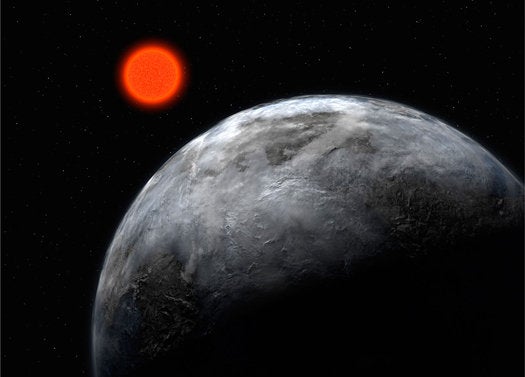
The red dwarf Gliese 581, one of our own solar system’s closest neighboring stars and a regular point of exoplanetary interest, can finally claim the title of owning the first confirmed potentially-habitable expolanet. French researchers running complex computer models have demonstrated that the planet Gliese 581d--once thought too cold to sustain life--indeed could possess the proper ingredients to sustain liquid water and an atmosphere.
Gliese 581 and its “Goldilocks zone”--the orbiting range wherein habitable planets are neither too close nor too far from their star to support life--have received a good deal of attention since the first of three planets thought to be orbiting there was discovered in 2007. One was 581d, the other 581c. Gliese 581d was originally deemed to close to the outer edge of the zone (read: cold) to support life, but hopes ran high for 581c until a later analysis proved it too close--temperatures on the planet are likely akin to those on Venus, where any liquid water would boil off immediately.
Then there was astronomers’ brief flirtation with Gliese 581g, a planet thought to be orbiting somewhere between the 581c and 581g, primely placed to support liquid water on its surface. But upon closer inspection, it turned out that 581g probably doesn’t even exist.
Now interest has turned back to 581d, the outermost of the three (possible) planets and one that all scientific analysis suggests is real. Using a new kind of computer model that is better capable of simulating possible climates, a team of French researchers has determined that 581d could very well have a dense, stable carbon dioxide atmosphere that would keep the planet warm enough to support oceans and to prevent atmospheric collapse on its perpetually dark side.
Oh, and that’s the thing: Gliese 581d wouldn’t be particularly hospitable to humans. For one, it is tidally locked, so one side always faces the sun and one much colder side is in perpetual darkness. While twice as big as Earth, its mass is seven times greater meaning the effect of gravity would be roughly double. And that atmosphere: toxic. Not that it really matters, because it would take humans 300,000 years or so to get there by current methods, and that’s if we had a spacecraft capable of traveling that far.
But that makes the finding no less exciting for astronomers. For the first time we know beyond just speculation that a planet has the potential for life. While not yet possible, future generations of telescopes will be able to directly search for life on Gliese 581d, and who knows what they might find there?
Five amazing, clean technologies that will set us free, in this month's energy-focused issue. Also: how to build a better bomb detector, the robotic toys that are raising your children, a human catapult, the world's smallest arcade, and much more.


Online Content Director: Suzanne LaBarre | Email
Senior Editor: Paul Adams | Email
Associate Editor: Dan Nosowitz | Email
Assistant Editor: Colin Lecher | Email
Assistant Editor: Rose Pastore | Email
Contributing Writers:
Rebecca Boyle | Email
Kelsey D. Atherton | Email
Francie Diep | Email
Shaunacy Ferro | Email
Space travel outside of our solar system is silly without some kind of teleportation system.
Call me overly optimistic if you will, but I find it silly when people are so skeptical about space travel simply because of "distance" and the complexity it presently represents (key word "present").
Yes, the vast distance seems insurmountable to us now. But, our technology is growing exponentially. When we do discover a way to transverse the galaxy, it will be through technology and new science we find possible through future means (that seem impossible to us now.)
Is that really so hard to grasp? Think of what we can do now that would seem infinitely impossible 200 years ago. To think in those same patterns of reflection given the incredible speed and growth with which we've shown our passion for progress seems incredibly ignorant on our part. I'll admit that the bungling, bloated, inept country that we have become over the years may not be the ones to develop this new science/tech ... but we are but a small portion of the larger common denominator.
“We can't solve problems by using the same kind of thinking we used when we created them.”
The problem here being time and distance. The solution being ... things we can't even grasp at the moment.
But we will.
@Chad_Is_Rad
Wonderful post, and I wholeheartedly agree. I would like to add, however, that even if we do not find a way to traverse the vast distance, knowledge for its own sake is still worth the investment.
Until such technologies arise to allow us to bridge these gaps in much shorter time, we are simply going to see a return to the old days where people devoted their entire lives (in some cases multiple generations) to exploration. I hope to see a re-emergence of this ethic as it is the only thing (barring a cataclysm) that will make us push out from our comfy little ball of clay.
Right now unfortunately humanity does not possess the will to make use the technologies we have for exploration. What difference does it make if gliese is 20.5 lightyears when we aren't even willing to follow through with plans on a body 238855 miles away.
i say lets focus on traveling to near by planets like mars and our moon first before setting our sights on other solar systems and galaxies. lets keep searching for life, but the conventional way is not cutting it. we need to invent and invest in something more powerful and faster.
corrrect, do what we can with what we have now, research will continue and faster modes of transportation will be developed
We will not go anywhere as long as we limit ourselves to only thinking in the box. I agree that we should focus on our solar system right now but, limiting our use to only chemical rockets is like showing up at Indy on Memorial Day with a horse and buggy. Plasma reaction steering systems are already within our grasp and Space-Time Dimensional Compression should be studied with focus and vigor. As a retired engineer, I feel the days of Apollo were examples when we were at our best. But the days of post Shuttle are just regression back to what we were before that and not what we could be. Where is the vision of Jack Kennedy when we need it? Where is the genius of Einstein when we need it? Where is the interest of youth when we need it? We gave you the moon. Now it's your turn. Come on, you are out there. Step forth and grasp for the brass ring.
Well, we'll probably want to study this for at least another 200 yrs, the weather could get a lot better or worse. Sounds like we could start our first prison colony there.
On another note, if there's already intelligent life there, we're screwed, thanks to Bebo's (owned by AOL BTW) ill-advised 2008 high powered radio blasts of a collection of user submitted "teeniebopper web 2.0 content". If we don't get there first, you can bet they'll be sending an attack fleet in 17 about years.
If I could afford to go back to school to get a Science Degree and get a space profession I would...it's too bad that I don't have the money...money runs the world...lovely...
@Katie: Justin Beiber will be the end of us all!
If you never look, you will never see.
If you never step, you will never walk.
If you never ask, you will never learn.
If you never hear, you will never know.
We are but one grain of sand. There are more stars and planets in the heavens than grains of sand on the whole planet. Think about that next time you look up.
Playing Devil's Advocate since 1978
"The only constant in the universe is change"
-Heraclitus of Ephesus 535 BC - 475 BC
Well the things is...after the success of the einstein experiment, whereby two satellites have finally proven beyond a shadow of a doubt that space-time does indeed bend around an object with high gravity.
Long distance(by long I mean multiple light years) space travel then, is merely an energy problem. If we can harness enough energy and then focus it to first contract and then inflate space-time then we can shorten distances that seem beyond our reach today.
I think if humanity focused on just the energy problem, we would solve all of our other problems. Environment, water shortage, food shortage, space travel, peace.
so im thinking the energy crisis will at some point move to mining the moon and end somewhere using binary neutron star system. stick a magnet in that puppy and you got yourself move energy than you know what to do with. of course get it back using some sort of quantum energy teleportation bullshit.
i love this stuff... its just awesome
Man when I here about this I feel like Im ready to run through the streets naked in happiness. Hopefully we build some spaceship faster than anything we have here so we can make it there no matter how long it might take, a suicide mission in some ways but hey Im tired of having the no purpose arguments with theists, if we find that there is life somewhere else the whole religion thing will finnaly stop slowing down society. Its a real shame that science books have to have stamps on them saying their just "theories" Im very disappointed in the U.S the whole foundation of this nation is based on education, so it really pisses me off.
Not to be a pompous jerk, but the article has a fairly obvious typo.
"The red dwarf Gliese 581, one of our own solar system’s closest neighboring stars and a regular point of exoplanetary interest, can finally claim the title of owning the first confirmed potentially-habitable expolanet."
Check the last word in the first sentence of the first paragraph.