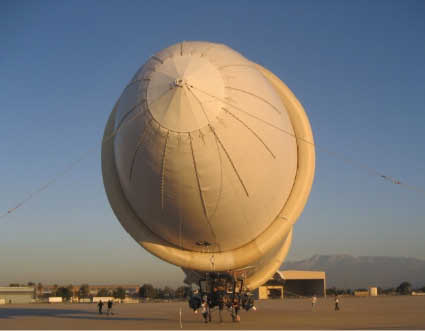
A California company is working on a new airship design that could solve one of the biggest problems facing buoyancy-aided aircraft — how to control floatworthiness without wasting fuel.
Aeros, founded by Russian-born entrepreneur Igor Pasternak, is working on a rigid-hulled airship that varies its buoyancy to take off and land vertically. By compressing and decompressing helium, the density in the ship can be varied as a means to control the ship’s static heaviness. Static heaviness is the ratio of buoyancy to gravity, and it's the main variable that must be controlled to fly a ship along a predictable path.
Buoyant ships can float in the air because their fuel, usually helium these days, is lighter than the air. Any kid who has ever lost a balloon at the county fair understands, and rues, this phenomenon. The buoyant gas is counterbalanced by fuel, cargo or other ballast, allowing the ship to fly at a controlled altitude. But in order to move forward, a ship has to burn fuel, and this reduces its weight — so it would gain altitude. To balance the buoyancy, airships must vent their precious helium or let in regular air, but this wastes an expensive and diminishing resource.Modern airship designs deal with this by employing non-rigid hulls, multi-lobed hulls containing different gases, taking on water ballast at cargo unloading docks, and so on. But Aeros uses a compression system instead, called Control of Static Heaviness (COSH). It involves a rigid airframe and a membrane containing helium gas. The membrane will contain pressurized tanks: More pressure in the tanks makes the vehicle heavier, and less makes it lighter, Aviation Week explains.
In 2012-2013, Aeros will test a ship called the Pelican, a 230-foot-long, 600,000-cubic-foot rigid air vehicle with the COSH system. The Pelican project is funded by the Pentagon’s Rapid Reaction Technology Office, after DARPA’s Walrus contest went the way of the dodo. Walrus was intended to loft an entire military battalion and all its equipment and plop it down somewhere else, but the project was later cancelled because it wasn’t feasible — the ship would have been so huge that it couldn’t fly above 10,000 feet, well within the range of surface-to-air weaponry.
Pelican still has some issues to iron out, such as providing enough lift to take off with a heavy load; the Register explains further. But on its face, changing gas density to control buoyancy seems like a novel solution to an old problem.

Five amazing, clean technologies that will set us free, in this month's energy-focused issue. Also: how to build a better bomb detector, the robotic toys that are raising your children, a human catapult, the world's smallest arcade, and much more.


Online Content Director: Suzanne LaBarre | Email
Senior Editor: Paul Adams | Email
Associate Editor: Dan Nosowitz | Email
Assistant Editor: Colin Lecher | Email
Assistant Editor: Rose Pastore | Email
Contributing Writers:
Kelsey D. Atherton | Email
Francie Diep | Email
Shaunacy Ferro | Email
I think I understand, but it feels like I can't quite wrap my head around how the helium being in the tanks makes it heavier. It just seems weird that "helium in balloon = lift" and "helium in balloon in tanks = not lift" since the helium being lighter than the air around it is what causes the lift, but just because it is denser does not mean that it weighs more. Is it that when not in the tank the helium is pushing against the hull of the balloon? grah, I just can't wrap my head around it.
Somthing tells me that when they put the helium in the tank, they are removing it from the bladder and compressing it. Therefore, as the helium in the bladder is removed, the bladder is less bouyant. They helium in the tanks is compressed, so it is no longer bouyant.
Plus, the ship looks like a sneaker. Just wanted to say that.
@Draange - Cybegor is right, compressing the gas makes it less buoyant. The forces in play are the Buoyant force vs. Density. Here's a video explaining www.youtube.com/watch?v=VDSYXmvjg6M
Yeah it looks like a sneaker, but maybe that will work to their advantage when they are seeking sponsorship money...
I don't understand how this a novel idea, haven't submarines been using this for a long time. You would of though someone would have applied this concept to airships before. In fact I thought this was how they operated up until this point.
The people of Cardington(do this all ready with their SkyCat series of airships http://www.bbc.co.uk/news/technology-12110386 ). This tech is not exactly new. They use a combo of compressed helium, ducted fans and aerodynamic lifting body design. :)
Instead of thinking "buoyancy"; think of displacement. The airship's volume displaces (x) amount of air, with a gas that is less dense (lighter) than air such as helium.
In the case of this design, the airship will only become "heavier" when air is let into it to replace the space that the now-compressed helium used to occupy.
Hi All,
This is interesting research and I suppose that one day it might be possible to build an airship that will be able to carry heavy power consuming compressors and use safe fire and bullet proof pressure tanks that can't explode to store the static weight control Helium, but in the mean time the more obvious solution to static weight control is the one the US Army has chosen for the LEMV program. That solution is to shape the envelope like a flying wing and use vectored thrust.
They call this new class of lighter than air aircraft, hybrid air vehicles (HAV's for short) and the first one built by none other than Hybrid Air Vehicles from Blighty will fly later this year.
If you want to know more about HAV's see the news section of my web site: 3w hybridairship dot net
Regards JB (Airship & Blimp Consultant)
Something's gotta give. Fuel costs are ridiculous and right now hope obviously floats. If they decide to stick with the beta design they can possibly target Trojan or Durex sponsors.
Heliumhead
n.b. The rate of climb and rate of descent of non-rigid and semi-rigid airships
is limited by the ability to control gas pressure within safe limits. Unlike HTA machines, aerostats and airships have to maintain adequate control of both
Center of Gravity and Center of Buoyancy. Luckily they don't have to fly fast to do either.
Assuming you're interested in a gas, rather than a liquid, you can adjust: Volume, Pressure, Temperature and Quantity. (You have limited control
over temperature, pressure, or mass of the medium the airship is suspended in.)
Various techniques of manipulating one or combinations of two or more of these variables to adjust buoyancy have been tried with limited success since the dawn of manned flight. The patent office has approved a couple hundred buoyancy manipulation and control patents in the past two centuries (Classification 244/97).
The tricky part is to maintain the Volume, Pressure and Temperature within acceptable limits, at an acceptable cost in equipment, power requirements, and system complexity.
If AEROS system can safely eliminate the requirement for huge ballonets, by rapidly and economically compressing a similar volume of Helium (to 15 to 30 psi), it would satisfy two essential criteria. It's worth finding out if such a system can be made airworthy, and maintainable.
As the helium is removed from the 'balloon' it is replaced with air, which is heavier than the helium. To raise the craft, the air is displace and helium let out of the tanks to replace the air displaced (so that the total gas volume stays the same all the time or the pressure inside the balloon). It's really quite simple!
The same thing would apply to a boat at sea and why for so many centuries boat makers thought people who said a steel boat could float thought they were crazy.
When a boat is floating, you have the bulk of the ship containing only 'air' and the steel walls of the ship prevent water from rushing in so the combined weight of the air plus steel is far less than the same steel structure filled with water--which of course would sink just ask anyone aboard the Titanic!
Why not suspend hydrogen filled ballons within the helium baloon. Hydrogen is far more abundant and twice as bouyant. It is only dangerous when exposed to oxygen, which it won't within the helium.
Hi All,
Forget about Hydrogen, as Helium and hot air are the only two lifting gases that are approved of for airships of any type and it will stay that way, even though various nutters keep suggesting ways to build a Hindenburg Mk 2 or R101 Mk 2. Luckily both the aviation authorities and the insurance companies like Helium because it puts fires out.
Regards JB (Gasbags comedy www.hybridblimp.net)
This is very high cost to build and operate.
Flying takes less energy than moving thru water. Flying heavy cargo slowly should be close to ocean ship in cost per ton / mile.
See www.concordlift.com for a radially new configuration designed to transport large numbers of standard containers or as a Ro Ro automobiles.
The cost would be less than highway trucking in 3rd world counties.
This is designed to be low cost to build and to operate
@skyship007
I'm intrigued why suggesting hydrogen makes me a nutter.
Hydrogen is twice as bouyant and far more abundant. So it's flamable, that is a concern. But commercial aircraft have been flying for a while now with rather a lot of flamable contents, yet manage to get approved.
@NOM...gas is diferent than liquid, gas ignites much easier than a liquid...Does the liquid itself burn?
Flammable and combustible liquids themselves do not burn. It is the mixture of their vapors and air that burns.
What if we synthesize a molecule like a buckey ball that has longer bonds so the avg density is less than helium or hydrogen is that even plausible??? maybe im crazy
Everyone who talks of a Hindenburg Mk 2 is a nutter. I don't work with nutters or fly with them. The modern German Centurion 4.0's that power the new HAV 304 are amazing engines burning Jet fuel which has a flash point of 50C but is stored in tanks that will be 20C max on the hottest desert day. The engines are no where near the fuel tanks and are not hot enough to heat spilt fuel past 50C anyway, unlike a turbine. There is zero risk of misting fuel from a concrete scrape causing a vapour flash, so the net result is the worlds best crash worthy system. I don't even care if you drop the ciggy butt after a prang into any spilt fuel, the chances of a post crash fire as as close to zero as anyone can get. Unless some nutter puts Hydrogen in the bag!! Then it will be a potential bomb that no insurance company will touch.
Regards JB (www.hybridairship.net)
If we are talking about huge air ships flying in a controlled direction, doesn't the wind play a factor? How far up do they have to go to get out of the wind? At that altitude does temperature affect the helium? I have no knowledge concerning blimps so feel free to educate me in basic terms.
I've been reading Popular Science (or at least looking at the pictures) for over 50 years. Every six months to a year, there is an article on the emergence of a new scheme for the return of lighter than air flight. So, I wouldn't hold my breath on this one either.