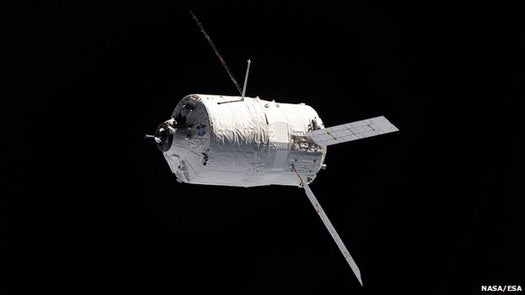
The ESA's Automated Transfer Vehicle NASA/ESA

Both NASA and the ESA can see the decommissioning of their current spacecrafts on the horizon, but a new collaboration between the two could see a jointly designed U.S.-European spacecraft akin to the current ESA Automated Transfer Vehicle (ATV) later this decade.

The ATV is Europe’s largest spacecraft--an unmanned, robotic freighter than transports more than eight tons of supplies to the International Space Station at a time. It docks with the ISS automatically and can serve as a crew vessel while attached to the orbiting station, though it is not designed for manned space travel.

But only three more ATV missions are scheduled/funded by the ESA beyond the one that is at the ISS now, and officials there--who, it should be noted, are facing the same kind of fiscal tightening as NASA--feel that the technology tested and expertise gained from the current ATV initiative should be built upon. As such, they’ve reached out to NASA concerning a possible joint venture in spacecraft design.

It’s really not clear what kind of spacecraft that would be or what its mission profile would look like. ESA officials are not yet saying if it would be a manned vehicle or not, or what it might bring to the table. But both the ESA and NASA have some complimentary technologies and interests to offer one another.

For instance, the U.S. has built its space legacy upon manned missions, whereas the ESA’s space endeavors have been largely robotic. Both are interested in the possibilities beyond Earth orbit, including the idea of using the ISS as a jump-off point for longer missions to the moon and eventually Mars. And both--though neither is likely to admit it--are likely having hushed conversations about China’s space ambitions, which threaten to eclipse those of NASA and the ESA in the next decade.

For now, we can only speculate as to what this new spacecraft might look like and do should it become a reality. ESA Director General Jean-Jacques Dordian told BBC that he wants to have a proposal hammered out by October.

[BBC]

8 Comments

This is the way stuff should get into space. Why bother putting on all sorts of extra safety precautions and limitations to have a human crew, where all they are doing is something an unmanned robotic vehicle such as this can do for a fraction of the cost?

I can't find the launch cost of the ATV, but it's probably around $200 million?

SpaceX will use their Dragon craft, which can carry 13,000 lbs compared to the ATV 16,000 lbs. The Dragon will cost no more than $60mil per launch. There will also be manned capabilities. There's no point for governments to do rocket launches anymore. SpaceX has proven that they can do it for fractions of what NASA and the ESA have been doing.

spacex has shown tons of potential and is the way of the future, don't be so down on nasa, after all without nasa's help spacex wouldn't exist

This system can only unload freight to the inside of the ISS. The Japanese system has provisions for external loads. I doubt the ESA system can be modified to carry the external loads. Why do this when SpaceX has the dragon and could also lob up an external pallet that would do the external job? Besides, the ESA design is very expensive.

Dragon is an updated apollo command capsule. ATV is an updated TKS-spacecraft. The primary payload difference between the two is pressurised volume. ATV has 5 times more, and can delivery a complete labratory ready to go as soon as power and data lines are connected. Dragon cannot and never will be able to do that because of its relatively tiny size.

The other significant difference is the ATV has a very sophisticated automated docking system. Many of NASA's current exploration plans assume this technology exists - and it's better for NASA to buy a tested and working system than try and develop one in house.

At ~$70M, ATV is more expensive than Dragon's ~$50M, but it's a more flexible and powerful design, precisely because it's not hampered by dragon's heatshield. In space terms, that's pocket change, especially in comparison to starting from scratch or modding dragon to compensate.

I work for Orbital Sciences and we are building a similar capsule called COTS. Right now it's in production and will carry about 20,000 kg of cargo and cost around $200 million to launch. It will go on at least 8 missions between 2011 and 2015 to the ISS, and will drop of cargo, take waste, and burn up in the atmosphere.

Additionally, here's a pretty cool animation of a COTS mission.

http://www.orbital.com/video/CygnusMissionOverview/video.html

jaygott12: From your own web site: http://www.orbital.com/NewsInfo/Publications/Cygnus_fact.pdf
Total cargo mass 2000kg. You are out a decimal point and that makes all the difference.


July 2013: The Future Of Flight

The incredible innovations, like drone swarms and perpetual flight, bringing aviation into the world of tomorrow. Plus: today's greatest sci-fi writers predict the future, the science behind the summer's biggest blockbusters, a Doctor Who-themed DIY 'bot, the organs you can do without, and much more.


Online Content Director: Suzanne LaBarre | Email
Senior Editor: Paul Adams | Email
Associate Editor: Dan Nosowitz | Email
Assistant Editor: Colin Lecher | Email
Assistant Editor: Rose Pastore | Email

Contributing Writers:

Kelsey D. Atherton | Email
Francie Diep | Email
Shaunacy Ferro | Email

circ-top-header.gif
circ-cover.gif