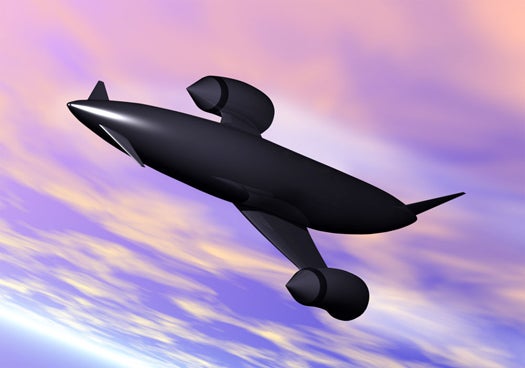
The Skylon Spaceplane Reaction Engines

The Skylon spaceplane, a concept spacecraft that has been incubating in the UK for something like three decades, has all of a sudden taken a big leap forward thanks to a technical review by the European Space Agency. And if the money comes through--Skylon is a privately funded venture--this summer’s test program could quickly turn into a full-fledged ground demonstrator engine followed by a fifth scale model of one of the engines that would actually take to the skies.

The proposed Skylon would be reusable like the space shuttles but would dispense with massive, expensive rockets, taking off and landing via a conventional runway instead. Its novel integrated engine design allows the spacecraft to operate more like a conventional jet at lower altitudes, pulling in oxygen from the atmosphere rather than from external oxygen tanks. This drastically cuts down on its fuel load at takeoff.

At higher altitudes where the atmosphere thins, Skylon’s Sabre engine switches to full-on rocket mode and propels itself more like a conventional launch vehicle--though by this point it is already moving fast enough, and the air is thin enough, that it doesn’t need too terribly much fuel. Along the way it has to shed no external fuel tanks, allowing for what engineers are calling “single-stage-to-orbit” spaceflight. In this way, the reusable 275-foot Skylon could launch payloads of more than 16 tons into space with regularity at a far lower per-kilo cost than conventional rockets can.

But the hybrid air-breathing/rocket engine presents some serious challenges as well, and that’s what’s kept Skylon grounded for so many years. The engine must manage 1,000-degree high-speed gases flowing through its intake, then cool them prior to compressing and burning them along with hydrogen. This has led to the design of a novel heat exchanger that can take said gases and plunge them to -130 degrees celsius in just 1/100th of a second--no small feat. Engineers then had to devise a unique anti-frost solution that allows this heat exchanger to run continuously without freezing up.

By the ESA’s account, engineers working on the Skylon and its Sabre engine have done all of these things. ESA’s technical staff have seen it working on the lab bench and have given the engine their approving nod to go ahead with ground tests. That will happen this summer, when a scaled-up version of the cooling tech will be demoed.

That’s a big deal. If Skylon--or something like it--ever takes flight, engineers claim it could bring the roughly $7,000 per pound payload cost to launch satellites into orbit down to less than $500 per pound.

Skylon's Sabre Engine:  Reaction Engines

[BBC]

19 Comments

I do with them the best o fluck but my money is still on SpaceX. Falcon Heavey will launch next year with a cost to leo at $1000/lb. It is designed to be recovrable and reusable wich will reduce the cost further. Skylons payload capacity is less that 1/4th that of falcon heavy making missions to mars or the moon dificult and expinsive because many launches of small parys that would be assembled in orbit would be required. 

Skylon might be good for transporting space tourists or supplying space stations but I think SpaceX will capture a large share of that busness.  Skylon doesn’t even have a window to look out of when your flying to orbit (>_<)

sorry about the ugly font, popsci wouldent let me post it with normal font because something triggerd its fucking defective spam filter.

i have been fighting this spam filter constantly too. What a defective program...

I don't buy that it's been "on the bench" since the 80's. More like it was fully functional then, and has only recently been surpassed far enough that this can go public. The SR-71 project was started in the 50's, but wasn't public until the late 70's. It's a giant global poker game, you don't lay your cards out for the world to see, I don't have a problem with it, but I don't like being played the fool and told it's "a new amazing product" There is nothing in that tech that looks ground breaking in the slightest.

It is nice however to see that we are FINALLY getting SSTO transportation.

Hey.. whatever ever happened to the atmospherically vectored V-Spike engine from 15 years ago? Hum.. Or how about all the ram/scram jet tech we were working so hard on.. funny how all that news is quite.

UFO's are just advanced aircraft. Look back at the UFO reports from the 50's talking about cigar shaped UFO's with fire shooting out the back overtaking a commerical airliner, now look at a SR-71 in flight from the side.. easy to see why people were so confused, they were not used to seeing that type of flying tech, so they assumed aliens.

Oh and as far as the spam filter, I've never had a problem, try typing in the captcha correctly, including upper/lower casing.

Playing Devil's Advocate since 1978

"The only constant in the universe is change"
-Heraclitus of Ephesus 535 BC - 475 BC

If you use your imagination and look at it just write, I think it’s a Unicorn Alien Space Craft. Most likely flying in the background will be the Iranian Flying Saucer. I wish them luck in solving all the technology obsticals. It sure is a cool looking plane\spacecraft!

@CodeZero, agreed!

Why eliminate the external tanks though? Here's my idea. Keep the tanks, as the fuel is being expelled out one end, pull in air in the other end and compress it. This stored compressed air can then when in space either for thrust, or for mixing with more fuel. With the heat exchanger they describe, cooling and storing the air should be possible.

I have a question. Since there are no fans in the engine, how does it suck in air?

I'm pretty sure its a ramjet

and yes the spam filter thinks everything is spam...

this is great but still a decade away or so, no external tanks because they are not needed and would add too much drag, then it would need the extra fuel to overcome the drag, spacex will be ready sooner for a similiar payoff in cargoe costs, definately something that could do away with most rockets, could these leave orbit and go to mars or the moon?

Bear in mind that a 16 ton payload is room for 14 average satellites with room to spare. These vessels would not only be instrumental in installing more satellites, but could also lay the foundation for a future permanent space installment.

@navy1270

And if you look at the design of the air intake it resembles a ram jet. Though it is not clear how the vehicle will accelerate TO ram-jet speeds.

In the engine break away you can see objects labeled "compressor" and "turbine". These are terms associated with conventional jet engines. This gives me the impression that the assembly at the rear can operate as both a rocket and a jet. Pulling O2 from the air while in the lower atmosphere, and switching to an internally stored oxidizer once in space. The spike in front screams (SR-71) ramjet.

It seems improbable that a jet this small could accelerate a craft that large to ramjet speeds. Perhaps it uses both rocket, and jet thrust to get up to speed, which doesn't sound very efficient. Typically, aircraft that are optimized to go high and fast aren't very efficient going low and slow. The SR-71 had to refuel immediately after takeoff because it used most of its fuel to get off the ground.

I am very curious to see how efficient these hybrid engines really are. If they deliver as promised, there are other applications (SST, military) that would benefit as well.

they refuelded right after take off because their fuel tanks didn't seal until they got up to speed and the tanks expanded from the heat and then sealed, they left much of their fuel puddled on the ground, it's a wonder none of them exploded during take off

It's a turbo ramjet with a "chiller cone" attached to the front, the french invented the turbo ramjet in the 50's. Google "Nord 1500 Griffon", In fact if you check wiki's page for "Air Turborocket" "Air Ramjet" you have a link to the SABRE.

Might help clear up the low speed "lack of fan" issues you guys are coming up with.

Playing Devil's Advocate since 1978

"The only constant in the universe is change"
-Heraclitus of Ephesus 535 BC - 475 BC

@democedes, drchuck1 is correct, The SR-71's skin was made from Titanium, which expands when heated. So the fuselage was designed with HUGE gaps. The SR-71 loses 3/4's of it's fuel during prep, taxi and take off. Once at operating temps it is refueled and ready to cruise. It has nothing to do with the fuel comsumption of the engines. They didn't explode during take-off for a few reasons, 1) they didn't hit the afterburners during takeoff, so the exhaust would be (relatively) cool, 2) the locations of the fuel supply prevents (or helps limit) spillage from coming in contact the engines, and 3) Speed and airflow, the air blowing in and through the fuselage would have blown it back and away from the engine components. Quite the amazing bird, at full speed it takes a full state in order to turn... lol. A russian mig pilot was quoted as saying that it blew by him like he was standing still, and he almost melted down his engine trying to catch up, and he was already at above mach speeds. I would have loved to taken my re-enlistment flight in one of those beasts!

Playing Devil's Advocate since 1978

"The only constant in the universe is change"
-Heraclitus of Ephesus 535 BC - 475 BC

this looks like reversed engineered alien space craft technology.

@JediMindset
Why do you think lots UFOs are seen around area 51? Maybe lots of new odd looking planes. So i'd say your idea of what alien space craft look like came from planes like this.

yeah true but don't forget that UFOS are seen around the world. not only around area 51.

@JediMindset
That's more people misunderstanding what it is that they are seeing. People are really bad at telling what they are seeing. The long history of UFOs shows.

yeah i agree. in the past we didn't understand aeronautics like we do now. but now we have a good idea of what we have the ability to create and what we don't.


June 2013: American Energy Independence

Five amazing, clean technologies that will set us free, in this month's energy-focused issue. Also: how to build a better bomb detector, the robotic toys that are raising your children, a human catapult, the world's smallest arcade, and much more.


Online Content Director: Suzanne LaBarre | Email
Senior Editor: Paul Adams | Email
Associate Editor: Dan Nosowitz | Email
Assistant Editor: Colin Lecher | Email
Assistant Editor: Rose Pastore | Email

Contributing Writers:

Kelsey D. Atherton | Email
Francie Diep | Email
Shaunacy Ferro | Email

circ-top-header.gif
circ-cover.gif
bmxmag-ps