The World’s Biggest Space Experiment Launches Tomorrow, Ready to Find Dark Matter and Alternate Universes
The ultra-sensitive Alpha Magnetic Spectrometer will hunt for the nature of matter
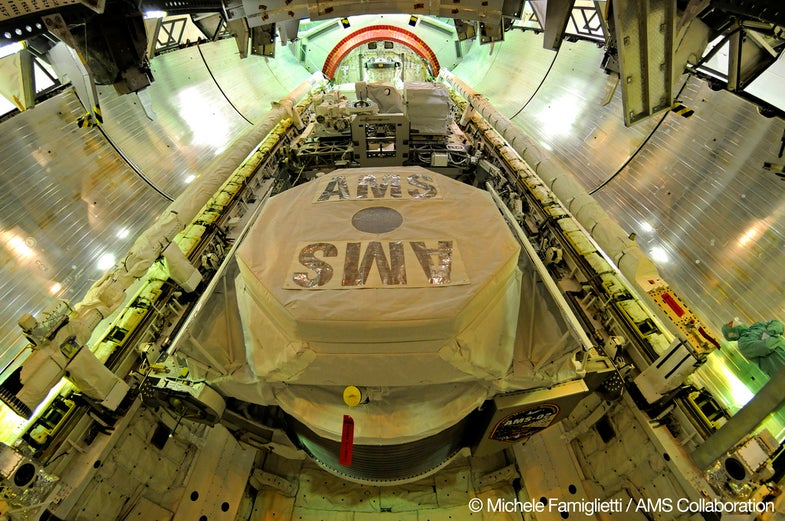
Friday’s space shuttle launch will be much more than the final hurrah for the shuttle Endeavour. Riding in its cargo bay is a massive and controversial physics experiment that could help answer some of the most confounding mysteries in science. With the delivery of the Alpha Magnetic Spectrometer, the space shuttle’s penultimate mission could turn out to be one of its greatest achievements.
Soaking up cosmic rays from its permanent perch on the International Space Station, the AMS is designed to study the universe’s deepest secrets — what happened to all the antimatter, and what, in the name of all creation, is dark matter?
“The nature of dark materials is the great mystery of our time,” said Peter Fisher, an MIT physicist involved in the project.
The AMS traveled a long and circuitous path to reach Friday’s launch. The Department of Energy experiment, nearly two decades in the making, involves some 600 researchers at 60 institutions across 16 countries. It cost somewhere between $1.5 and $2 billion — apparently, no one has quite nailed down a price tag. It was almost canceled entirely when NASA dropped it from the launch manifest after the Columbia disaster, but scientists, most notably Nobel laureate and principal investigator Samuel Ting, convinced NASA to put it back on the schedule.
The AMS is Ting’s brainchild — some would even argue his albatross — and if it works as planned, detecting the telltale signs of dark matter, it could potentially win him another Nobel.
The AMS is kind of like an orbiting version of the particle detectors in the Large Hadron Collider. At its heart is a powerful cryogenically cooled permanent magnet that bends incoming particles, in this case from cosmic rays, beams of high-energy materials belched toward Earth from dying stars, black holes and other cosmic phenomena. The way the particles bend in the magnetic field reveals their charge.
The 7-ton AMS canister also contains trackers to measure incoming particles’ energy and velocity, which will tell physicists exactly what they’re looking at.

AMS was built at CERN and tested inside the LHC, which helped calibrate its instruments. It was already detecting cosmic particles while being prepared for launch, Ting said last fall.
The system is so sensitive that it can detect one single anti-nucleus in a sea of billions of atomic nuclei. It can measure particles with energies of 100 million TeV — to put that in perspective, the LHC, often called the world’s biggest science experiment, sends particles zooming around at a comparably trivial 7 trillion electron volts and measures their collisions.
The atmosphere strips these ultra-high-energy cosmic particles of some of their qualities, so physicists have long been angling for a space-based detector. The AMS is technically called AMS-02, because an earlier version flew on the shuttle Discovery in 1998. Incidentally, that was also the last mission to the Russian outpost Mir.
That mission, which lasted just 10 days, detected some very bizarre signatures — including a possible “strangelet,” an elementary particle made up of strange quarks as well as up and down quarks. The standard model of particles and forces says there are six flavors of quarks (the building blocks of protons and neutrons), but as far as scientists can tell, everything is made of just two — the up and down flavors. If these strangelet particles exist in any sort of abundance in the cosmos, AMS will see them.
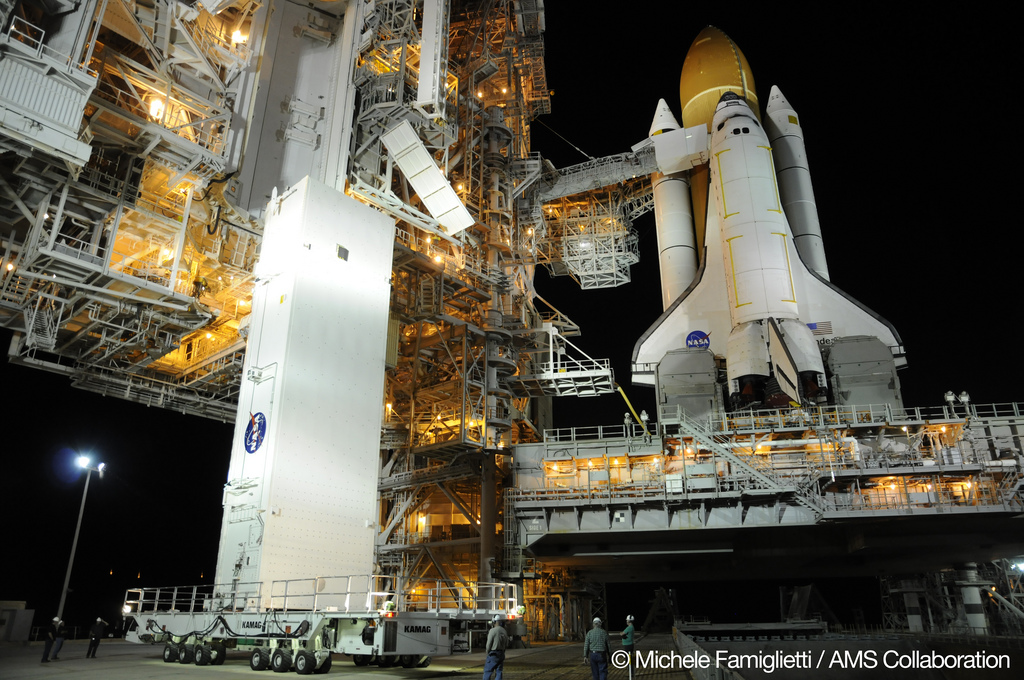
Alpha Magnetic Spectrometer With Endeavour
Along with unmasking strangelets, the AMS will look for signatures of primordial antimatter, if any of it persists in the universe. This could help solve the question of why everything exists.
From a purely mathematical point of view, nothing should — antimatter and normal matter should have annihilated each other in the first moments after the Big Bang. But they didn’t, and the universe was left with a preponderance of matter over antimatter, and therefore something rather than nothing. Some recent studies at ground-based particle detectors have shed some light on why this is the case, but the AMS will take better measurements. It will be able to detect anti-helium or anti-hydrogen — so far only trapped in a lab — which could be evidence for antimatter galaxies, or even parallel universes made of antimatter.
The AMS will also sniff out the weak signatures of dark matter, which is six times more abundant than the “normal” matter we can see. AMS is sensitive enough to detect new classes of weakly interacting massive particles (WIMPs), and signals in the background positron, anti-proton, or gamma ray flux that could show dark matter is present.
Such lofty goals are a fitting finale for the space shuttle, which helped scientists discover dark matter in the first place, through its delivery of the Hubble Space Telescope.
While all these bizarre possibilities are exciting, in an interview with BBC, Ting said he hoped the experiment would go beyond even his wildest dreams.
“To my collaborators and me, the most exciting objective of AMS is to probe the unknown, to search for phenomena that exist in Nature but yet we have not the tools or the imagination to find them,” he said.