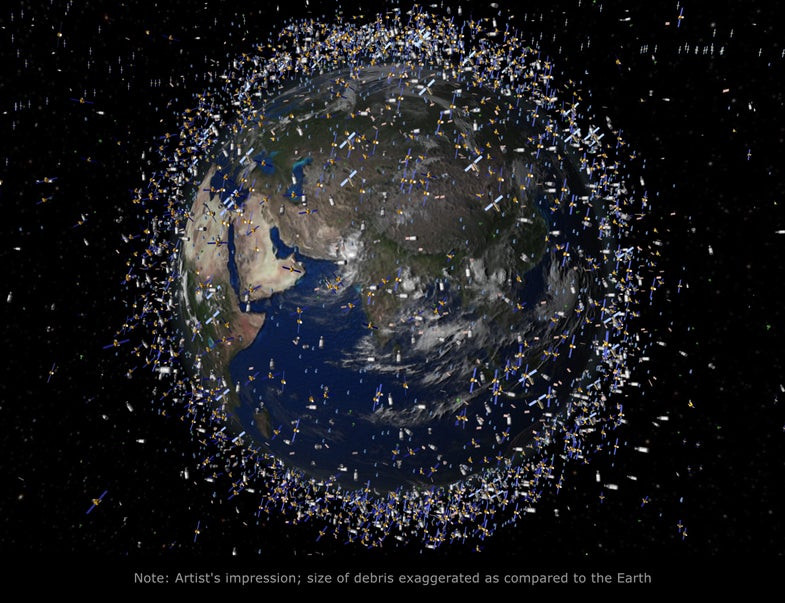
When it comes to solving the growing space junk problem, solutions range from catching it in giant nets to blasting it from orbit with lasers--and these are DARPA’s and NASA’s best plans, respectively. By contrast, the Naval Research Laboratory has a scheme that seems much more feasible, though fraught with negative consequences: using a cloud of tungsten dust to create atmospheric drag at orbital altitudes, deorbiting the thousands of pieces of tiny space junk whirling about the heavens.
The idea is simple enough: at altitudes below about 560 miles, the drag of the atmosphere naturally decays orbits, causing smaller bits of debris to slowly lose their orbits over the course of a couple of decades. But above that limit small debris--the stuff smaller than 10 centimeters that is very hard to track--can stay up there for decades or even centuries, threatening to damage satellites and spacecraft.
A researcher at the U.S. NRL suggests releasing a cloud of tungsten dust at about 680 miles up, creating a layer of particles that will completely shroud the planet. The particles themselves will be just 30 micrometers across, but because tungsten is nearly twice as dense as lead they will still add effective weight to any small debris they latch on to.This, the thinking goes, will drag small debris pieces down below that 560 mile marker over a decade or two, where natural forces will take over and the debris will burn up, scrubbing orbital space clean of small debris over the next 25 or 35 years.
If you haven’t begun verbally objecting to this idea at this point, feel free to begin now. First of all, what effect is this tungsten cloud going to have on all of the equipment we don’t want to deorbit, like our functioning satellites? What about the delicate optics on our science satellites and the the solar panels that keep our communications satellites powered up? And, as Tech Review notes, might this tungsten layer obscure our view of the cosmos, reducing the power of our earth-based telescopes?
Put another way, this problem began when we started putting stuff in orbit that wasn’t naturally there before. And while you’re not going to get an argument against human space ambitions on this site, we do respect the notion that perhaps putting more junk into space isn’t the answer here.
But, while the NRL paper does concede the idea needs some finessing, the major objections can be managed for if not dealt with outright. Future satellites could be designed to either move above the cloud or to exist within it. And the tungsten shouldn’t adversely affect the ones that are already up there anyhow, it says, as they are adequately shielded for heat and radiation already.
We’re still not sold, but desperate times call for desperate measures. If the day comes when the space debris problem gets so bad our satellites are falling from the sky anyhow--as some say it will--a tungsten cloud may be a reasonable solution to scrub the skies clean.
Read the paper at arXiv.
Five amazing, clean technologies that will set us free, in this month's energy-focused issue. Also: how to build a better bomb detector, the robotic toys that are raising your children, a human catapult, the world's smallest arcade, and much more.


Online Content Director: Suzanne LaBarre | Email
Senior Editor: Paul Adams | Email
Associate Editor: Dan Nosowitz | Email
Assistant Editor: Colin Lecher | Email
Assistant Editor: Rose Pastore | Email
Contributing Writers:
Rebecca Boyle | Email
Kelsey D. Atherton | Email
Francie Diep | Email
Shaunacy Ferro | Email
Tungsten has an extremely high melting point, so in the process of raining space debris (which will burn up) pellets of really dense metal could put holes in a few heads. How about this, a car crusher in space, that hoovers up (possibly magnetizes) the chunks of debris, crushes it, then releases its collected space junk?
How many tons of tungsten does it take take to make a cloud big enough to encircle to earth, and how do we get that much in orbit?
If it doesn't work, we could always zap the cloud with electricity and create the world's largest and brightest light bulb. Who is with me?
Does anyone care that we'll be breathing in tungsten, it will get into our blood stream. Who ever came up with idea is a psycopath. I wonder if U.S citizens will even realize or care that they are being treated like 3rd wolders.
We are all now dumber for having read this idea. The focus of any investment should be in preventing the situation from getting worse, not creating a carcinogenic cloud around our planet. Tungsten dust would not exactly do wonders for the many still-functioning satellites, spacecraft (which isn't really NASA's problem anymore), and ISS. This idea has DARPA written all over it.
If we can determine how to bring the large objects down, and prevent any more of the 10cm or less objects, we can wait for some safer options to present themselves in the future.
Even better, since this is on the outer edge of the ionosphere, if there were high energy particles interacting with the tungsten from a X class solar flare, it could interact with the tungsten and create a sweet light show.
facepalm @Aldrons Last Hope. How much tungsten do you expect to be detectable in the air after having diffused through over 600 miles of atmosphere?
This sounds like a DARPA back door project to get approval from congress and the masses for excessive amounts of tungsten to be deployed into low orbit which I'm sure the provisions won't specifically detail that the tungsten needs to be in a form of powdered flaked particulates. Can we say deception for approval of a more sinister, more American like, plan that involves rods made of tungsten which can be sent on orbital trajectories to make massively devastating kinetic weapons which have the potential of lethality greater than any atomic weapon ever created without the nasty radioactive aftermath? Just sayin' we should watch ourselves because once you start slippin' that slide goes down a long way.
IMHO, any new satellites that are released into orbit should have an extra booster or something that can make it knock itself out of orbit and burn up by itself so we dont have this problem in the future. once they find a way to clear the stuff up there right now, then my idea would keep this problem from ever coming back. problem solved. NEXT
Is this like Orbital Herpes?
An expanding foam similar to the ones used in insulation in houses. One that would burn up on reentry without releasing toxic chemicals. The debris would hit it and get trapped and after time would fall to earth.
why don't the astronauts just play golf on a spacewalk?
I'm glad they use Captchas, even if they are a PITA.
Absolutely Ludicrous I Say! Besides disrupting atmospheric clarity, radio transmissions, solar absorbency, and current satellites it would cause planetary environmental effects. The simplest solution would be shooting the debris with lasers from higher orbiting satellites until it fell back to earth. Magnets won't work on more than half because of the aluminum and a net would have to be hundreds of miles wide and incredibly strong for fast moving objects. You'd have better luck by increasing the Earth's gravity...
Expanding on Metamorphosis idea of a "car crusher" spacecraft. A truly enterprising company wanting to become known as commercial space entity (spaceX/virgin galactic) should create such a device and equip it with a spear gun/robotic arm that could be controlled by people on the ground. Tweak the firing software so objects too large or still in use couldn't be fired/grabbed at, and then charge people $25-$1000 a shot to help reel in the junk. It would be like a giant claw machine in space. Even if hundreds of thousands of people lined up to use this thing it may not offset the project's cost (unless the materials could be recycled) but brand recognition in an area like space commerce could be priceless.
Depending on the price I would love to "work in space" even if it was just being a garbage man.
get ready for the big show
Ok definitely a bad idea!
I think we need to build a space based refinery and a method for retrieving the junk (at least the larger pieces of it) and test out the ability to create new space based construction projects using the debris. Colonization on the moon or mars would demand this kind of technology and it should be easier since the junk is mostly metal alloys anyways. I always hear how we can manufacture building materials from asteroids or the surface of planets if we only had an easier, quicker way of getting there, but I don't think its quite that simple. If we want the ability to live in space we need to know that we can harness and use the resources that are available there. This would make a great first step towards that, and also clean up some of the junk. Not to mention that a type of orbital rover would need to be built that could retrieve the debris and this would also be a new type of technology in need of testing and perfecting.
Thanks for reading
G®îMÅü®Å
People who say "It's as easy as taking candy from a baby!" have never tried taking candy from a baby!