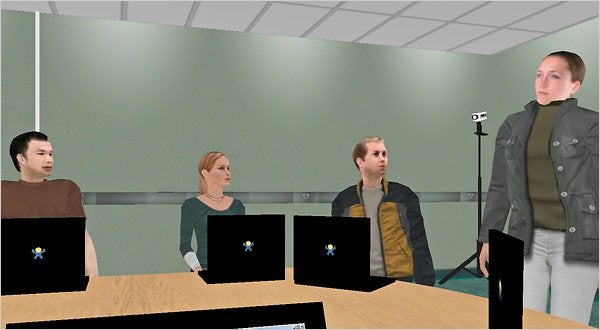
Meeting of the Minds (and Their Virtual Bodies) Cade McCall via NYT

Getting up for class or an early meeting always goes the same way: you get out of bed, and it goes downhill from there. But if a couple of researchers from Stanford and UC Santa Barbara are correct in their new book, in a few years we’ll all be meeting in virtual classrooms and conference rooms anyhow. This isn’t just the same old future hype, they say; technology has caught up with the vision, and the age of the avatar is imminent.

Which technology? Specifically, Drs. Jim Blascovich (of UCSB) and Jeremy Bailenson (of Stanford) cite the Microsoft Kinect, the Nintendo 3DS, and IBM’s Watson computer. They call these technologies “paradigm-shifting” for avatar conferencing and say that they make virtual meetings ready for the living room, classroom, and conference room.

This isn’t like videoconferencing--it’s far more immersive--nor is it like two avatars chatting in two-dimensional environs like Second Life. Essentially, you would use a photo to generate a true 3-D avatar to your liking--perhaps one that’s had a shower and dresses a bit more smartly than you do--and you and each of your meeting-mates would sit around looking, gesturing, and talking to each other in 3-D.

But it gets better. The Watson piece of the technology means avatars could be put on a kind of autopilot, where an AI takes over your digital presence, nodding politely at good points, laughing at jokes, and otherwise feigning attention while you hit the snooze button for the seventh straight time.

You could even tamper with your physical traits, Blascovich and Bailenson say, to make a better impression. Research shows that when a person’s face is subtly digitally morphed with that of a politician’s in an image, the person receives that politician more warmly even if they don’t share simpatico political views. The person won’t even realize the photo has been altered.

That means you could doctor your own features to exhibit some of those of a professor, a client, or a superior to gain a little extra goodwill. Of course, that might be considered unethical. Since you’re already sleeping straight through your 8:30 while some AI keeps your avatar nodding attentively, you might not want to push it.

[NYT]

11 Comments

Avatar's not my style, I prefer to feel, walk, see, talk, smell and taste in a positively human fashion.

For now...

Eh, I don't think this is paradigm shifting at all, a lot of people perfer human to human interactions. The fact that the person you're talking to in this way might be asleep is enough of a reason for me to not even consider this. Might be useful for NPCs in a game like WOW, add a bit of life to them and all that, but outside of that...eh, no. Until everyone doesn't want to talk to anyone in person this will just be another technological curiosity.

The author obviously doesn't watch the show Caprica, because what you just described is the central premise of the show. Google: Holoband

By the way, the comment "...nor is it like two avatars chatting in two-dimensional environs like Second Life" is incorrect. Second Life is a fully 3D environment, in which your 3D Avatar travels at will in a vast 3D world. Many companies, including some of the world's largest, already have a presence in Second Life.

And no, this isn't SPAM. I have no financial connection to Second Life;I'm just correcting a misstatement in the article.

Shikata ga nai

With nanotechnology intergrated into our nervous system virtual reality will seem exactly like reality. With touch, smell, vibrations, taste all being realistic. It's a fantastic time to watch the singularity event happen within our lifetimes. Isn't it?

I think this could be very useful in some situations where meetings are impossible and/or impractical. Unfortunately, I believe it will be abused to the extent that the article states: "...avatars could be put on a kind of autopilot...tamper with your physical traits...The person won’t even realize the photo has been altered..."
So in other words we can pretend to be what we're not and we can pretend to be there when we are not. I see obesity and a lot of liars emerging from this...

Surrogates anyone?

I hope the porn industry doesn't catch wind of this...

...okay maybe

many of you obviously don't know how a business meeting takes place. "So in other words we can pretend to be what we're not"... businessmen who are looking to impress a client, move up in the company, or just present an idea do this constantly. I dont condone "not being yourself" but in the business world being able to impress, even if you're not being who you normally are, is essential. You can be yourself when you're out with the guys having a drink...this technology makes it easier to do something that's already being done. Isnt that one of the points of technological advancements, making things we already do easier. stop being pessimistic people, give this a chance.

I think this „Watson Autopilot“ would only work for certain situations where the participants interactions to the meeting are limited. For example, students in a distance learning situation. If you do not have to answer questions just sitting an nodding gets you by. However, at a meeting where the person needs to actively participate would be harder. “Could you please explain how the pH of the solution affected the growth mechanism and final grain size of the precipitated particles”.

I think this is great stuff though. Improving the interaction between research groups and allowing students to attend lectures offered in various universities is an unquestionable benefit.

I go to UCSB. Let me just say how hard it was to get up for morning Bio...but I'd rather not do it with an avatar...

Sadly, I fear that physical interactions are declining quickly in our society. I love my computer and smartphone; but if I'm going to class, I'm going to class. I don't want to be lazy about it. Sorry, Dr. Blascovich, I'll force my lazy ass out of bed for now.


June 2013: American Energy Independence

Five amazing, clean technologies that will set us free, in this month's energy-focused issue. Also: how to build a better bomb detector, the robotic toys that are raising your children, a human catapult, the world's smallest arcade, and much more.


Online Content Director: Suzanne LaBarre | Email
Senior Editor: Paul Adams | Email
Associate Editor: Dan Nosowitz | Email
Assistant Editor: Colin Lecher | Email
Assistant Editor: Rose Pastore | Email

Contributing Writers:
Rebecca Boyle | Email
Kelsey D. Atherton | Email
Francie Diep | Email
Shaunacy Ferro | Email

circ-top-header.gif
circ-cover.gif