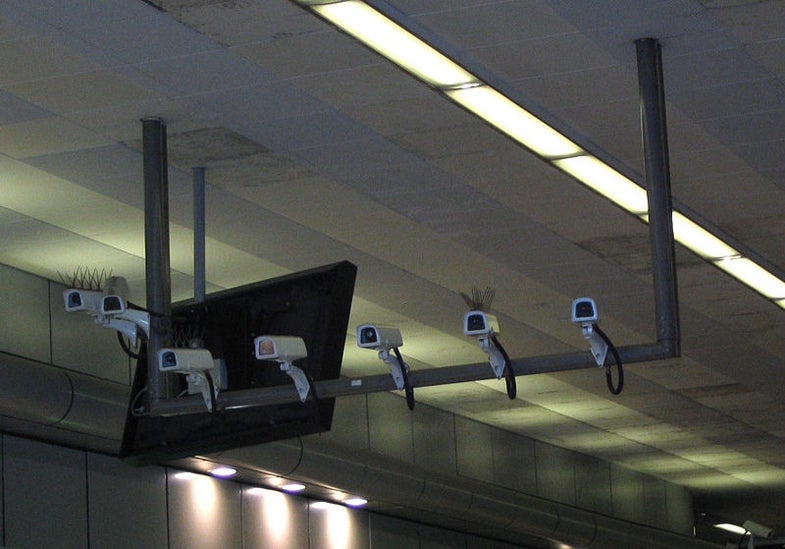
Researchers at SUNY Buffalo and Amrita University in India have managed to create a tracking network that works well even with the cheapest of cameras. How? It uses the power of its cold, rational brain to make up for any flaws in the equipment.
The idea behind the software was to eliminate the need for other, more physical forms of tracking, like RFID (or, in the future, RFID's more powerful brother, NFC), but using artificial intelligence to supplement mid- or even low-end cameras. Simply recognizing a face from a security camera is no joke--people can look vastly different day to day, and there are all kinds of variables (angle, lighting, clothing, posture) that can throw off the effectiveness of that kind of software. But what if said software could make certain rational assumptions?This system requires cameras--though not necessarily top-of-the-line cameras--be placed at building entrances or exits, a place where they can capture with reasonable quality a person's face, height, or gait. That information is fed to a central computer, which notes not only the appearance of that person but also their location. From there, the central computer cross-checks that person's scan with all the others currently in the building, thereby eliminating some of the troublesome variables. If Dr. ScrubStealer is in the supply closet on the fifth floor, she couldn't possibly also be the similar-looking Nurse SleepsALot, who is down in the second-floor lounge, napping in the middle of her shift.
That further reasoning allows the system to identify people with much higher accuracy than other systems using low-quality cameras, which can be a boon for struggling hospitals (hospitals being one of the prime candidates for the system) that are unable to pay for pricey HD security loops. The only possible foil: Twins.
Five amazing, clean technologies that will set us free, in this month's energy-focused issue. Also: how to build a better bomb detector, the robotic toys that are raising your children, a human catapult, the world's smallest arcade, and much more.


Online Content Director: Suzanne LaBarre | Email
Senior Editor: Paul Adams | Email
Associate Editor: Dan Nosowitz | Email
Assistant Editor: Colin Lecher | Email
Assistant Editor: Rose Pastore | Email
Contributing Writers:
Rebecca Boyle | Email
Kelsey D. Atherton | Email
Francie Diep | Email
Shaunacy Ferro | Email
1st Post!!!!!! This idea sounds pretty cool but at the same time I could see it creating some uncomfortable conversations with your boss.
the ability for computers to reason could help us in the future. (matrix revolutions)
oh ya, its for the businesses..
Pssh
NO. Thats big brother watching us every time we drive through the intersection or while entering a bathroom to do our thing.
But in a sense is a cool technology.
This is truly frightening -- as is a similar but more ambitous system reported earlier (either in PopSci or a competitor).
The possibility for error is stupendous -- and difficult to test. There are just so many variables. 'Good' errors will just result in "no id ". Bad errors will, of course, be mistaken id.
This is not good because the results will be presented as gospel. If there's a problem, and the computer mistakenly says that you were the one -- you are sunk. No one will doubt the machine.
This worries me. A lot.
“Happiness is when what you think, what you say, and what you do are in harmony." -Mahatma Gandhi
I agree. Until the public at large has an understanding of Bayesian probability (never going to happen), I would worry over a widespread roll-out of such technology. It would certainly be one more "infallible test" to be misinterpreted due to a lack of understanding of probabilistic reasoning.
P.S. PopSci, judging by the type of "CAPTCHA" you use, you need better CAPTCHA software. Any first-year computer science student could write a program in a couple of hours to break yours (a good developer, and there are millions of them in the world, could do so in about 10 minutes). Just a recommendation to keep the SPAM posts down. I used to wonder why there were so many, but now that I've registered and seen the CAPTCHA in use, I think I know. You should probably go with a graphical type like you use in the registration screen. Text parsing, especially when it is so regular in structure, is *much* easier than optical character recognition.
Creepy.
the thing is, though, that using both keeps the spam away, because the programs are for one or the other, not both. besides the fact that it actually works, no one is ambitious enough to actually write a new program, just so that they can keep posting spam.