With New Materials, Air Conditioners Can Be Powered By Waste Heat
Future buildings may use heat to cool off more efficiently, using new materials developed at Pacific Northwest National Laboratory. The...
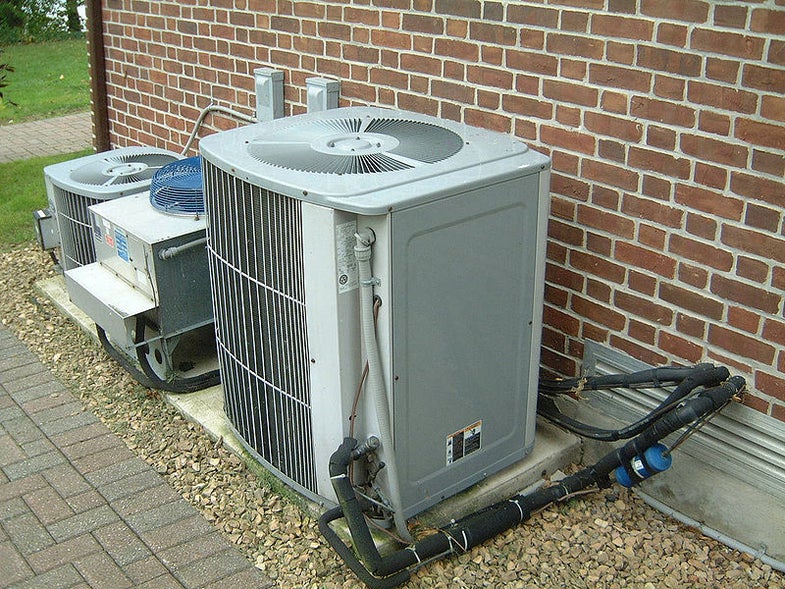
Future buildings may use heat to cool off more efficiently, using new materials developed at Pacific Northwest National Laboratory. The materials could enable compact adsorption chillers inside homes and office buildings.
Adsorption chillers are a type of air conditioner that runs on waste heat, requiring very little electricity. But they’re big and expensive, which has limited their use to large, hot places like power plants or industrial spaces, as Technology Review explains.
PNNL received a $2.54 million grant last summer from the DOE’s Advanced Research Projects Agency, ARPA-E, to build smaller adsorption chillers based on PNNL-developed nanostructured metal-organic heat carriers, or MOHCs. The material is more porous than existing adsorption materials, which makes them more efficient. PNNL researchers displayed the new material at a recent conference.
Adsorption is the binding of molecules or particles to a surface. In an adsorption chiller, hot water drives the cooling process instead of electricity. An evaporated refrigerant (in this case, water) binds to the surface of silica gel. The gel acts as a sponge for water vapor, and when the gel is heated, the water molecules are released, condensing into water droplets when the pressure rises.
The nanostructured MOHCs are even better sponges, trapping three or four times more water by weight, which can reduce the size of the system. They are also more efficient at releasing the water molecules, further reducing the chiller’s size; Tech Review gives the full breakdown here.
5kW Adsorption Chiller
PNNL says a variety of heat sources can be used to warm up the MOHCs and free the water vapor, such as burning natural gas or other fuels, heating with solar thermal, or capturing engine or fuel cell system waste heat.
The research is funded by ARPA-E’s Building Energy Efficiency Through Innovative Thermodevices (BEETIT) project.