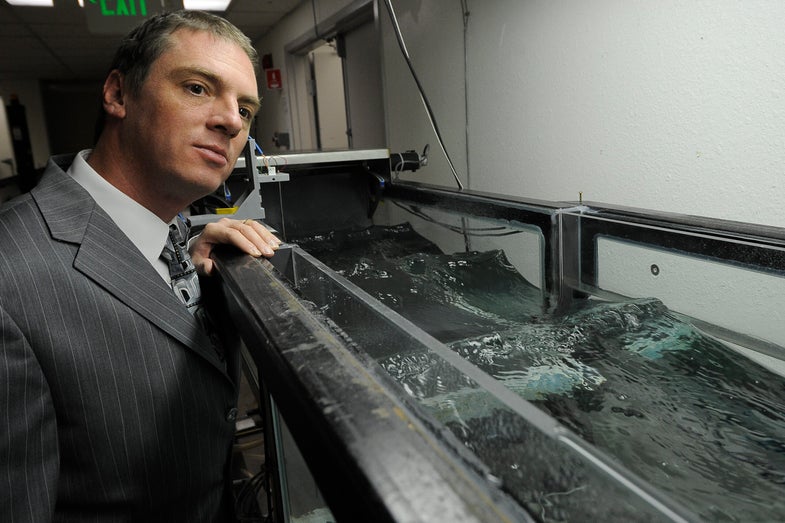
Wave Energy Dr. Stefan Siegel reviews the wave height in the Aeronautics Laboratory's 1:300 scale experimental wave tank at the U.S. Air Force Academy. The Department of Energy has funded additional testing at a larger scale. Rachel Boettcher/USAF

Using a small tank of water in a Colorado laboratory, Air Force researchers have captured 99 percent of the energy of a model ocean wave, proving it’s possible to use aeronautical principles to harness the power of the oceans.

The researchers used a cycloidal turbine, a lift-based energy converter, to grab the energy of a simulated deep-ocean wave. It can change direction almost instantly, and its structure is similar to that of a Voith Schneider propeller, which is used to power tugboats.

It involves a main power shaft and a few hydrofoils whose angle of attack can be adjusted to meet the wave. The main shaft is aligned parallel with the wave crests, according to a paper describing the system presented at an American Society of Mechanical Engineers conference.

The entire concept is not unlike a helicopter propulsion system, which involves shifting the angle of attack of the main rotor blades to move the helicopter sideways or to pitch forward and back. That explains why Air Force aeronautics researchers are involved — some of the people working on this project have studied fluid dynamics for military aircraft and NASA spacecraft, according to an Air Force news release.

The research is part of a National Science Foundation-funded project to build the world’s first free-floating submerged wave energy converter. In a series of experiments, the system was able to convert 95 percent of an incoming wave’s energy into mechanical energy, driving the shaft. The rest of the energy was lost to harmonic waves. But after some tweaks, the Air Force team, led by Dr. Stefan Siegel, was able to improve the energy conversion rate to 99 percent. The work was performed in a small tank, a 1:1300 scale version of the system’s size in the ocean.

The team’s grant runs through this September, but the results were so promising that the Department of Energy is providing $400,000 to build a bigger simulator tank at 1:10 scale. The next steps are to improve the converter’s survivability in severe weather, and to study methods for transferring energy to the grid.

7 Comments

F#@&!!!!!!!!!!! I was just working on this concept! dontcha' hate that?

I wonder what the energy conversion rate was before this concept? 99 percent is incredible!

99% on a 1:300th scale model?!... sounds good but a lot can happen when you make the actual device. I just wish this gets thru testing and off to production 'coz I'll be buying one :D

-=SisaR=-

Cool! This would solve many of the problems of tethered wave turbines. It's probably all below the surface, so the folks at Cape Cod (and anyone else with an ocean view) should want this over offshore wind turbines any day. Wonder why the Naval Academy didn't think of this?

note that they are talking conversion to MECHANICAL energy - if you want electricity, you still have to convert the Mech to Elec.

The % on that is not 99%, but it is pretty good. I don't know the best conversion rates of Mech to Elec - anyone here know the stats?

--)->

Water turbines have often gotten very high efficiencies, in excess of 90% for 150 years. Of course doing that with the energy in a wave is a bit different. Note that they are claiming to extract most of the energy from the wave itself, but not all of the energy from the moving water. If one could theoretically extract 100% of the kinetic energy from a water source then the water would stop dead in its tracks, and one clearly doesn't want that to happen in one's turbines either. One wants the water to have enough energy left in it to continue to flow away at a reasonable rate.

Efficiency is actually not the key issue here anyway. Many people get distracted by these numbers, as though that it the be all and end all of an energy system. Theoretically, if a system were cheap enough and the energy input were plentiful enough, a 1% efficient system might be just fine for one's needs. In the early days of solar panels they had horrible efficiency, but were still just fine for certain space applications and still better in terms of weight and cost, compared to the alternatives. Nowadays, they are way better than that, which makes them useful in a variety of terrestrial applications too.

Ultimately, what matters in any power plant is the unit cost to deliver the power all the way down to the end user. High efficiency often helps lower this cost, but it is not the only thing, nor does that matter if the system is always going off line or needing to be serviced.

Generating electricity from this mechanical energy may not be the best thing to do with some of these system. Perhaps running a forward or reverse osmosis system with the mechanical energy to produce fresh water would be more valuable, for example. The alternative is that most osmosis systems would use electrical power, produced and transmitted from far away. By contrast, if you burn coal to generate electricity then you can expect that you only get about 1/3 to 1/4 of the energy from the coal turned into electricity, and less than that when it is transmitted, and used to run a pump hundreds of miles away. That's to say nothing of the environmental impact of burning coal, or unrefined crude, to purify one's water.


June 2013: American Energy Independence

Five amazing, clean technologies that will set us free, in this month's energy-focused issue. Also: how to build a better bomb detector, the robotic toys that are raising your children, a human catapult, the world's smallest arcade, and much more.


Online Content Director: Suzanne LaBarre | Email
Senior Editor: Paul Adams | Email
Associate Editor: Dan Nosowitz | Email
Assistant Editor: Colin Lecher | Email
Assistant Editor: Rose Pastore | Email

Contributing Writers:
Rebecca Boyle | Email
Kelsey D. Atherton | Email
Francie Diep | Email
Shaunacy Ferro | Email

circ-top-header.gif
circ-cover.gif