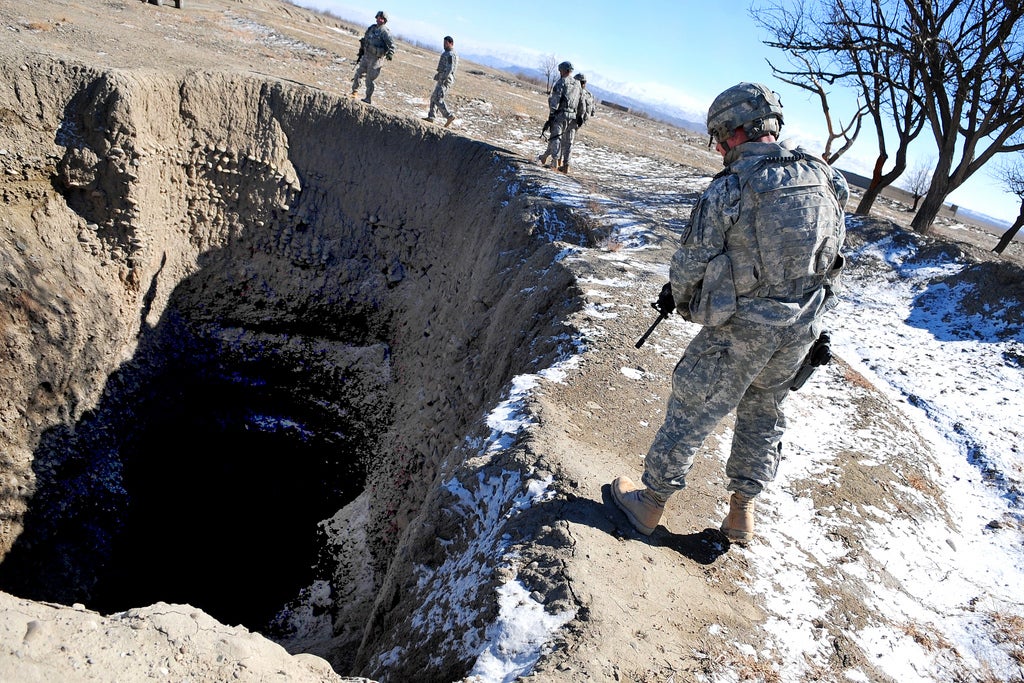
A new technique uses electromagnetic pulses to detonate improvised explosive devices from afar, potentially thwarting the roadside bombs that have been the scourge of the wars in Iraq and Afghanistan. And, lest anyone forget, the ongoing guerrilla conflicts in places like Colombia.
Two Colombian doctoral students studying at the École Polytechnique Fédérale de Lausanne (EPFL) in Switzerland came up with a remote IED detonation method that can set off bombs from 65 feet away. It uses powerful radio waves to induce electrical currents in the IED’s detonators, setting them off.
Félix Vega and Nicolas Mora had to find a way to induce a strong enough current to set off IEDs whose detonators are sometimes buried deep underground. Then they had to make sure they hit the right radio frequencies — a difficult task given that IEDs, by definition, are all different.To scan lots of radio frequencies, the researchers used short impulses with a fast response time. But by the time the impulses reached their targets, the currents were not strong enough to detonate the IEDs, the duo’s professor, Farhad Rachidi, said in a statement.
Vega and Mora realized IEDs do have some things in common, however — their detonators operate in fairly similar frequency ranges. The team developed a system that concentrates on that range, and therefore loses less energy.
EPFL researchers tested the system in Colombia last November, using actual improvised explosives provided by a team of professional bomb disposal experts. They were able to set off the IEDs at an average distance of 20 meters, or roughly 65 feet.
The next step is designing a smaller prototype that is weather-resistant and easier to transport, Vega said.
Five amazing, clean technologies that will set us free, in this month's energy-focused issue. Also: how to build a better bomb detector, the robotic toys that are raising your children, a human catapult, the world's smallest arcade, and much more.


Online Content Director: Suzanne LaBarre | Email
Senior Editor: Paul Adams | Email
Associate Editor: Dan Nosowitz | Email
Assistant Editor: Colin Lecher | Email
Assistant Editor: Rose Pastore | Email
Contributing Writers:
Kelsey D. Atherton | Email
Francie Diep | Email
Shaunacy Ferro | Email
Why announce this development and publicize it? It just gives the enemy an early reason to change their tactics and use non-electrical detonators and other countermeasures before they would have otherwise done. When the device is ready for field use, why not just drive around at at night in the suspect territory for a while, pointing the device in all directions and hopefully detonate some of the ieds before they are laid (and, hopefully, some of the culprits along with them). This reminds me of the time when the intelligence agencies proudly announced that they were getting information from terrorists cellphones and after that the source dried up considerably.
Some things should never be revealed. Intelligence agencies and development agencies/corporations/and people should resist the impulse to boast. Let the enemy find out this kind of stuff the hard way. Just common sense, that's all.
M.Hat,
This is important research and its successes deserve rightful scrutiny, and recognition. The people conducting this research are PhD students, not defense contractors, so their whole job is to get their work published so that they might get their degree.
I would agree that in a perfect world some things are better left kept a secret, but a counter-IED device is just as much of a deterrent. A perfect example is security cameras in banks. Yeah, people still rob banks, but now the bank robbers have to consider the risk of being identified so they have to go thru all extra planning if they don't want to get caught. An obvious corollary to that is that now that they've adjusted their tactics to not get caught in the bank they might leave themselves vulnerable outside if they have to throw on a ski mask on the sidewalk and risk being identified too early.
Countering IEDs is a back-and-forth thing. The most common IED is command detonated. Pretty soon the bad guys realized every time we saw a clue of an IED that we would stop and investigate. Then they started putting dummy bombs and being more creative at hiding secondary devices away where the vehicles would stop. It's all about tactics. You're assuming the FARC and Taliban are regular readers on PopSci, and that they would have read this article. But frankly, after a few weeks of their devices being blown up early they would have figured it out and adapted. Non electrical detonators are much more difficult to employ tactically so other than pressure mines, which already exist, I don't believe their is much threat. If we produce viable counters for every method of employment than pretty soon they'll give up or be forced to expose themselves to so great a risk just to try new things that our defensive tools inadvertently have a positive offensive effect.
Another thing to think about is that this report is from these guys doing their experiments. I don't think the FARC or Taliban have to worry about GI Joe running around with something like this for a while because of the natural belabored defense procurement process.
Dear Commenters,
Just curious, couldn't R&D develop a microwave EMP machine? Just like how microwaves can induce electrical impulses in circuitry (ref. Is It a Good Idea To Microwave __ on youtube) to activate the electronic components in an IED.
Comments appreciated,
btuan
Maybe now they will just light fuses and hope to kill enemy troops, M Hat !!!lol
I stand by what I wrote. In all circumstances, the less information they have about our countermeasures and countermeasure developments, the better. If we'd never publicized the fact that we were tracking them with their cell phone calls, we might have Bin Laden by now. Again, when it comes to this kind of thing, it doesn't matter where our countermeasures come from or what stage of develpment they're at, let's keep our secret work secret. M.Hat. Ex-EOD.
i wonder, if you could cause a current in an IED, if it would re-emit any of that current, either as a magnetic field or as energy in the form of electromagnetic radiation. couldn't we then use a rapidly pulsed EMP, and scan for the same pattern in a different frequency using a directional antenna? if that would work, you might be able to extend the range, and at least detect them from much farther away. if one was detected, all they'd have to do is send out a stronger EMP directed at the source of the return.
Right?
if anyone plans to use this idea, or can get it to someone who can use it, please email me.
It took me about a minute to think of a way to effectively defeat this technology. I'm no PhD, so I'm sure it'll take the bad guys about the same amount of time to figure it out.
It just the same old game, defense, counter-defense and counter-counter-defense. Whether they've read this magazine or not, once we started deploying this technology, they would have already started working on a way to beat it, just like the old game between superpowers.