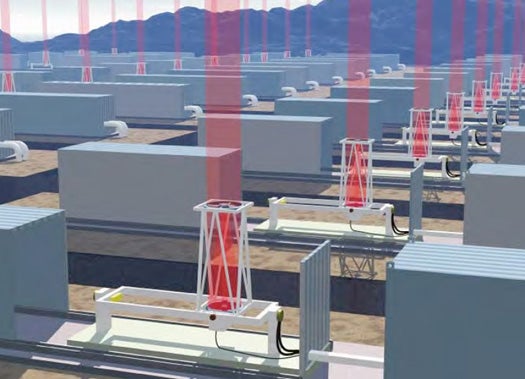
Launching payloads into space is expensive, but high costs aside it’s also a horribly inefficient process. Conventional rockets are almost pure fuel, leaving only a small percentage (usually in the low single digits) of a launch vehicle's total weight available for payload. So NASA's Glenn Research Center in Ohio is looking into a whole new system of payload propulsion that uses lasers or microwaves to launch vehicles into orbit.
Doing so could significantly reduce the costs and physical dangers associated with regular spaceflight. Rockets, as we noted earlier, are more or less massive controlled hydrocarbon explosions--bottled up fuel that (if all goes well) ignites in stages to hurl the rocket skyward. The new technology would use ground-based lasers or microwaves to target a heat exchanger aboard a rocket, coaxing increased energy output from the fuel.
This heat exchanger causes the temperature of the fuel aboard the rocket to spike, pushing it to something like 3,100 degrees, a temperature that drastically increases the rocket's thrust. But it’s not incendiary like a conventional rocket, so it emits only hydrogen. Also, it can’t explode as towering tanks of bottled up rocket fuel are wont do.The drawback: the technology is really optimized for small payloads weighing in the neighborhood of 200 pounds. But it would also be able to cheaply launch several rockets daily, so it could carry larger objects into orbit piecemeal for assembly later. The small-payload scheme also fits nicely with the increasing proliferation of micro- and nano-satellites.
Five amazing, clean technologies that will set us free, in this month's energy-focused issue. Also: how to build a better bomb detector, the robotic toys that are raising your children, a human catapult, the world's smallest arcade, and much more.


Online Content Director: Suzanne LaBarre | Email
Senior Editor: Paul Adams | Email
Associate Editor: Dan Nosowitz | Email
Assistant Editor: Colin Lecher | Email
Assistant Editor: Rose Pastore | Email
Contributing Writers:
Rebecca Boyle | Email
Kelsey D. Atherton | Email
Francie Diep | Email
Shaunacy Ferro | Email
"Also, it can’t explode as towering tanks of bottled up rocket fuel are wont do. " proof read much?
ScottieD, wont is a word which means has a habit of doing. It's pronounced like the word want.
Alex103, perhaps ScottieD was referring to the fact that the term should be "wont to do"?
it does require a "to" in in between it and "do", though. I think.
also, has the technology been tested on a smaller, or indeed ANY scale? how do we know it will work? the power required to do something like that is enormous, and would need a big battery, adding weight, needing more power, and needing a bigger battery. good idea, but it *could* be pretty impractical.
Good catch there harry, my mistake. Sorry Scottie, you were right. I'll have to proofread better myself, that was slightly embarrassing.
Yes, I daresay, good show old chap.
So this isn't replacing fuel with lasers, it's just making the fuel more efficient using lasers, right?
Cool idea. I weigh less than 200 pounds; can I be shot into space aboard a laser-enhanced mini-rocket? Please?
-IMP ;) :)
Whatever happened to the space elevator scheme? Couldn't they make a cable strong enough yet? Or are they worried terrorists would cut the cord and we end up with thousands of miles of cable cluttering the ground?
Sadly we can not make a cable strong enough fore a space elevator yet. And I do seem to remember reading about this same concept being tested about half a year ago with smaller payloads and it was very successful. I think this is very exciting for our space program :)
@gizmowiz there is a still a lot of kinks to be worked out with a space elevator. and i am pretty sure. no the cable is not strong enough yet. They are getting better at making carbon nanotubes, but the so called cabled and ribbins they want to make are still mostly glue, and not nano tubes. it needs to be 2% glue and 98% tubes, its still pretty much opposite those number. not to mention we have no means to begin a cable. we have plenty of ideas, but no one is anywhere near close enough trying any of them out.
1. Laser Rockets: this has been a staple of science fiction by Jerry Pournelle and Larry Niven for 20+ years; about time for it to finally happen.
2. Space Elevators; There won't ever be a space elevator, because it would become the Numero Uno target for every terrorist in the world.
Ken Mitchell
Citrus Heights, CA
IceMetalPunk; Yes, but only if you are made of ablative materials. :-)
Ken Mitchell
Citrus Heights, CA
Im going to miss watching shuttles take off the old way mostly cause of the excitement. It just seems like space launches play a part in American tradition, especially when they say "Houston we have lift off". It wont be very fun to watch a guy flip a switch and some lasers turn on.
@-my name here-
you wrote:
"also, has the technology been tested on a smaller, or indeed ANY scale? how do we know it will work? the power required to do something like that is enormous, and would need a big battery, adding weight, needing more power, and needing a bigger battery. good idea, but it *could* be pretty impractical."
The lasers will be ground-based. As such, there will be no need for adding "extra weight" (mass), thereby not increasing the energy needed.
Rick
The most practical use would be for the boost phase that takes the rocket through and out of the lower atmosphere. Might want to use LOX instad of H2 for the working fluid in this phase because of its density. The engine can then be switched to chemical mode with LOX/H2 for the rest of the flight. This way the concept can be used for a much larger vehicle. The heat exchanger could have it's own (outer) nozzle with a low expansion ratio, while a highly-expanded inner nozzle would be attached to a conventional combustion chamber inside the heat exchanger/outer nozzle.
This configuration would only require the laser battery to track the vehicle for 20-30 miles.
rodreilly
Simpler: two high-expansion ratio nozzled outboard engines, with a big short nozzle/heat exchanger in the vehicle's central core.
rodreilly
Wow this pains me to have to say, but sense some of you people don’t seem to be able to read or understand the article, I’ll make it simple for you BIG LASER ON THE GROUND PUSHES ROCKET INTO SPACE, SO YOU DON’T NEED NO FREAKIN BIG BATTERIES!!!! Got it good
I know that there has been a project that has a little laser powered craft, it was about 6 inches tall, and they fire laser shots which heats air in these cupped areas around the girdle of the craft, and it just pops away, spinning itself into the air via little combusted air explosions. Last I knew they'd only mastered a couple hundred feet though. I go see.
Lightcraft Technologies LTI is the company with the craft I spoke of, It made 233 ft, and hovered for a bit at around 230. Flight time of 12.7 secs was listed in wiki, but as that was in 2000, they probably know a lot more by now. They were talking 100KW laser to achieve 30 kilometers.
Great idea... electrical means is great. I also like the idea of a multi-nuclear reactor at the base of a tall mountain, powering a super rail-gun coiling around the top at around 20,000 ft and then pointed straight up for the last 500 feet. Effectively cheating approx 10% or more because it gets easier to break free the further away you get. Oh yea, the rail-guns payload should be of scramjet design or similar. If we can get materials up this way, that would be great!
We really need to accomplish cheaper access to space so we can start building robots that will assemble pieces of a larger space research facility, large enough to host a nuclear fission reactor, and ultimatley begin construction of a particle accelerator. This task will be the ultimate accomplishment of our race for the next 50-100 years. A breakthrough in energy would definatley speed things up a bit.
really is this what all the big brains @ nasa can come up with?, still launching vehicles from the ground;
high altitude launch/retrieval platforms, surely are more logical, if platform using similar method as aircraft carriers to launch space vehicle from 60,000ft on robotic giant airships ; we know high altitude works thanks to spaceship one; vertical airship rather than usual blimp type, allows carrying of larger loads & doesn't get effected as much by winds @ lower altitudes;
nasa needs to start thinking outside the box
I recall reading about this since the 1970s, and the biggest experimental setup I've seen involves little disks about the size of a person's palm. I'm not debunking it, I'm just wondering when they'll put some real money where their speculation is.
@engineerzero I agree this article and others like it promoting the fantasy of riding a beam of light into space does nothing but help promote someones fraudulent investment scheme!
I have looked into this and found the same information quasi44 did. Its cool how it works though. It uses a laser to explode air inside a conical Frisbee very quickly and this propels the little foil like piece of mettle into the air! Using just the information I have been able to find on this technology there is Absolutely NO way it would send any ship into space unless the ship carried its own fuel. Yeah I know this article does state that but its still very misleading. Yes this technology could make conventional rockets more efficient by using a ground based laser to heat the propellant to a higher temperature than the rocket could on its own! But that's it! Its still a rocket! And good luck landing that artists rendered ship....Oh and did I mention the amount of power it takes to launch that little Frisbee a few hundred feet, I forget but its a lot!
I think when they mention this type of technology in the future it should not infer that it is some sort of spacecraft that uses high powered lasers or light riding as a form of propulsion but rather a way of enhancing the current one.
I read about this very idea in a computer program by Knowledge Adventure back in 1994. Step 2: build it!
Actually, there were a lot of ideas in that program that I now get to look up and follow up on.