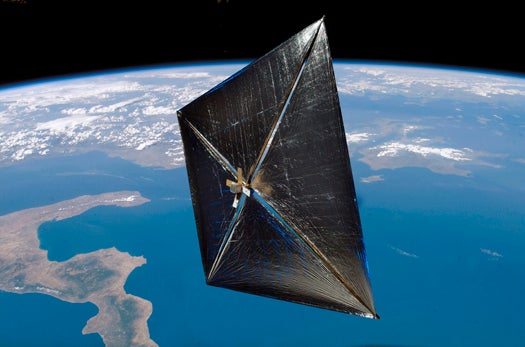
Space is a big place, and NASA has lost a tiny satellite somewhere up there. Now the space agency is seeking the help of ham radio operators to find their troubled NanoSail-D, a nanosatellite that according to reports has finally ejected from NASA's Fast Affordable Science and Technology Satellite more than a month after it was supposed to.
NanoSail-D was supposed to be a technology test-bed for NASA. Not only was it supposed to be the first launch of a nanosatellite from a larger autonomous microsatellite in orbit, but NanoSail-D was also supposed to deploy a small solar sail boom system that would demonstrate that technology's capabilities.
But NASA never heard from NanoSail-D after that initial launch--it turned out later that the nanosatellite hadn't launched from FASTSAT at all. Now NASA has confirmed that Nanosail-D has finally, if somewhat spontaneously, separated itself from its mothership and is free-flying in space. But mission handlers still have yet to hear the beacon signal coming from NanoSail-D confirming that it is functioning properly. If it is trying to phone home, it would be doing so at a frequency of 437.270 MHz. If you’ve got a ham radio and feel like searching for a needle in a sky-sized haystack, NASA could use your help.
[AP]
Five amazing, clean technologies that will set us free, in this month's energy-focused issue. Also: how to build a better bomb detector, the robotic toys that are raising your children, a human catapult, the world's smallest arcade, and much more.


Online Content Director: Suzanne LaBarre | Email
Senior Editor: Paul Adams | Email
Associate Editor: Dan Nosowitz | Email
Assistant Editor: Colin Lecher | Email
Assistant Editor: Rose Pastore | Email
Contributing Writers:
Rebecca Boyle | Email
Kelsey D. Atherton | Email
Francie Diep | Email
Shaunacy Ferro | Email
Maybe it hyperjumped! :)
And THIS is why they're shutting down NASA...
They're not shutting down NASA and this mistake was not out of the ordinary. It takes a lot of hard data + a ton of physics/math calculations to pull this sort of thing off. NASA has had WAY more successes than failures. We should increase funding.
Also, in order to find this satellite, they NEED to be in checking from multiple places at once. Therefore, getting enthusiasts to join in is an intelligent and pleasingly inclusive solution.
I hope I'm taking you out of context and if I am, I apologize. Otherwise, you had that coming. ;-)
Its warp drive engaged.
Seriously. Hyperjump?! Warp drive?!
It's NASA. Not a CIA Skunk Works project of the late 22nd Century.
i bet you this is one of those darpa tests on how fast we can find an object in the sky, like those weather balloons not to long ago.
@pheonix
no, not seriously... it's called sarcasm.
Wasn't there an organization that tracked satellite/
space junk? Could they not find the last object added to this mine field?
Reminds me of a popular science fiction in the early 60's, "Thrash in Space"........or was it "Lost in Space"? With a squadron of multiple space debri out there, space travel becomes more precarious as it is.
So is it finders keepers once I locate the errant sat at 437.270 MHz? Too bad the article did not mention the reporting protocol in case we hear it chugging along in space. Wonder what is the identifying call sign for the sat as it "phones home"
I'd think that it might be beneficial to try to set up scanning groups at certain times to be able to eliminate large portions of sky systematically. Ham operators live for this kind of stuff, creative call thinking of them.
It would be nice if NASA told us some particulars like it's anticipated orbit time based on the last known altitude. Also, I'm sure that they've considered the nature of the glitch to allow for the possibility that the launch might have led to an unplanned de-orbit, but I take it we are hoping for something better than that. So; get it's location and then take a look from the ISS when they get into position, providing that orbital height allows it; to see if it deployed sail?
Folks,
I work at a Gov. tracking station. We are NOT looking for this device.
@ SSBN611B ; So then who gave PopSci the frequency to scan for, and why does the article link under 'seeking the help' take me to an article saying plainly that Nasa engineers in Huntsville are seeking help from HAM operators? I'm asking here, not saying you are wrong, because I don't know. Is it possible that your tracking station has not received this task through some error, or have you verified already?
@quasi44,
There's a separate gov't facility, SPACETRACK, that tracks objects in space, not part of NASA. NASA gave popsci the frequency because they're the ones that designed it and of course knew the proper frequency. Since they don't know where it is and what it's projection is, it can't give those numbers to SPACETRACK. All it knows is what frequency to listen to - assuming it's talking. HAM operators (not part of any gov't agency, just people like me and you that might own a HAM radio) would be able to hear that frequency on their device, and that's why NASA made the appeal to them. I know that's long-winded, but I tried to respond to each point you had. ;-)
This is the WIKI page for SPACETRACK:
http://en.wikipedia.org/wiki/Space_Surveillance_Network
I hope I answered your question. =D
@alias007, good work at answering the Q's.
First, the satellite is not lost; it has been 'borrowed'. Seriously, this act of 'borrowing' shows us that we humans are not ready for multi-variable space flights. Can you imagine making a mistake by single digit decimal point while traveling in a wormhole?
As to who 'borrowed' the little engine up in space, well, always suspect the Elephants! They want to cut NASA funding to save money, yet they OK's outsourcing jobs outside US while Americans are struggling to find them. How can you save money if you don't have a job to earn it in the first place?
More jobs for NASA, more jobs for NASA in the US!
call NORAD , if it's bigger than a soft ball they've got it on a computer screen flying across the sky.