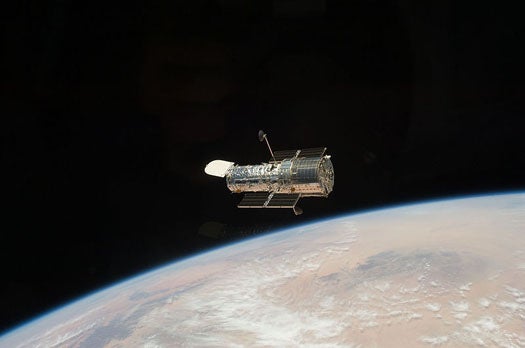
Hubble, Captured From STS-125 NASA

While the astronomical community anxiously awaits the launch of the James Webb Space Telescope, the Hubble Space Telescope keeps reminding us just how remarkable of an instrument it really is. Astronomers studying ultra-deep imagery from Hubble have located what could be the most distant galaxy ever glimpsed some 13.2 billion light years away—so far away that the galaxy appears as it did when the universe was just 480 million years old.

The discovery is notable not just because of its superlative nature, but because the universe was undergoing massive changes over a relatively short duration during this period. The infrared data collected by Hubble’s Wide Field Planetary Camera 3 (WFC3) showed significant changes taking place in the periods spanning from about 480 million years after the Big Bang to about 650 million years after the Big Bang.

During this 170 million year period—a short time on the cosmic scale—the rate of star birth increased by ten times. Galaxies were populating and forming the basis of the universe we know today, fed by the gravitational influence of dark matter (we think) during these formative years.

This early galaxy appears as just a smear of starlight in the Hubble images and is more than 100 times smaller than the Milky Way. Calculations show that it’s redshift value—the extent to which space has stretched its light into larger wavelengths—is around 10.3, though precisely measuring redshifts this high is outside of Hubble’s capabilities (though after months of calculating and recalculating, astronomers are confident they are correct).

When Webb launches later this decade (it’s slated for launch in 2014), it will be the first space telescope that can accurately measure redshift values above 10, meaning not only will it be able to confirm Hubble’s new findings, but it should be able to find other young galaxies, even those very first ones that were thought to have formed 200 to 300 million years after the Big Bang.

[Eurekalert]

15 Comments

Forgive me in advance for my ignorance but from what I am told the expansion of the Universe is like a balloon being inflated. That Galaxy is moving away from us but we are also we are also moving away from it.
I liken it to two cars that start out at the same point and both cars drive one hour away from each other. The cars are now two hours away from each other but they are both only one hour older from when they started.
Using this example wouldn’t that Galaxy be 6.6 billion years old instead of 13.2?

But it's taken the light 13.2 billion years to arrive at Earth, so the galaxy appears as it was 13.2 BILLION years ago.

Ah, O.K. My car is one hour away from the starting point so when I look back one hour I'd see nothing because the other car is no longer there. I'd have to look one more hour away to see the other car so the other car is now two hours old. Got it. Thanks.

Dude, You dont got it. :(

ok, lets try and explain this a little. your car and my car are both 1 light-hour apart from each other. that means that the light that you are receiving from my car right now came from my car 1 hour ago. So, you are seeing events that happened 1 hour ago.

In reality the two cars would have to be around 700 million miles apart. If you had a clear line of sight and a powerful telescope, the distant vehicles light would be approx 1 hour old. Capich?

@OnlyHuman
Your example might have been a poor choice. In fact it is best not to use the example of "moving through space" when discussing the expansion of space. Imagine only that you are at a space station that is exactly two light-hours away from another space station. Neither of you are moving relative to each other. By any normal method of measurement, comparison to objects around you for example, you are not moving .... however, the other space station sends you a signal which should be at a certain predetermined frequency but instead is slightly lower (shifted to the red). That shift is due to the expansion of space between you. You could then do a calibration based on knowing your distance to the other space station which could then be used to measure the distance to other objects.

In reality the calibration is done by determining the distance to closer objects by other means and also noting the red-shift. In that way a red-shift scale can be deduced that allows the distance of even the most distant objects to be measured. If not for the expansion of space, we would have a much more difficult time determining distances to these furthest objects. There would be much greater uncertainty.

Can we already see a "cosmic horizon" with the telescopes operating now? Or I suppose all we would see is empty space past everything else, is there anything pertaining to relativity that establishes an end to space or would it just become progressively more void of any form of matter?

Ha Ha funny. Hubble was absolutely amazing. Thier website is a must see. I cant wait to see what amazing things JWST sees.

Your question about the galaxies moving away from each other is a great example of how weird physics gets when dealing with light. Your example assumes that you can do classical speed, time and distance calculations with light and objects moving relative to light sources. The truth is that you can't. It doesn't matter how fast you move toward or away from a light source - the light still travels towards you at the same constant speed. Michelson Morley devised an elaborate experiment [1] which measure this and Einstein's theory of special relativity [2] later explained the results.

[1] http://en.wikipedia.org/wiki/Michelson–Morley_experiment
[2] http://en.wikipedia.org/wiki/Special_relativity

Ugh why are you guys always explaining it in the most confusing ways. Here this is a simple way to think about it OnlyHuman, Imagine you have a big piece of stretchy rubber (like balloon material), and you lay it flat on a table, and hooked up to something that will stretch it slowly. If you took a marker and put a dot on 2 ends of it. Now start stretching it at the same time, slowly drawing a line from one side to the other. As the distance between the 2 points becomes greater, so to does the amount of line you have to draw between them. so even tho they started out closer since the distance between them increased so did the distance the light had to travel.

Hubble Finds Most Distant Object Ever Seen in Universe
Astronomers have pushed NASA's Hubble Space Telescope to its limits by finding what they believe is the most distant, ancient object ever seen in the universe. Its light traveled 13.2 billion years to reach Hubble. http://www.newslook.com/videos/286291-hubble-finds-most-distant-object-ever-seen-in-universe?autoplay=true

'Far Out Man':
The goal for teaching or answering questions is not to try and make yourself sound like Einstein.
I have a Masters in Astronautics and could use all types of big words as well, but there is no need. Just answer with a simple response.

OnlyHuman: just think of things in terms of the fact you are seeing light as it was 13.2 billion years ago, because that is how long it took to get here. Start off with the thought of you being stationary. It could have blown up the next day, but you won't know that until tomorrow.

Then think of the next option, which is the star is moving away from you at a certain speed (assume constant speed - there is no need to get into acceleration bravado). Just remember the added distance equals the speed (in this case, the speed of light) * time.

Then do the same for your position being one of moving away at a constant speed in the opposite direction (don't get into angles or anything - that just adds complexity). Sound good?

Or, just watch Star Trek and then let's have 'Far Out Man' explain to us what Warp drive is, and how the transporter can work at close to the speed of light. And, would the stars all stretch into lines like you see on the screen when they hit the Warp drive each time?

I still can't believe Obama's administration is cutting our manned space program off like this. Absolutely disgusting and idiotic.
Does anyone realize that the NASA budget is LESS than 10% of the 'last minute ADDITION of $200B' to the Health Bill that was crammed down our throats?

That's right. NOT the whole bill - less than 10% of the 'overnight quickie of $200B' to get the extra 3 votes - without ANY approval... and we will be paying Russia to take us to the ISS next year.

Why can't we just rebuild the Saturn IV BTW? I know the politicians made NASA cut-up the blueprints, but we could easily regenrate the thing by taking it apart and using advanced rendering techniques. It worked in 1967 - I would think it would work just fine in 2011.

Sickening. OK, off the soap box, but what is happening to our space program is disgusting.

very cool. even though i do think there is more of a universe to see if we could look beyond 14 billions of light travel. big bang theory is a hoax.

@oleg16
If all the objects in your range of vision are moving away from you, it is not a 'hoax' to believe they must have exploded away from a single point. Try to come up with a different reason!

@SpaceMax
Nice rant. I couldn't sound like Einstein if I tried. What words were too big for you?


June 2013: American Energy Independence

Five amazing, clean technologies that will set us free, in this month's energy-focused issue. Also: how to build a better bomb detector, the robotic toys that are raising your children, a human catapult, the world's smallest arcade, and much more.


Online Content Director: Suzanne LaBarre | Email
Senior Editor: Paul Adams | Email
Associate Editor: Dan Nosowitz | Email
Assistant Editor: Colin Lecher | Email
Assistant Editor: Rose Pastore | Email

Contributing Writers:

Kelsey D. Atherton | Email
Francie Diep | Email
Shaunacy Ferro | Email

circ-top-header.gif
circ-cover.gif