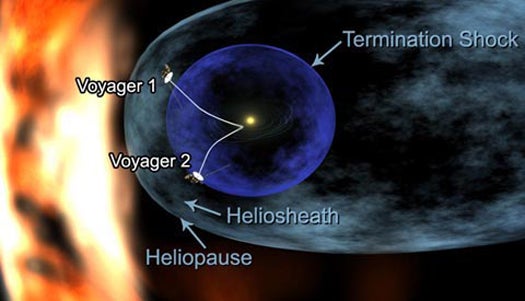
NASA’s Voyager 1 spacecraft, now in its 33rd year on the job, has reached the very edge of our solar system and is nearing the cusp of interstellar space. How does NASA know? The wind has died down. Voyager 1 has reached a point in the heliosheath that envelopes our solar system in which the speed of the solar wind that has been at Voyager’s back for three decades has dropped to zero.
That point is some 10.8 billion miles from the sun, beyond the outer planets and somewhat near the boundary between the solar system and interstellar space. That boundary is defined by the heliosphere, which reaches outward from the sun as far as the charged particles given off by our anchoring star can reach.
Those charged particles hurtle outward at supersonic speeds until they cross what is known as the termination shock. From there, they begin to slow and heat up significantly in a buffer region known as the heliosheath. Eventually, when traveling outward, they reach a point where the net outward speed of the solar wind drops to zero, and like the eye of a storm the chaos of the cosmos is calm for a bit (the wind is more likely turned sideways due to pressure from the interstellar wind that exists in the regions between stars).That’s where Voyager 1 is now. In fact, it’s been there for a while. NASA handlers knew Voyager 1 crossed the termination shock back in late 2004 when the solar wind at its back began to slow. In June of this year Voyager recorded a net outward wind speed of zero, but the researchers wanted to conduct a few more measurements to make sure Voyager wasn’t simply in an eddy of some kind. Since June, the net outward solar wind speed has remained at zero.
That places Voyager 1 fairly deep in the heliosphere and about four years from emerging from the other side into interstellar space, where it will remain the furthest-reaching mission ever launched from Earth. That’s pretty impressive when you think about it: a piece of equipment conceived in the Apollo era when the moon seemed a distant target – Voyager 1 launched in 1977 mind you – is now poised to become the first man-made object to leave the solar system for the larger galaxy beyond.
[NASA via Bad Astronomy]
Five amazing, clean technologies that will set us free, in this month's energy-focused issue. Also: how to build a better bomb detector, the robotic toys that are raising your children, a human catapult, the world's smallest arcade, and much more.


Online Content Director: Suzanne LaBarre | Email
Senior Editor: Paul Adams | Email
Associate Editor: Dan Nosowitz | Email
Assistant Editor: Colin Lecher | Email
Assistant Editor: Rose Pastore | Email
Contributing Writers:
Kelsey D. Atherton | Email
Francie Diep | Email
Shaunacy Ferro | Email
Goodspeed Voyager 1
How is it communicating back to earth?
@Mathieu - Well it's powered by a nuclear reactor which should be able to power at least some instrument until 2025 also it takes about 16 hours to send a message to it.
@craigboy I could wiki this, but thought it would make a better discussion here. does it not have solar panels of any kind.
@inaka_rob: Solar panels wouldn't be of any use at the distance that it's at right now, in fact (off the top of my head) they're not really worthwhile anywhere past Mars. Like Craigboy said, it's powered by a small nuclear reactor, though it's fuel should finally die off in the 2020's. That's pretty good for a roughly forty year mission.
@leanpocket
Agreed
@ Sierra & Craigboy: Sorry guys,it's not powered by a small nuclear reactor but by a radioisotope thermoelectric generator.
What a bunch of hooey.
It's all fake. All of it. Moon landings, Mars landings, Voyager1, Voyager2.
Just a government cover up trying to get us all to believe the liberal "science" that says the Earth is round instead of flat.
Wait. That can't be right. I was abducted by aliens back in '73.
i remember when these early probes were being launched...at the time it never crosed my mind about these probes ever leaving our solar system...i just imagined what wonders would be discovered as they visited other planets...incredible work done by those who are either retired or resting in peace...congratulations on such an astounding accomplishment
I'm loving the talk of solar and interstellar currents as if it's passé, I mean, do we REALLY know how fast that interstellar wind is, what if this kin to a small toy boat edging out of a small stream unto a larger faster flowing body of water. I'm quite interested to see what happens when it does cross into those interstellar regions, wouldn't it be facinating to "see" Voyager 1 just swept away faster than expected... oh to only hope.
Don't worry about her folks. We'll meet her again when she returns in 2271 to meet the creator. Lets just hope she doesn't destroy all the carbon units before we can get all of her knowledge.
Godspeed V'Ger.
lnwolf41
This was launlched when america could still dream of going into outer-space; now were becoming scared backwater
bumpkins while everyone else takes what had and makes it better, faster, and stronger.
On to science, I just read that both Pioneer spacecraft are slowing, does anybody know if the voyager space probes had any decrease in their velocity during their flight?
Someone should be able to find out by studying the radio transmissions recieved.
I remember listening to launch commentary on the ride to elementary school. When I excitedly told the class about a spaceship America had launched that would leave our solar system Mrs. Seton told me to stop lying and made me sit in the corner. To think, I am only four years from finally being vindicated!